While the US power grid struggles to keep up with the growth of AI data centers, China is considered to have abundant energy resources.
Jeffrey Brian Straubel, co-founder of Tesla and currently CEO of battery recycling company Redwood Materials, thinks the US should really be worried. “I think the grid cannot cope. The growth rate and energy demand are both at unprecedented levels,” he said at the Brainstorm Tech conference of Fortune in Aspen, Colorado, this week.
Experts say this concern is well-founded. According to the International Energy Agency (IEA), a typical data center can consume as much electricity as 100,000 households, while new generation super-large facilities can consume the equivalent of two million homes. The agency also said that global data centers consume 415 terawatt-hours of electricity by 2024, of which the US accounts for 45%, followed by China and Europe with 25% and 15% respectively.
The US has the largest data center scale in the world, far behind other countries. According to the AI Index from Stanford University, last year the US owned 5,427 data centers compared to China’s 449. Meanwhile, according to AlgeriaChina’s electricity output is twice that of the US and this gap is expected to widen thanks to a strong investment strategy in the national power grid system.
Theo ReutersChina owns the world’s largest power grid. Last year alone, the country of billions of people added more than 500 GW, bringing the total capacity to 3,800 GW, double that of the United States. Research organization BloombergNEF estimates that in the next five years, China’s additional electricity generation capacity will be six times higher than that of the United States, largely from renewable sources such as solar power or wind power.
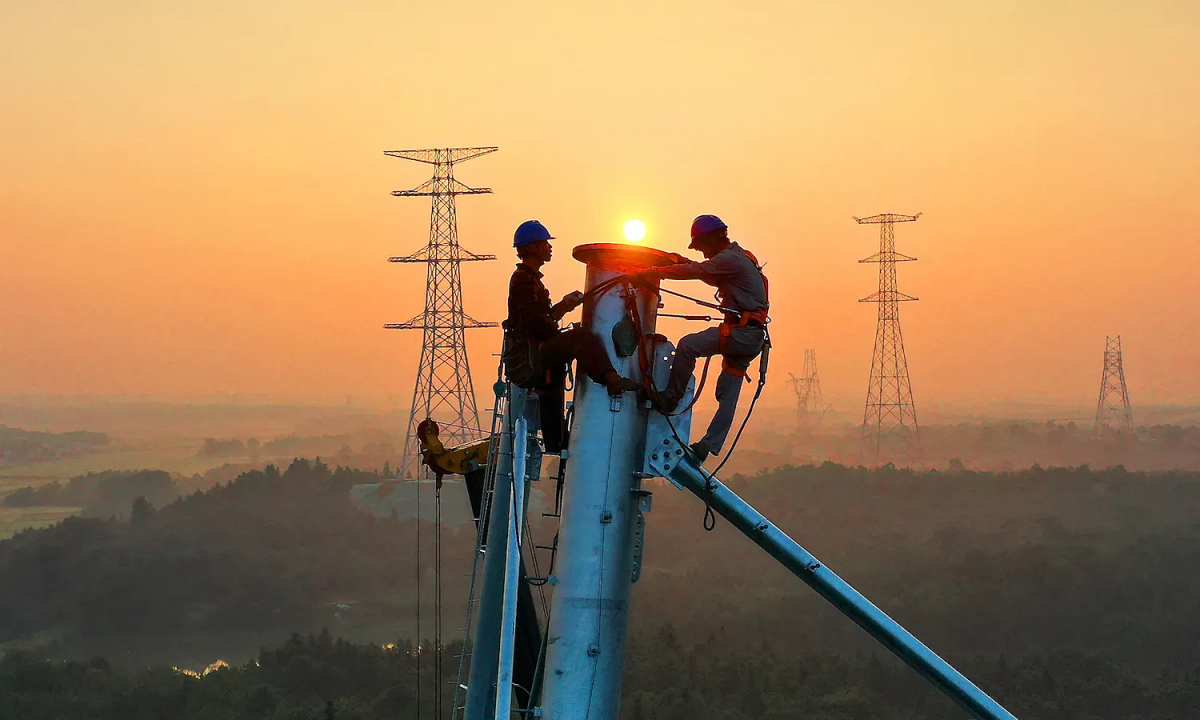
Workers work on a high-voltage transmission pole in Jiangxi province, China, September 2025. Image: Foreign Policy
Many American technology leaders share the same concern about the prospect of electricity shortages. At the World Economic Forum (WEF) 2026 in Davos (Switzerland) in January, Nvidia CEO Jensen Huang compared AI to a multi-layer cake. The top layer is the applications, for example chatbots, below is the software, including the language model, followed by infrastructure and memory chips. The last layer – energy – plays the most important role.
“Energy is the core principle of AI infrastructure and the constraining factor that helps determine the amount of intelligence the system generates,” he emphasized.
Previously, he also said that China has an advantage in AI infrastructure compared to the US. Although the US holds the advantage in chips, he warned that China can build large projects at breakneck speed. “If you want to build a data center in the US, from start to finish until operating an AI supercomputer, it probably takes about three years. While they can build a hospital in a weekend,” Jensen Huang told John Hamre, President of the Center for International and Strategic Studies (USA), at the end of November last year.
In addition to the speed of infrastructure development, he is also worried about the relative energy supply of countries in supporting the AI fever. “China has twice as much energy as the US, while the US economy is larger. This makes no sense to me,” he said, adding that China’s energy capacity is still increasing sharply, almost steeply, while the US is much more flat.
Late last year, OpenAI CEO Sam Altman also predicted that AI costs “will eventually boil down to energy costs”, and warned that China’s advantage could put “America’s AI leadership at risk”.
Digital Reality Data Center in Ashburn, Virginia, March 17, 2025. Image: Reuters
Elon Musk, CEO of SpaceX, once warned that increasing the scale of AI on Earth will soon encounter a giant “hardware wall”. He said it is difficult to build or expand new AI data centers anywhere outside of China due to severe global power shortages.
In a conversation with podcast host Dwarkesh Patel and President of financial services company Stripe John Collison, Musk commented that advanced AI chip production capacity is increasing exponentially but the world’s power grid system is not keeping up, except in China.
“The problem lies in the energy source. Electricity output outside China is almost flat. There is a little increase, but not much,” Musk explained. “If you build a data center anywhere outside of China, where do you get the electricity from, especially when expanding? How do you operate the chip, with a magical energy source or rely on the ‘electric fairy’?”.
Earlier this year, SpaceX announced plans to launch one million satellites as data centers in orbit, allowing it to overcome the limitations of the underground power grid. The satellite cluster will use solar batteries to operate AI computing hardware. According to Musk, solar cells in orbit can generate five times more electricity than on the ground, which is hindered by the atmosphere.
A solar power farm in Hainan province in Qinghai province, western China, July 2025. Image: AP
“Wherever we go, people take the availability of energy for granted,” Rui Ma, founder of media company Tech Buzz China, wrote on X after returning from a tour of AI centers in China mid-last year.
For American AI researchers, this is almost unthinkable. In the US, soaring demand for AI conflicts with the fragile power grid. Investment bank Goldman Sachs warns that this could seriously inhibit the industry’s development. Meanwhile, according to Ms. Ma, in China, this is considered a “solved problem”.
David Fishman, an American scholar specializing in Chinese energy industry research, estimates that the country’s average increase in electricity demand is greater than the entire consumption of Germany each year. In conversation with Fortune Last year, he shared that many rural areas in China have solar panels covering their roofs, and even one province can produce as much electricity as an entire country.
Fishman said that China’s electricity reserve ratio has never dropped below 80-100%, which means maintaining a capacity twice as high as demand. Therefore, instead of viewing AI data centers as a threat to grid stability, the Eastern country sees them as a convenient way to “absorb excess supply”.
In the US, regional power grids often operate with only a 15% reserve margin, sometimes lower, especially in extreme weather conditions. In places like California or Texas, authorities repeatedly warn when expected energy demand puts pressure on the system.
Fortune commented, the difference between the two AI powers is very clear. The US faces political and economic controversy over its power grid’s ability to meet demand, while China operates AI with surplus energy.
https://SuffieldLandscaping.us/lawn-care/lawn-mowing
https://SuffieldLandscaping.us/lawn-care/lawn-renovation
https://SuffieldLandscaping.us/lawn-care/lawn-seeding
https://SuffieldLandscaping.us/lawn-care/sod-installation
https://SuffieldLandscaping.us/lawn-care/weed-control
https://SuffieldLandscaping.us/yard-clean-up
https://SuffieldLandscaping.us/yard-clean-up/green-waste-disposal
https://SuffieldLandscaping.us/yard-clean-up/gutter-cleaning
https://SuffieldLandscaping.us/yard-clean-up/junk-removal
https://SuffieldLandscaping.us/yard-clean-up/leaf-removal
https://SuffieldLandscaping.us/yard-clean-up/tree-removal
https://GranbyLandscaping.us
https://GranbyLandscaping.us/gardening
https://GranbyLandscaping.us/gardening/brush-removal
https://GranbyLandscaping.us/gardening/flower-bed-maintenance
https://GranbyLandscaping.us/gardening/flower-planting
https://GranbyLandscaping.us/gardening/hedging
https://GranbyLandscaping.us/gardening/mulching
https://GranbyLandscaping.us/gardening/plant-removal
https://GranbyLandscaping.us/gardening/pruning
https://GranbyLandscaping.us/gardening/weeding
https://GranbyLandscaping.us/lawn-care
https://GranbyLandscaping.us/lawn-care/artificial-grass-installation
https://GranbyLandscaping.us/lawn-care/dethatching-lawn
https://GranbyLandscaping.us/lawn-care/fertilizing-lawn