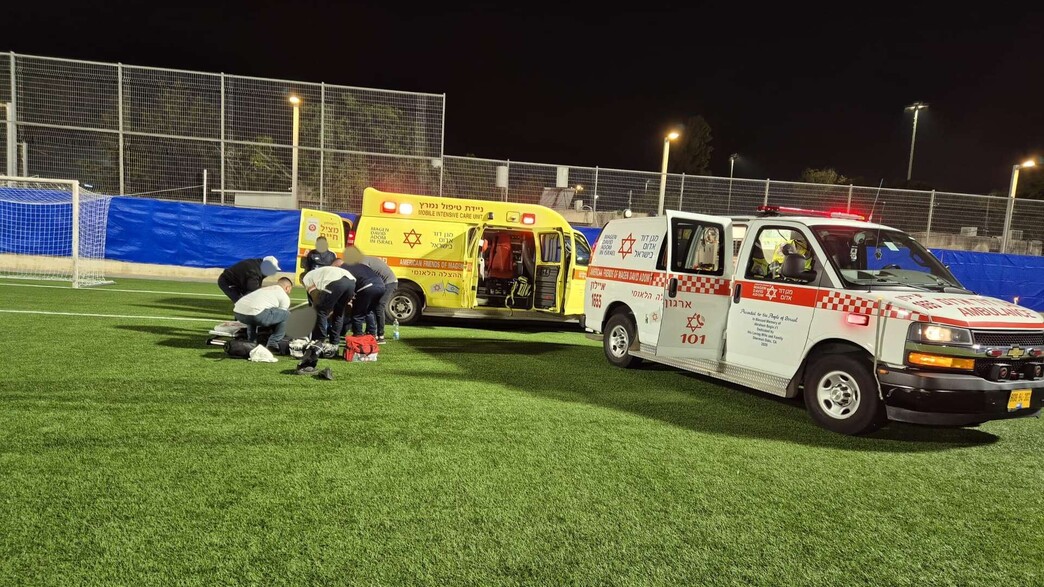
Today (Thursday) the World Cup officially opens, and hundreds of millions of fans around the world will sit in front of the screens for weeks to cheer on their favorite team. But along with the excitement, the dramas and the penalties in the 90th minute, experts have been warning for years that big football games can also become a dangerous trigger for the heart.
Behind these warnings are alarming data. Dr. Shirit Zzom Beiser, cardiologist and sports physician, director of the Sports Cardiology Service at the Beilinson Medical Center of the Klalit Group, explains that for nearly two decades, studies have been conducted around the world that examine the relationship between major soccer matches and an increase in cardiac events. “One of the largest studies in the field was conducted during the 2006 World Cup in Germany,” she says. The cardiac and referrals to the emergency room due to heart problems. The increase was particularly noticeable in men and in fans who were very emotionally involved in the games.” According to her, the highest risk was recorded in the first two hours after the start of the game. “See an increase in heart attacks, chest pains and cardiac arrhythmias. Later, additional studies were conducted, including in the 2014 World Cup, and they also showed an increase in hospitalizations due to heart attacks during the tournament.”
Later, a large meta-analysis was also published that included 19 different studies from around the world. The researchers found a 17% increase in the risk of hospitalization for acute cardiac events during major soccer tournaments, along with a 3% increase in mortality from cardiovascular disease. According to the data, the risk was particularly high for fans who experienced a strong emotional involvement in the games, and especially after losses of the team or national team they supported.
Dr. Zum-Beiser emphasizes that those who are at the highest risk are people with known heart disease, those who have already had a heart attack or catheterization, men and fans who are emotionally involved in games. “Mental stress is a known trigger for heart attacks,” she explains. “During such games there is an increased secretion of stress hormones, an increase in blood pressure and heart rate, an increase in the tendency to arrhythmias and even an increase in blood clots.”
Even in Israel, tragic cases that happened around football games are known. In the last two years alone, three Israelis have died after suffering heart attacks during matches in Israel and abroad. In April 2024, the late Moshe Toashi, a 75-year-old Hapoel Tel Aviv fan, died after suffering a heart attack during a loss against Beitar Jerusalem. Last year, the late Yigal Brodkin, a 50-year-old Real Madrid fan from Israel, also died after collapsing during the El Clasico match at the Santiago Bernabéu stadium in Madrid immediately after Kylian Mbappe missed a penalty.
In other cases, the events ended in a miracle: a fan who had a heart attack during the State Cup final was saved thanks to rapid medical treatment in the stands, and in recent years a 13-year-old boy during a soccer game and a 9-year-old boy during a basketball game were also saved after going into cardiac arrest.
“At that moment I realized that something terrible had happened”
When the late Hazi Yacovi went to a match between Hapoel Tel Aviv and Hapoel Ra’anana in September 2024, there was no indication that this would be the last time his wife Sharon would see him. mako health.
For the Jacobi family, Hapoel Tel Aviv was much more than a football team. “Our wedding was red, the house was red and our lives revolved around the game board,” says Sharon. “We traveled together as a family to games in Israel and abroad, everything revolved around Hapoel.”
That evening, the late Yacovi went to the game together with his son Nebo, who was 15 years old at the time. “I said goodbye to him as usual. I told him that I love him, that he should live a life and take care of Nebo,” recalls Sharon. “He told me bye and left.” But during the game, she received an unusual call from her son’s phone. “It was strange, because they never call in the middle of a game. I asked to speak to Nebo and I heard him scream. At that moment I realized that something terrible had happened.”
The late Yacovi received treatment on the spot by MDA teams that included electric shocks, and was taken in critical condition to Wolfson Hospital, where the doctors had to pronounce him dead. Since then, says Sharon, the family’s life has completely changed. “Nevo was there and saw everything. Hezi and Nebo were one person. I just gave birth to Nebo – Hezi raised him,” she says with humor. “They were a greedy couple, one soul. Nebo lost half of his soul that evening.”
She also says that while it was happening, she asked if there was a defibrillator in the place. “Then we found out that there were devices in the compound,” she recalls. “Since then, we have been working to perpetuate Hezi through donations of defibrillators and raising awareness for saving lives.”
The MDA is also well aware of the phenomenon. The VP of Medicine and Blood Services at the MDA, Dr. Raphael Strogo, explains that the organization’s teams regularly secure football games and major sporting events throughout the country, and sometimes provide medical treatment to fans who suffer from cardiac events during the games.
“Sports games, and especially football, evoke many and sometimes excessive emotions in the spectators,” says Strugo. “During games we sometimes take care of fans in the audience, including in cases of heart attacks. There are also cases where MDA teams are called to the homes of people who watched sports games and suffered a heart attack. The excitement increases when the viewing is with friends and not alone, and when combined with alcohol this may cause the ‘celebratory heart syndrome’, which manifests itself in sudden disturbances in the heart rate during an exciting or happy event.”
Dr. Strugo also adds that over the years they have provided medical treatment and saved the lives of fans who came to watch their favorite teams, such as a 9-year-old boy whose heart stopped beating while watching a basketball game in Jerusalem, a man who collapsed while watching the State Cup finals and other events that happened in stadiums. “From these cases it appears that it is important to remember that besides the enjoyment of watching the games, in the end it is just a sport,” he says.
“During the World Cup, people also tend to drink more alcohol, smoke more, eat less healthily and sleep less,” concludes Dr. Zum-Beiser. “Those who are in a risk group should be careful to take their medication on time, not to overdo it with alcohol and smoking and remember that in the end it is a game. Health is more important than any victory.”
https://www.elephantjournal.com/profile/ibygjzjuoo/
https://wallhaven.cc/user/uudcmhiqay
http://www.biblesupport.com/user/842864-julianadams52/
https://hedgedoc.envs.net/s/4nxbCgDB9
https://graph.org/httpscrowdonetquora-link-building-05-22
https://beteiligung.amt-huettener-berge.de/profile/ElijahPhillips13/
https://talkmarkets.com/profile/joshua-smith-260522-104214
https://www.annuncigratuititalia.it/author/MilesGonzalez81/
https://pinshape.com/users/8975646-williamthompson17?tab=designs
https://www.infoq.com/profile/Elias-Jackson.1/#allActivity
https://www.dibiz.com/ibygjzjuoo
https://lipscosme.com/users/n/@supreme_rouge_6z14
https://jobs.suncommunitynews.com/profiles/8316278-anthony-collins
https://www.gta5-mods.com/users/MaverickAdams69
https://topsitenet.com/profile/dylanclark61/1846322/
https://cinderella.pro/user/279053/ChristopherWright67/
https://eo-college.org/members/sebastianwilliams33/
https://bbsradio.com/users/alexandergomez21
https://library.zortrax.com/members/austin-lee/
https://cannabis.net/user/231999
https://www.liveworksheets.com/u/cameronjohnson88
https://aprenderfotografia.online/usuarios/julianlee51/profile/
https://www.abclinuxu.cz/lide/davidwright45
https://forum.bug.hr/forum/user/nolanthomas84/148758.aspx
https://pennylane.ai/profile/NathanWilson75