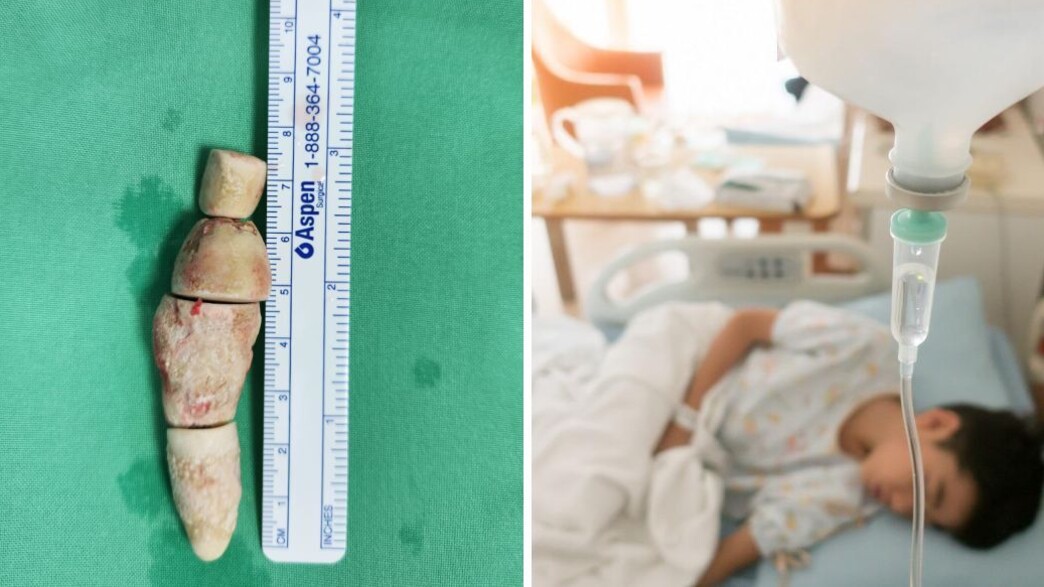
Idan (pseudonym), 6 years old from the center, began to suffer from repeated attacks of stomach pains at the age of two and a half. At first his parents were sure that it was a passing virus or sensitivity in the digestive system, but after noticing bloody urine in his diaper, they began to undergo a series of tests and revealed a surprising picture – kidney stones. It later turned out that he suffers from a rare genetic disease that causes repeated formation of stones, which may even impair kidney function. In the years that followed, Idan underwent several medical procedures, and today he is under close observation and receives medication and nutritional therapy that manages to keep his condition stable.
A similar story is also for Noam (pseudonym), now 15 years old. After recurring stomach pains, he underwent a comprehensive metabolic and genetic investigation, then it became clear that he suffers from kidney stones. Later, he needed several surgical interventions. During the follow-up, the doctors decided to also check his younger brother, who had a small stone discovered at an early stage. Thanks to the early diagnosis and the treatment that began immediately after, the doctors were able to prevent further deterioration and future complications.
These two stories illustrate a phenomenon that pediatricians in Israel are encountering more and more in recent years: kidney stones appearing among children and teenagers. If in the past the phenomenon was considered a problem that mainly characterizes adults, today it is also diagnosed in very young children – and sometimes even in babies.
“In recent decades, there has been a 3-5-fold increase in the incidence of kidney stones in children in the world and in Israel even more than that,” notes Dr. Sheli Levy, a senior physician at the Institute of Pediatric Nephrology and a kidney stone clinic at the Schneider Pediatric Center of the Klalit Group. “We are seeing more awareness, more referrals and more understanding of the importance of diagnosis, treatment and long-term follow-up.”
According to her, although it is still a relatively rare phenomenon, it is no longer unusual as it was in the past. “We see children of all ages – from one month old to puberty. There are even very rare cases of kidney stones or calcifications that are detected in the fetus already during pregnancy. However, the main increase in frequency is seen among teenagers.”
What is the explanation for the increase?
According to Dr. Levy, the reasons are varied. “We think that part of the explanation is related to changes in the Western lifestyle – more processed food, more salt, more sugary drinks and less drinking of water. The hot climate in Israel also plays a role, because many children do not drink enough and are at risk of dehydration. Other causes are structural defects in the urinary tract and recurrent urinary tract infections. Sometimes it is about other systemic diseases. By the way, there is a connection between obesity and kidney stones, and we also see metabolic genetic diseases that are relatively more frequently diagnosed in Israel.”
The signs are not always clear. While in adults an obstructing stone usually causes severe attacks of pain in the lumbar region radiating to the groin, in children the picture may be less typical. “It can be a non-specific abdominal pain, back pain, burning when urinating, recurrent urinary tract infections or episodes of bloody urine,” explains Dr. Levy. “In babies and small children, sometimes all you see is restlessness, crying or a decline in general condition.”
One of the unusual cases treated by the teams was that of a one and a half year old baby girl who arrived at the hospital after several days of illness. “She was apathetic, didn’t urinate and showed signs that looked like kidney failure. In the end we found out that she had stones that were blocking both kidneys. After draining the kidneys, she recovered quickly. It was a very impressive case that illustrated how different the signs in children can be.”
According to her, it is important to understand that with children the stone itself is often only part of the story. “A kidney stone in a child is not the disease – it is the symptom. That’s why our goal is not only to remove the stone, but to understand why it was formed. We perform a comprehensive metabolic and genetic investigation, check the composition of the urine and blood, look for underlying diseases and tailor individual treatment to each child.”
“We have seen cases where children arrived late – and the kidney almost stopped functioning”
According to Dr. German Kreiderman, an expert in urological surgery and endourology at the Stone Clinic at the Schneider Center, not every stone requires intervention. “If it is a small stone that does not cause obstruction, pain or inflammation, it can be monitored through periodic examinations. Some stones remain stable, some are expelled naturally, and some begin to grow and cause a blockage.” According to him, intervention is required when the stone causes pain, impairs kidney function or leads to recurrent urinary tract infections.
“Most treatments today are performed using minimally invasive approaches,” explains Dr. Kreiderman. “We insert a thin camera through the urinary tract, reach the stone, crush it with a laser and remove the fragments.” “In cases of particularly large stone loads, the kidney can be reached directly through a small incision in the waist,” he explains. “Another option is extracorporeal crushing using shock waves, a non-invasive treatment suitable for certain cases.”
According to Dr. Kreiderman, a stone that blocks the passage of urine and is not treated in time can cause significant damage. “If the blockage lasts for a long time, it can cause irreversible damage to the kidney. We have seen cases where children arrived late and the kidney was almost no longer functioning.” “The way to prevent this serious complication is to see a treating doctor and complete the investigation required for any suspicion of stone disease,” he explains.
“Early diagnosis and correct treatment can prevent years of suffering, repeated surgeries and sometimes also irreversible damage to the kidneys”
“A child is not a small adult,” he emphasizes. “The urinary tracts are narrower and sometimes they do not allow for the immediate passage of the instruments.” According to him, in many cases it is necessary to first insert an internal tube (stent) that will expand the urinary tract and only then perform the treatment itself. “The meaning is that sometimes a child is required to undergo more than one operation and more than one anesthesia around the same stone.” He adds that the treatment requires specialized equipment adapted to children and extensive experience in the field, and is therefore carried out in a limited number of centers in Israel.
A multidisciplinary team including nephrologists, urologists, nurses, dieticians, geneticists and other professionals works at the Schneider stone clinic. “The joint work allows us to look at the child from all directions, locate the cause of the formation of the stones and build a long-term treatment and prevention plan,” concludes Dr. Levy. “Ultimately, early diagnosis and correct treatment can prevent years of suffering, repeated surgeries, and sometimes irreversible damage to the kidneys.”
http://uchkombinat.com.ua/user/epoxyoption03/
http://vintagemachinery.org/members/detail.aspx?id=172615
https://egamersbox.com/cool/index.php?page=user&action=pub_profile&id=545670
https://eskisehiruroloji.com/sss/index.php?qa=user&qa_1=moneyeagle84
https://medibang.com/author/28514295/
https://g.clicgo.ru/user/hyenaparty07/
https://airzap.ru/user/profile/157215
http://support.roombird.ru/index.php?qa=user&qa_1=landcousin32
http://piglix.com/user/branchlily70
https://buyandsellhair.com/author/seacold16/
http://buyandsellhair.com/author/shaniyafhdonovan/
http://okprint.kz/user/shocklily93/
https://classifieds.ocala-news.com/author/branchtrout51
https://onlinevetjobs.com/author/clovergong06/
https://www.pennygaff.com.au/forums/users/tulipoboe79/
https://www.garagesale.es/author/kenyarobin11/
http://jobs.emiogp.com/author/drawertrout44/
https://servodriven.com/forums/users/polospoon89/
https://www.ludikarus.com/author/drawerbasin63/
https://nhadat24.org/author/storeafrica80
https://forum.issabel.org/u/baitlily79
https://www.demilked.com/author/polojaw93/
https://platform.joinus4health.eu/forums/users/moneybuffer95/
http://animationfixation.net/forums/user/cloverafrica59/
https://blog.webit.ru/author/valuetrout58/