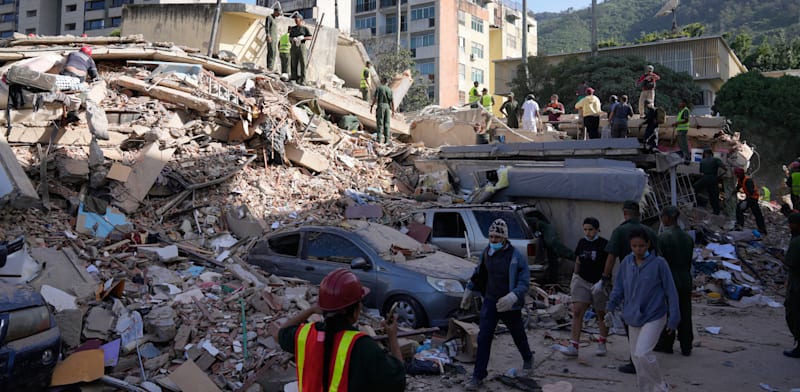
The economic situation in Venezuela reached a new low in the last decade, and it currently has the highest inflation in the world, but agreements signed between it and the US gave hope for a significant economic recovery. Its oil exports were freed from sanctions, and optimism about its future increased – and then came the earthquake at the end of the week.
1,400 people have been declared dead so far, but estimates are that the number is expected to exceed 10,000. The economic damage from the disaster is more difficult to quantify, but estimates speak of tens of percent of Venezuela’s annual GDP.
The American army has already gone in to help with rescue and humanitarian aid, but it is unlikely that this will change the situation dramatically. Will Venezuela be able to recover?
Huge destruction
The earthquake measuring 7.5 on the Richter scale struck at the end of the week off the coast of Venezuela, near the capital city of Caracas and the main port of Porto Cavio. The dimensions of the destruction are enormous, and it is not yet clear what the extent of the damage to human life and property is. According to estimates by the US Geological Survey, there is a probability of 28% that up to 10,000 people died, 44% that between 10,000 and 100,000 died, and even 23% that more than 100,000 died. That is, the chances are that more than 10,000 people perished in the earthquake. At the moment, the official number for Venezuela is 1,430 dead, but this number Frequently updated upwards.
In terms of property damage, the earthquake near the capital and largest city was particularly devastating. According to the US Geological Survey, the most likely damage is between 10 billion and 100 billion dollars, with a reduced chance of less or more than that. A special report by the United Nations estimates that the direct damage to property alone will amount to 6.7 billion dollars.
In the last decade, Venezuela has become an extremely poor country, with a GDP of only 111 billion dollars, so a damage of tens of billions of dollars, even in the most optimistic estimate, would be a huge damage worth whole percent if not tens of percent of its annual product.
deteriorated into a crisis
In the 1990s, Venezuela had a fairly prosperous economy, but in 1999, Hugo Chávez, a radical socialist leader who increased the government’s control of the oil industry, came to power, and used the industry’s profits to establish a comprehensive welfare system under military control. But starting in 2014, near the death of Chávez and his replacement by his deputy Nicolás Maduro, oil prices began to fall. The economic base of Venezuela’s “Bolivarian” socialism was dropped, and the country rapidly deteriorated into an economic crisis.
The government’s response was mass money printing designed to support the state’s welfare obligations. But the move led to hyperinflation, which peaked at 2 million percent. The combination of soaring prices and restrictions on foreign exchange and international trade led to widespread shortages of basic products such as food, medicine, and even toilet paper. The shortage, in turn, led to the mass departure of millions of people from the country, in what became the largest refugee crisis ever in the Americas. “Venezuela’s situation is very difficult. In recent years, almost a quarter of the population left the country, leaving behind those close to the government, the poor and those who cannot leave,” explains Matan Lev-Ari, former representative of Israel at the Inter-American Development Bank.
Huge protests were ignited throughout the country, but they were suppressed, powers were stripped from the parliament, and most of the power was concentrated in the hands of President Maduro. The presidential election in 2024 was apparently rigged, with Maduro claiming victory with 52% of the vote, but the Central Election Commission refused to publish a breakdown of the results, and an independent vote counting project by the opposition led to the opposite conclusion.
The Trump administration, which entered the White House shortly after, significantly tightened the sanctions on Venezuela and accused the regime of smuggling drugs into the US, and Venezuela’s oil exports were blocked. The US moves reached a peak in early 2026, when President Maduro was taken from his home by US special forces, and is now in custody in New York.
faced change
The dramatic move by the US led to a new agreement between the US and the Venezuelan regime. The agreement removed a significant part of the sanctions, restored oil exports, and gave hope to Venezuela. International sources estimated that growth in 2026 would reach between 4% and 7%. But then the earthquake struck and put an end to hopes for a change of direction in the immediate future.
“The crisis may be great for the government,” says Lev-Ari. “The timing of the deadly earthquakes is the first test of American policy in the post-Maduro era. Indeed, the US Army announced the sending of aid forces and the State Department announced an aid package of $50 million,” but the package is expected to increase to $150 million.
However, it should be noted, this is a minor amount compared to the damage that is estimated in billions if not tens of billions. But besides the American support, “the World Bank and other institutions that for years did not operate in the country also announced their intention to pour in aid that will focus on the reconstruction efforts,” says Lev Ari.
It is not yet clear how Venezuela will deal over time with the new crisis, the dimensions of which have not yet been clarified. But the tremendous weakness of the country, which came partly from the handiwork of the regime and partly from the actions of the US against it, makes Venezuela especially vulnerable to the forces of nature.
For your attention: The Globes system strives for a diverse, relevant and respectful discourse in accordance with the code of ethics that appears in the trust report according to which we operate. Expressions of violence, racism, incitement or any other inappropriate discourse are filtered out automatically and will not be published on the site.
Форлакс: м'яке рішення для нормалізації роботи кишечника – STUDLIB
Як підібрати електропривід для запірної арматури – Гайд від Promua-group
Как устроена модель цифровых активов в Stability – STUDLIB
Як вибрати якісний ламінат для дому та квартири? – STUDLIB
Друковані листівки як доступний інструмент залучення клієнтів – STUDLIB
Печать объемных и смоляных наклеек, шильдов и линзовых этикеток – STUDLIB
Як розпочати криптокар’єру та які навички для цього потрібні? – STUDLIB
Аптечка першої допомоги при застуді: ефективні засоби та правила використання
Ольфакторне мистецтво: як обирати оригінальні аромати від офіційних дистриб'юторів – STUDLIB
Надійне зберігання ювелірних виробів з використанням сучасних сейфів
Огляд нових моделей хірургічного обладнання для операційних залів – STUDLIB
Надійний захист металу: як правильно обрати та застосовувати фарбу по іржі – STUDLIB
Автоматика для насосів та гідроакумулятор: що для чого
PlayStation 5 и PlayStation 5 Pro раскрывают возможности и показывают улучшения в играх – STUDLIB
Минвата и влагостойкий гипсокартон: как правильно выбрать материалы для ремонта – STUDLIB
Выбор и замена мотора для Ford Kuga: характеристики и полезные советы – STUDLIB
Ускорение доставки из Китая в Северную Америку: полное руководство по авиаперевозкам
Яка пенсія у ліквідаторів ЧАЕС? – STUDLIB
Сети ролів на доставку: як не помилитися з вибором і наїстися компанією – STUDLIB
Клініка репродуктивної медицини LitA Clinic: партнер у плануванні та відновленні репродуктивного здоров'я – STUDLIB
Лопати Фіскарс | Преміальні штикові лопати для саду
Kia XCeed 2026: комплектації, ціни та що входить у базу – STUDLIB
Как выбрать систему капельного полива под ваши растения
Ефективний догляд за шкірою: як правильно обрати та застосовувати сучасні ексфоліанти – STUDLIB
Клінкерні ступені для ганку та вхідної групи: як обрати і чому це правильне рішення – STUDLIB