To save money, Filipinos flocked to install rooftop solar power, making the country the world’s leading solar cell import market.
Adrian Sabatera, a 39-year-old software engineer, recently decided to spend 570,000 pesos (9,300 USD) to install a solar power system on the roof of the house in Manila where he lives with three other people. “I wouldn’t be surprised if up to a third of the middle class switches to this model (rooftop solar power),” he said.
Solar power installation business Philergy German Solar in Manila said the number of customer contacts in the first 5 months increased more than 2.5 times compared to the same period in 2025. At one point, the company received up to 3,000 consulting requests per day, according to operating partner Jochen Staudter. “Customers make decisions much faster than before,” he said.
Top Chinese solar cell consumption markets in the period March 1 to May 31. Graphics: Reuters
Trade data from China – the supplier of the majority of global solar cells – shows that exports to the Philippines increased 145% in the three-month period through the end of May, reaching 407 million USD, making it the second largest consumer market, after the Netherlands imports as a transit point.
In May alone, even when China’s total solar cell exports decreased by 13%, turnover to the Philippines still increased by a third. The wave of rooftop solar power installations increased due to the war in the Middle East, causing electricity prices to escalate.
The weakening peso also adds to electricity prices, as the Philippines relies on imported coal and gas to generate electricity. The country’s largest electricity distribution group Meralco has increased electricity prices by about 10%. Currently, a household of three, consuming 200 kWh, has to pay nearly 2,900 pesos (nearly 50 USD), equivalent to 12% of monthly income, for electricity.
Average electricity cost (peso) for households using 200 kWh per month in the Philippines. Graphics: Reuters
The Philippines is one of the few Southeast Asian countries with almost no electricity subsidies, so residential electricity prices are the highest in the region. Only Singapore has similar prices, but the average purchasing power of its people is nearly 13 times that of the Philippines.
“Demand for rooftop solar power will continue to be driven by high electricity prices,” predicted Jochen Staudter at Philergy German Solar. In fact, Adrian Sabatera also hesitated to install solar power for many years due to the high cost. But equipment prices have dropped while electricity prices have continuously increased recently, creating motivation for him to spend money.
Solar power currently accounts for less than 4% of total electricity consumption in the Philippines, according to government data. Alnie Demoral, an analyst at the energy research organization Ember, predicts that in the next two years, distributed solar power capacity in the Philippines could nearly triple, reaching 3,500 MW, equivalent to the size of all of the country’s current large-scale solar power farms. The payback period is also shortened from 4 years to 3.1 years.
Manila-based businessman Jason Porciuncula installed a 12 kW solar power system with battery storage in January. When electricity prices set a record in May, his monthly bill was only one-fifth of the 21,000 pesos level last summer.
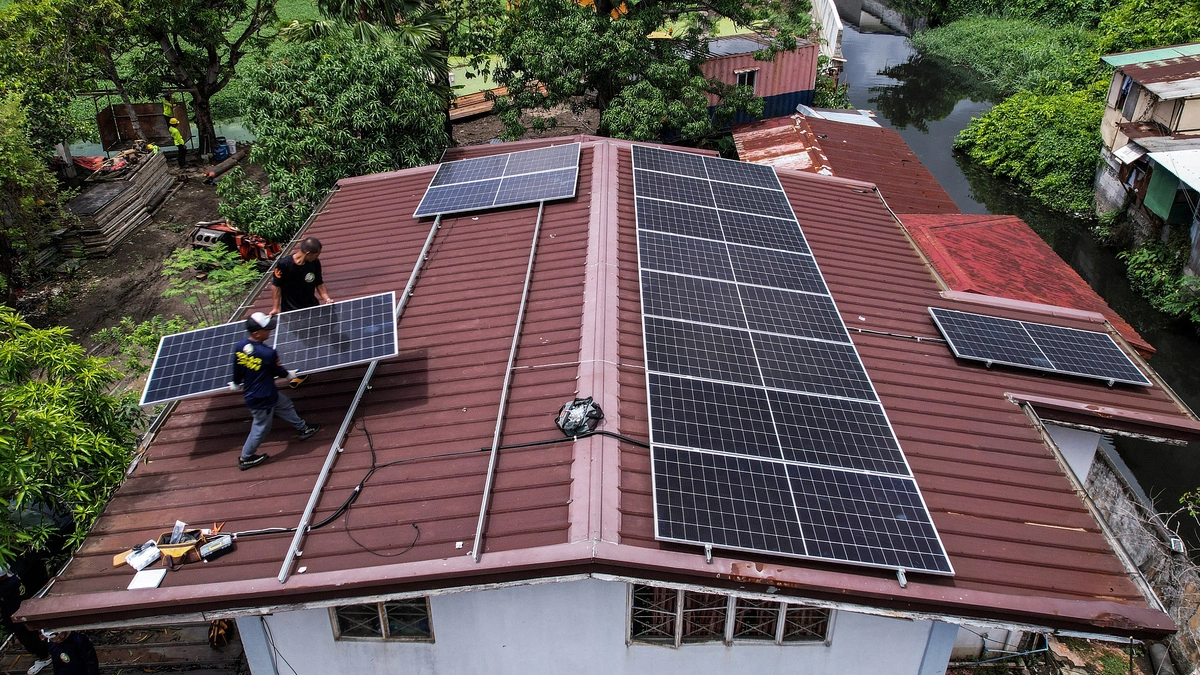
Workers install solar panels on the roof of a house in Kawit, Philippines on June 26. Image: Reuters
Installing rooftop solar power in the Philippines is currently not entirely favorable. According to Brenda Valerio, Director of New Energy Nexus in the Philippines, implementation progress is slower than demand, due to hoarding of components, fluctuating equipment prices and inadequate quality inspection.
The Philippine government is offering solar power installation loans of up to 500,000 pesos ($8,200) at an interest rate of 5%, below market level. However, this program does not apply to private sector workers.
Another barrier is that investment costs are still very high compared to the average annual income of a household, which is about 353,200 pesos (about 5,800 USD). “The opportunity is there but the initial cost is still too large for many households and businesses, despite the increasingly short payback period,” said Ember’s Demoral expert.