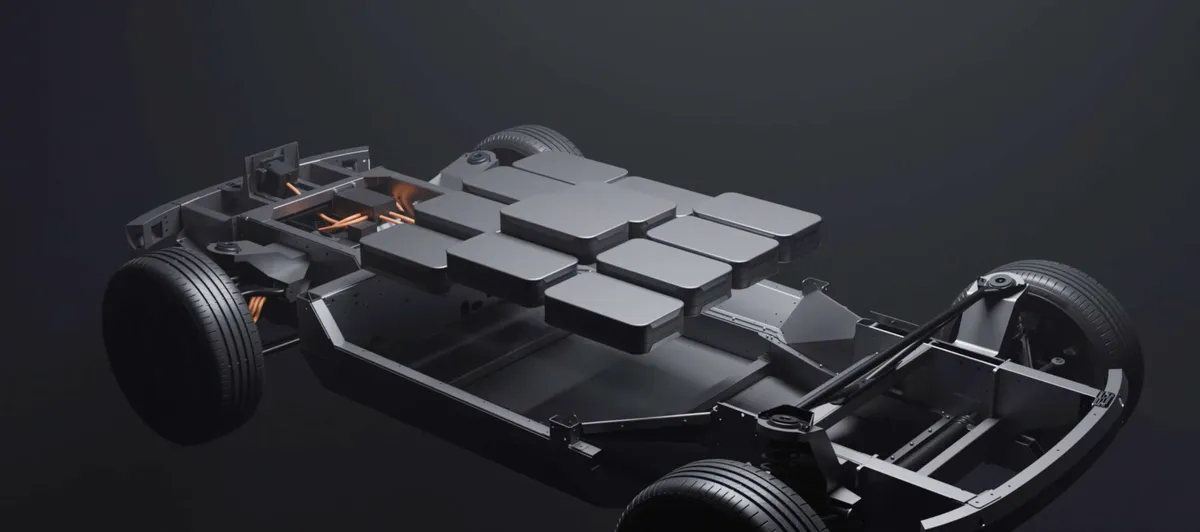
For years, electric car manufacturers and battery developers have been talking about solid-state batteries as the “holy grail” of the industry. The technology is expected to revolutionize electric cars by improving energy density, shortening charging times and improving safety – the buzz company Donut Lab has also promised this.
Although the promises have been great, mass production has proven difficult. One of the biggest challenges has been finding the right material. Many current solid electrolytes are hard and brittle, which makes them difficult to bind and reduces electrical conductivity.
The “highway” of ions
A research team at the Dalian Institute of Chemical Physics of the Chinese Academy of Sciences has developed a new PVDF-based gel composite electrolyte that changes the situation. The study was recently published ScienceDirect– in the science journal, reports Electrek.
The core of the invention is the use of lithium oxychloride (Li3OCl), which initiates a chemical reaction with the PVDF material. This creates stronger chemical bonds between organic and inorganic materials.
In practice, the new electrolyte acts like a “smooth highway” for lithium ions. When the ions can move in the battery faster and easier, the battery becomes longer-lasting, faster charging and safer.
Not ready yet
According to Chinese researchers, the battery concept equipped with new technology retained 84.15 percent of its original capacity after 350 charge cycles. The result is considered a significant step towards commercial application.
However, the durability mentioned above is still far from the durability of modern batteries with liquid electrolyte. By comparison, current NMC batteries last 1,000-2,000 cycles and LFP batteries up to 3,000 cycles before their capacity drops to 80 percent.
Electrekin according to the analysis, 84 percent capacity durability after 350 cycles is good, but not an industry-leading performance. For example, Factorial and Quantum Scape have been capable of 1,000 charge cycles with more than 95 percent capacity retention.
The Finnish Donut Lab’s claims about the durability of their own battery have been in a completely different category. Donut Lab said that the battery lasts for no less than 100,000 cycles, which has understandably caused confusion among battery researchers. There are shocking differences between the achievements of top Chinese researchers and the claims of Donut Lab.
in VTT’s tests Donut Lab’s battery did not perform as promised, and the tested cells swelled, indicating uncontrolled chemical reactions inside the pouch cell.
Donut Lab’s battery was tested in VTT’s laboratory.
KUVA: Donut Lab
Recently, the world’s largest battery manufacturer CATL has put the brakes on the degree of readiness and technological progress of solid electrolyte battery mass production, says Carnewschina.
According to its own words, the battery giant is only at point four on a nine-step scale with its own solid electrolyte battery. Batteries can only be delivered to customers in point nine.
CATL’s own investments in the near future are focused on lithium iron phosphate (LFP) and sodium ion chemistries (SIB).
A wild accusation: Donut Lab’s miracle battery is just a lithium-ion battery – This is how the CEO responds Will Donut Lab deliver on its wild promises? Now Risto Siilasmaa is speaking
La espalda de teflón – Apuntes a pie de página
댓글 : 우크라이나 전쟁의 이면: 서방과 러시아의 허위 정보전
FP a Distància | IES sa Blanca Dona
「若年女性支援団体等に対する事業の妨害行為等について」を発表しました
Topic 1817046
Toolmax
Max Tool
Toolmax.Com.Ua.Htm
Bot Verification
Maecenas lacinia nulla sit amet eros mollis eu
https://blogdir.in.net/article/use-shimla-call-girl-services-to-explore-the-ocean-of-seduction
Top 5 Sảnh Bắn Cá Đẹp Nhất Trên OK9 – Chơi Là Ghiền!
Toolmax
Amet Ut Porttitor
そらパパのメモ帳
Ircam Forum
3Lwjag0Ck3
Index.Php
KALEO – Webflow HTML website template
Webinar: Sådan får du succes med influencer marketing i 2019 – Bloggers Delight
Toolmax
toolmax0 Official Homepage
toolmax002 – Listen Free on Audiomack
Nuevas Experiencias Educativas
Napg