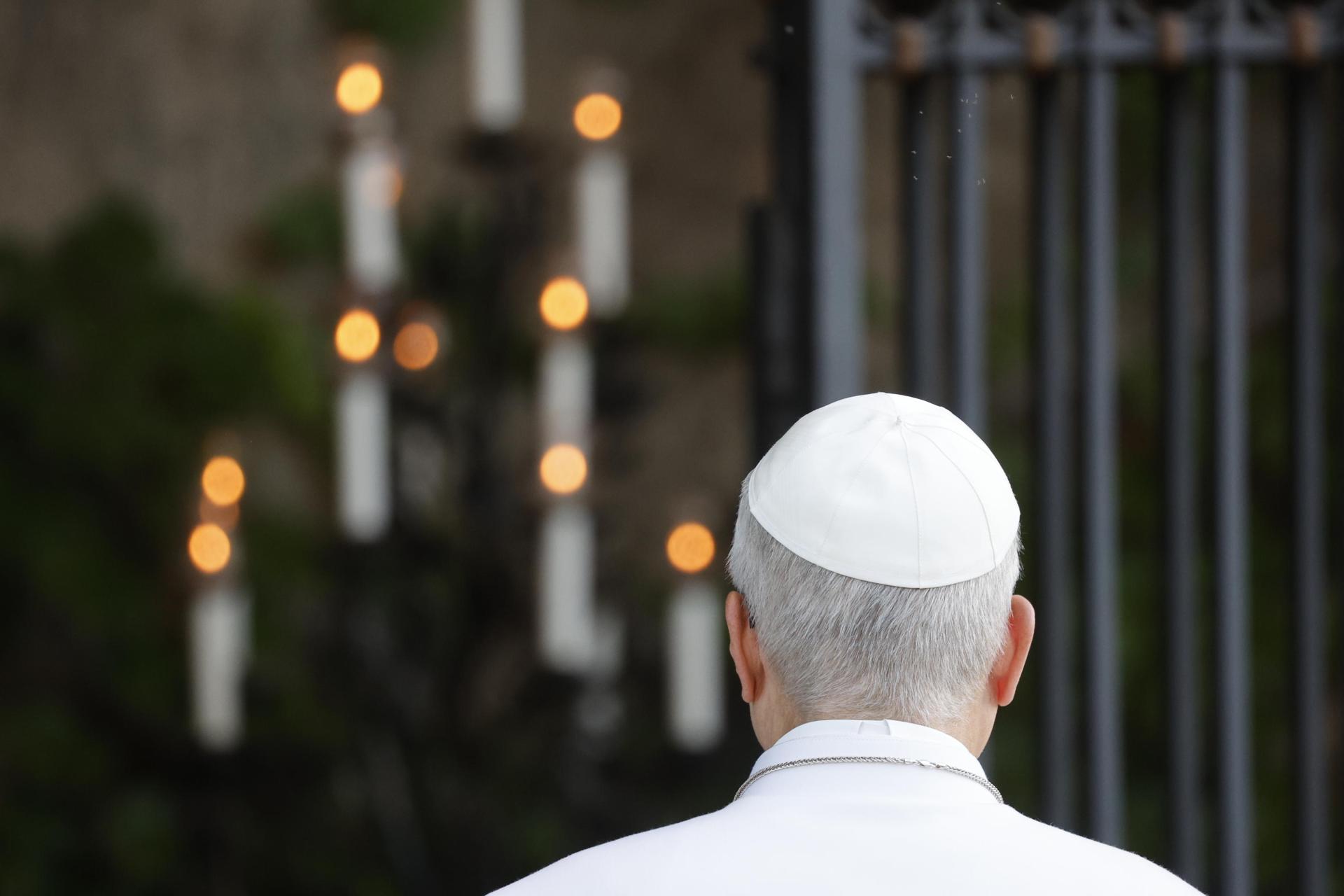
Pope Leo
The case dates back to 2023, when a dialogue with Vegara Cerezo was initiated following the publication of a 20-page manifesto in which he labeled Pope Francis a “heretic” and questioned the validity of his election. The now former priest also criticized texts such as the apostolic exhortation Amoris Laetitia, by the late Argentine pontiff, and the declaration Fiducia Supplicans, by the Dicastery for the Doctrine of the Faith.
In 2024, Vegara Cerezo’s obstinacy led his bishop, José Ignacio Munilla, to remove him from any office or position within the diocese. Munilla warned Vegara Cerezo in February 2024 and April 2025, urging him to alter his “posture expressed publicly and conspicuously through various media,” according to a statement issued by the Diocese of Orihuela-Alicante on June 25, 2026. In September 2025, Bishop Munilla issued a new decree prohibiting Vegara Cerezo from making public statements in the media — a move that Vegara decided to turn to the Vatican Dicastery for Clergy.
After this, and after another article by Vegara Cerezo, the Dicastery for the Doctrine of the Faith asked him to retract his offense of schism. Faced with his failure to provide a satisfactory response, on April 30 Pope Leo decreed that he be dismissed from the clerical state—a decision that was communicated to him on June 20.
In his statement on the matter, Bishop Munilla asked for prayers for Francisco José Vegara Cerezo and recalled the words spoken by Pope Leo XIV on June 11 in the Canary Islands, during a meeting with Spanish bishops, priests, religious and seminarians: “When you encounter difficulties, look up and ask the Holy Spirit for the grace to live united in faith, hope and charity.”
What is schism?
Canon 751 of the Code of Canon Law defines schism as “the refusal of submission to the Supreme Pontiff or of communion with the members of the Church subject to him”. The penalty for this canonical offense is usually excommunication, although in this case the penalty was less severe: dismissal from the clerical state.
What does it mean for a priest to be dismissed from the clerical state?
A priest remains a priest forever; however, if he is sanctioned with dismissal or expulsion from the clerical state, he loses all rights associated with that state. Consequently, he is no longer bound by celibacy and is prohibited from celebrating mass, administering sacraments or presenting himself as a priest. There is only one exception: if a person is in danger of death and the priest who has been dismissed from the clerical state is present, Canon 976 establishes that he can validly administer the sacraments, as the salvation of souls takes precedence over the grave penalty imposed on the priest.
©2026 Catholic News Agency. Published with permission. Original in English: Pope Leo XIV dismisses schismatic Spanish priest https://www.ewtnnews.com/vatican/pope-leo-xiv-dismisses-spanish-priest-from-clerical-state-for-schism
Some friends discuss predictions, odds, and upcoming matches
Group D2859 Betdex Odds O An Interesting Alternative For Value Focused Bettors.Html
The Art Of Betting Analysis
How does creativity influence your approach to betting? Do y
If betting were considered an art form, how would you descri
Betting often combines objective data with personal judgment
What factors do you consider most important when using a foo
How much has a football odds scanner improved your betting s
Which features do you think every football odds scanner shou
Has using a football odds scanner helped you follow matches
I enjoy following a mix of domestic leagues and internationa
How do you usually predict the outcome of a football match?
The Rapid Rise of U.S. Stock Trading on Crypto Platforms
Group.Php
Viewtopic.Php
Is a Crypto Exchange Aggregator Better Than a Single Exchange?
Headphone Reviews and Discussion – Head-Fi.org
Index.Php
I’ve been looking into OBMify for my trading needs. The int
Thinking of moving a larger portion of my portfolio to OBMif
We have Coinbase, Binance, and Kraken. Why switch to OBMify?
Planeo cambiar USDT por euros en efectivo en España. ¿Qué cr
¡Te damos la bienvenida a nuestro grupo Grupo iMineros ! Un
He visto que las tasas varían bastante entre proveedores. ¿Q
A la hora de cambiar criptomonedas, ¿qué valoras más: la com