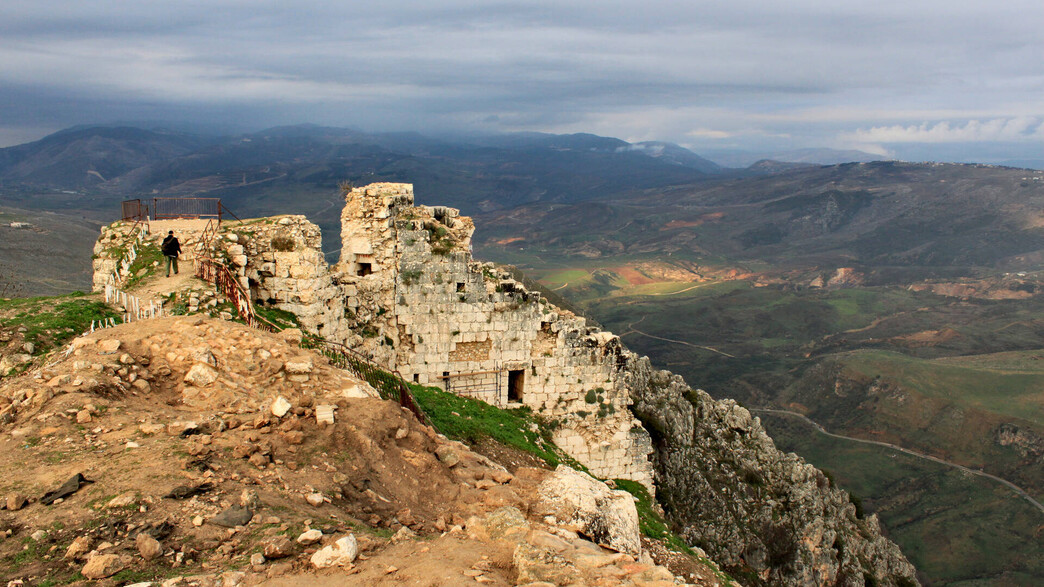
Beyond the military concrete castings and modern war wounds of southern Lebanon, one of the most fascinating and desirable heritage sites in the Middle East is hidden. While the “Beaufort” evokes in the hearts of many Israelis mainly the memories of bunkers and Katyushas, it has a tortuous history, which began as an architectural marvel of warrior-monks and European kings, and as a magnet for empires and sultans. Meet “Paradise”
The morning mists rising from the deep canyon of the Litani River dissipate completely only towards noon, but when they dissipate, the view from the windswept walls of Kelat al-Shaqif is breathtaking. On a steep rocky cliff, at a height of more than 700 meters above sea level, stands the fort, known to the Western world for almost 900 years as “Beaufort Fort”. The fort completely dominates the horizon: to the south you can see the finger of the Galilee and the settlement of Metula, to the west the lively urban center of Nabatia, and to the east the snowy ridges of Mount Hermon. On a clear afternoon, the local geography speaks the language of absolute tactical mastery.
For an entire Israeli generation, the name Beaufort evokes a specific and particularly painful collective memory. It immediately conjures up images of concrete bunkers woven into the medieval stone, the whistling of Katyushas, the incessant buzz of drones, and the final, bloody years of being in the security strip, which ended with a hasty night retreat in May 2000. Beaufort is the backdrop for cinematic works, and it has become a symbol of a generation of warriors who fought an elusive enemy in what was perceived as exhausting Lebanese mud. But history of the place did not begin with the Palestinian terrorist organizations in the 1970s, and it did not end when IDF forces blew up the concrete outposts twenty-six years ago.
The dramatic return of the IDF forces to the ridge, which received tangible expression in the hoisting of the state flag and the flag of the Golani Brigade over the ancient fortress fortifications, made waves in Lebanon and reignited the public debate in Israel. Prime Minister Benjamin Netanyahu defined the takeover as a dramatic turning point in the campaign to dismantle Hezbollah’s infrastructure across the Litani River, while international powers such as France rushed to demand an emergency meeting of the UN Security Council. But examining Beaufort only through the lens of contemporary military strategy or 20th century trauma misses the true and mesmerizing essence of the place. Beaufort is a historical magnet for empires, a site where the spirits of medieval crusaders, Kurdish sultans and modern foot soldiers share the very same mound, all drawn to the same rocky outcrop by an immutable geographical law.
The foundations of the beautiful fortress
Long before the age of modern artillery or satellite-guided UAVs, the strategic value of the rock above the litany was clear to the region’s rulers. While some historians estimate that the first foundations were built there as early as Roman or Byzantine times, the structure that exists today was born out of the religious and geopolitical upheaval of the 12th century. In 1139, King Polk of Anjou, a French ruler who led the kingdom Crusader Jerusalem, realized that in order to secure the northern border of his kingdom, he needed an impenetrable anchor.
The Franks called the site “Balfort” or “Beaufort”, which in old French means “the beautiful fortress”, a tribute to both its impressive aesthetics and its defensive integrity. The Crusaders planned and documented a sophisticated architectural marvel that spanned two separate levels, and was adapted to the natural triangular structure of the cliff. The fort was intended to serve as a vital link in a wide network of fortifications whose function was to monitor and control the trade routes and military traffic that connected the Galilee, the interior of the Levant and the Lebanese coast.
For decades, the warrior monks of the Latin Kingdom used Beaufort to project power over the surrounding valleys. The architecture was deliberately menacing: thick ashlars, deep rock-cut moats, and vaulted underground halls. The same caves and hewn spaces, created by the hands of medieval people to store grain and water during long sieges, are the very same spaces that centuries later would be used by 20th century warriors to store ammunition and hide from aerial bombardment. The fort became an integral part of the landscape, a place where religious fanaticism and advanced military engineering merged together. It was built to last forever, but its builders soon learned that an unconquerable location would always arouse the jealousy of powerful enemies.
The Kurdish sultan and the “super soldiers” of the church
The golden age of French control in Beaufort was violently interrupted with the rise of one of the most charismatic and brilliant leaders in Muslim history: Yusuf Tajir bin Ayyub, known by his famous nickname Salah al-Din. Following his overwhelming victory over the Crusader armies at the famous Battle of the Horns of Khitan in 1187 and the recapture of Jerusalem, Saladin turned his gaze north to dismantle the remaining Christian strongholds. Beaufort, hovering like an eagle’s nest over his supply routes, was a critical target.
In 1189, Saladin’s forces besieged the fortress. The defense of Beaufort during this period became a myth, and was characterized by an exhausting psychological and military struggle. The local ruler, Reginald of Sidon, used delays, intense negotiations and linguistic tricks to delay the Sultan’s advance for months, allowing the defenders to fortify the walls. When Saladin finally discovered the ruse, Reginald was arrested and tortured within sight of the fortress walls to force the defenders to surrender. Despite the shocking sight, the garrison refused to surrender, shouting at their master that they would rather see him dead than give up the Christian frontier.
The fort eventually fell to Saladin in 1190 after a year of relentless pressure, marking a monumental victory for the Muslim counterattack. However, the vicissitudes of medieval diplomacy returned the fort to Christian hands exactly fifty years later, through a treaty signed during the Barons’ Crusade. Realizing that they did not have the manpower required to defend such a huge border post, the secular lords transferred the fortress in 1260 to the Templar Order.
The Templars were the elite forces of their time: warrior-monks who took strict vows of poverty, celibacy and absolute obedience, but operated as a well-disciplined and well-trained standing army. Their patron, Bernard of Clarebeau, described them as having their souls protected by the armor of faith just as their bodies are protected by armor of steel. They were heavy cavalry and skilled archers, and the kings of Jerusalem relied on them as an essential standing army. The Templars invested their enormous corporate wealth in the Beaufort fortification, building massive new towers and upgrading the outer walls. Despite this, their tenure was extremely short, and in 1268 the Egyptian Mamluk sultan Baybers launched a fierce assault, capturing the fortress after a short and violent siege. For the next several hundred years, the fort remained under Muslim rule, passing from the Mamluks to the Ottoman Empire, gradually sinking into a long historical coma, as the development of gunpowder and modern warfare rendered the medieval stone walls obsolete.
From a medieval castle to a modern outpost
Beaufort’s modern revival began in the late 20th century, when the Middle East was engulfed in a series of bloody conflicts that thrust the ancient ruins back into the crucible of front-line combat. Following the establishment of the Palestinian terrorist organizations in southern Lebanon after 1967, the PLO recognized the non-temporal geographical reality of Beaufort. Fatah fighters turned the Crusader remains into a well-fortified base, embedded anti-aircraft guns in the fort’s courtyard and used the high point to direct artillery fire towards the settlements of the Finger of the Galilee and the north of the country.
When Israel started the First Lebanon War in June 1982, Beaufort was designated as the first target and of enormous symbolic importance. The battle for the fort, conducted on the night of June 6 by the patrol of the Golani Brigade, was difficult and complex. In total darkness, while moving through narrow communication trenches and ancient stone openings, IDF soldiers fought a close-range battle against the Palestinian terrorists who had fortified themselves on the spot. The fort was secured, but at a heavy price, which included the fall of the patrol commander, Major Goni Harnik. The victory was so significant that the next day Prime Minister Menachem Begin and Defense Minister Ariel Sharon flew in a helicopter to the summit, an iconic moment that was broadcast in every home in Israel.
For the next eighteen years, Beaufort became the ultimate symbol of the Israeli presence in southern Lebanon. The IDF didn’t just hold the hill, it integrated itself into the existing structure. Military engineers poured massive amounts of concrete, built protected bunkers, fortified firing positions, and tall earthen batteries alongside the 12th-century walls. Young fighters spent months inside this surreal hybrid of a medieval castle and a modern outpost, absorbing relentless barrages of mortar shells and grenades. A side from the rising enemy in those days, the Hezbollah organization.
Towards the end of the 1990s, the ever-increasing blood price in Beaufort and other outposts in the security strip raised sharp questions in Israeli society. The fortress, which was once celebrated as a symbol of heroism, is increasingly seen by the public as a symbol of futility, a demanding “Lebanese mud” that claimed the lives of young people without a clear strategic return. This psychological vulnerability was highlighted in the successful 2007 film Beaufort, which depicted the claustrophobia, fear and deep confusion of the last fighting force guarding the site in the spring of 2000. When the order to withdraw finally came, the engineering forces blew up the modern concrete emplacements with tons of explosives to prevent Hezbollah from using the military infrastructure, which then also caused damage to certain areas of ancient architecture.
For 26 years, the fort enjoyed a short respite of silence. The Lebanese government, with the help of international funding and the work of conservation architects, evacuated the fallen, restored the damaged arches and opened the site to visitors and tourists. Families from Nabatia and Beirat walked on the walls where Knights Templar and Golani soldiers once stood, looking out over the pastoral tranquility of the Litani Valley. UNESCO has even given the site increased cultural protection. But in the Middle East, geography is fate, and quiet is often only a temporary state of political balance of power. The current escalation, which has led to deep ground activity across the Litani River, has drawn the modern military machine back to the bearing rock. The abandoned village of Arnon at the foot of the fortress stands desolate, after its residents were asked to evacuate following the attacks, while soldiers The IDF is once again walking on the ancient stone steps.
The raising of the Israeli flag over Beaufort in 2026 carries with it a clear psychological message of control over the southern area, but it also re-floods the sediments of the past among both sides, between pride and fear. Recent events are a stark reminder that while empires, ideologies and military technologies change over the millennia, the value of the topographic high point remains constant. 900 years after King Polk laid the first stones, Fort Beaufort continues to stand as a living testament to the cycles of conflict in the region: a beautiful fortress judged for its strategic integrity to remain, once again, an eternal battlefield.
Usman Karmakar
Micro.blog – @WasimMazumder
YounusAhmed | Players list | Bandori Party – BanG Dream! Girls Band Party
Backloggery
ArifurKabir's Profile | The Cardinal Nation
Poser – 3D Rendering & Animation Software
Why More Players Are Choosing Pistolo Casino For Online Gaming Fun.247230
Delwar Mahmud הפרופיל של — The Movie Database (TMDB)
Emonparvez
FaisalAnwar
BrickLink About Me Pages – About GolamJalil
HarunAkter's Profile – MyAnimeList.net
♟ ImtiazRashid
Internet Archive: Digital Library of Free & Borrowable Texts, Movies, Music & Wayback Machine
Kazihabib
Labibgain
MasudAlam – watch faces for Apple Watch, WearOS, Galaxy Watch, Pixel Watch, Huawei Watch, and more – Facer
Bio
Forum
Tawk to ParvezAhmed
pinupcasinobd – Divezone
Real Plinko Wins in Bangladesh – Drop, Play & Enjoy Big Rewards
Saadkabirs
TamjidRahman's Profile – MyAnimeList.net
Blank Slate