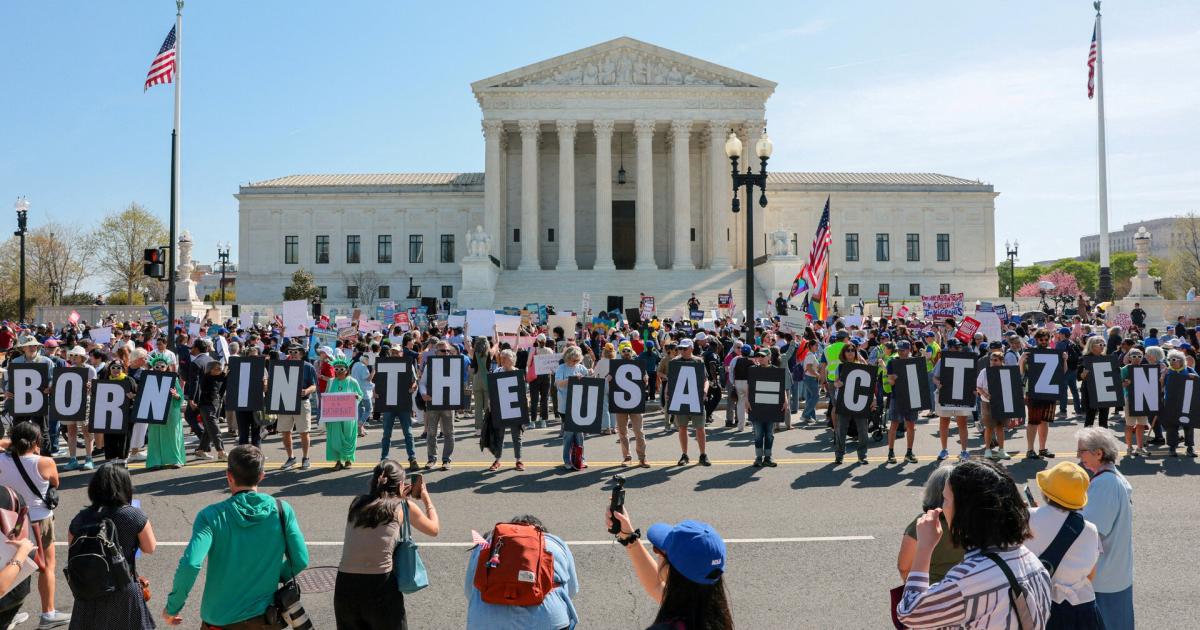
In the dispute over US birthright, President Donald Trump conceded defeat in a landmark ruling at the US Supreme Court. Children born in the USA continue to automatically acquire US citizenship, as is the case Supreme Court decided on Tuesday. This also applies to children of parents who are in the USA illegally or only temporarily. If Trump had succeeded, a large group of people would have been at risk of deportation.
The judges based their ruling on the history of the creation of the 14th Amendment and a landmark Supreme Court ruling from 1898. The children affected were “citizens from birth according to the Constitution.” The court also emphasized that terms like “lawful” or “temporary,” which Trump relied on in his birthright amendment order, do not appear in the constitutional text “for one simple reason: they don’t matter.”
What applies in the USA
In the United States, babies born there are automatically granted citizenship. The basis for this is the 14th Amendment to the US Constitution: “All persons born or naturalized in the United States and subject to the jurisdiction thereof are citizens of the United States.” This “Jus soli” (right of the land) guaranteed automatic citizenship to almost every child born on U.S. territory since 1868. The judges of the US Supreme Court have now confirmed this practice with their ruling.
What Trump wanted to achieve
Right at the beginning of his second term, Trump signed an executive order with which he wanted to massively restrict birthright rights. He wanted to exclude children whose parents are only in the USA temporarily or without valid residence documents from the US birthright. Babies of migrants without valid residence status, including those of asylum seekers, foreign students, tourists or foreigners who were temporarily transferred to the USA by companies, should no longer automatically receive US citizenship. Trump also wanted to take action against “birth tourism” – people who only enter the USA to give birth to their baby there.
What Trump has stopped so far
The fact that Trump’s order has not yet come into force was due to blockages by lower authorities. Several organizations had filed a class action lawsuit against the Trump administration. The name in the lawsuit, “Barbara,” is a pseudonym for an asylum seeker from Honduras who has been living in the United States with her family since 2024. At its core was the question of whether Trump was violating the 14th Amendment of the US Constitution with his decree.
How Trump is reinterpreting jurisdiction
In principle, the US President affirmed the previous legal position, but: “However, the 14th Amendment was never interpreted to universally extend citizenship to everyone born within the United States.” Instead, newborns would also have to be subject to US jurisdiction through their parents.
Typically, every person is subject to US jurisdiction once they are physically on its soil. Trump’s interpretation, however, is that only those who are permanently and legally rooted in the country – for example as a citizen or holder of a green card – are subject to the jurisdiction to the extent that justifies the automatic passport for their descendants.
Why the case is so central for the USA
The case shakes the foundations of America’s self-image as a nation of immigrants. Critics not only saw the plan as a violation of the 14th Amendment, but also warned of the creation of a group of children born in the United States without secure status.
The number of people without a residence permit could increase by 2.7 million by 2045 and by 5.4 million by 2075, according to forecasts by the Migration Policy Institute and Penn State University. If Trump had been successful with his initiative, another large group of people would have been created in the USA who would potentially have had to face deportation.
What a fundamental judgment there was already in 1898
For opponents of Trump’s initiative, the legal situation had already been conclusively clarified by the landmark ruling in the case of Wong Kim Ark in 1898. The son of Chinese immigrants who was born in San Francisco was denied entry back into the United States after a trip to China. The authorities’ justification: Since his parents never had the chance of naturalization due to the then “Chinese Exclusion Act” – a racist law to exclude Chinese migrants – he is also not a citizen.
At that time, the Supreme Court decided against it with a clear majority: the place of birth is the decisive criterion, not the origin of the parents. Jurisdiction also means that one is subject to the laws of the country and can be prosecuted by the police. As long as you are not a diplomat, you are subject to US jurisdiction.
Forum
Амжилттай бизнесмен болсон тамирчид
Foxxii scored 73 on 18 holes at Gleneagles Golf Course at McLaren Park
Showthread.Php
Спортын карьераас бизнесийн амжилт руу
Home.Php
Тамирчдын бизнесийн амжилтын талаар ярилцъя
Алдарт тамирчид хэрхэн бизнес эрхэлдэг вэ? | MolecularCloud
Content Creation course – June 2017: Хөлбөмбөгчид спортоос гадуур юу хийдэг вэ
PaperCall.io – Хөлбөмбөгчдийн бизнесийн амжилтын нууц
Алдарт хөлбөмбөгчид ямар бизнесүүдтэй вэ
Хөлбөмбөгчид спортоо дуусгаад юу хийдэг вэ – Casino Pub | Best Online Casino Review & Listing in Malaysia
Бизнес хийдэг хөлбөмбөгчид гэж хэн бэ – Kenzer & Company
Спортын брэнд болсон тамирчид
Аваргуудын Лигийн Хагас Шигшээ Тогло
Analysis of this season's league matches – Ezega Forums
Аваргуудын лигийн тоглолтын таамаглал
Лигийн хагас шигшээд хэн шалгарах бол
Шөвгийн наймын тоглолтын талаар – Favoreads Coloring Club
Forum
Лигийн хагас шигшээ тоглолтуудын мэдээлэл
Alexx scored 73 on 18 holes at Gleneagles Golf Course at McLaren Park
Showthread.Php
Лигийн зарим багуудын тоглолт таамаглахад хэцүү болжэ
Home.Php