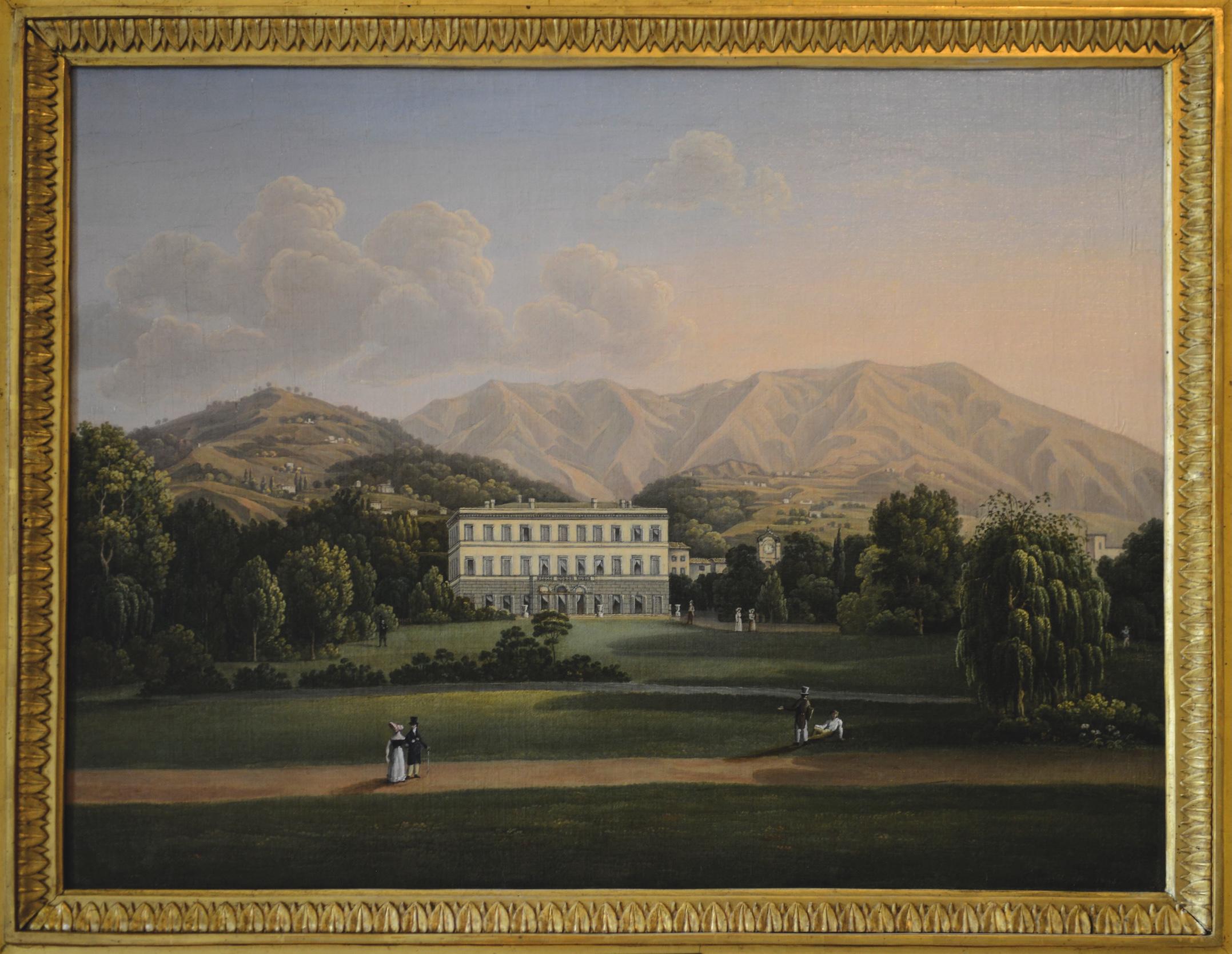
Living over a century apart, Elisa Bonaparte Baciocchi (Ajaccio, 1777 – Villa Vicentina, 1820) and Mimì Pecci Blunt (Rome, 1885-Marlia, 1971) shared the same idea of the role to be given to a historic residence. This is the underlying theme of the exhibition “Elisa Bonaparte and Mimì Pecci Blunt in Marlia. Two women, two centuries, one Villa”, which from 2 July to 16 August hosts the Hall of Frescoes of the San Micheletto complex in Lucca, headquarters of the Cassa di Risparmio di Lucca Foundation. The exhibition is dedicated to the ideal dialogue between Elisa Bonaparte Baciocchi and Anna Laetitia, known as Mimì Pecci Blunt, both linked to the Villa Reale di Marlia in Capannori (Lucca), which they chose as a place of culture, art and patronage.
The exhibition – curated by Roberta Martinelli, with research and texts by Simonetta Giurlani Pardini, exhibition project by Lucia Maffei, supported by the Cassa di Risparmio di Lucca Foundation and the Municipality of Lucca as part of the Vivi Lucca calendar – starts from a particularly important discovery that emerged from the archive: the discovery of a nucleus of fifteen letters, ten of which are entirely autographed by Elisa Bonaparte Baciocchi, some of which are exhibited for the first time.
In the Napoleonic context it is extremely rare to find letters written by Elisa. Dated between 1805 and 1820, they are addressed to various interlocutors, including his brother Luciano Bonaparte and the famous educator Madame Campan. The letters provide an insight into the princess’s political, family and cultural life and open up new research perspectives on her and Napoleonic Lucca. They constitute a new and significant line of historical investigation into events, habits and customs of the time. It is precisely from these new documentary sources that the narrative of the exhibition develops, built around the figures of Elisa Bonaparte Baciocchi and Mimì Pecci Blunt. For the occasion, a volume published by Maria Pacini Fazzi will be written.
The heart of the exhibition is the bond between the two women, reconstructed through the life of Mimì Pecci Blunt: from birth to education, under the direct tutelage of her great-uncle Pope Leo XIII, one of the most important figures in the history of the Church, up to the turning point represented by her marriage to Cecil Blumenthal, from which the “Pecci Blunt” partnership came to life and, subsequently, the purchase of Elisa Bonaparte Baciocchi’s Villa.
The first part of the exhibition retraces Mimì’s years of education in Rome, through documents from her childhood: from the photograph of the first day of school to the correspondence with her parents, whom she will only see occasionally from the age of four, from her early entry to the Roman College of the Assumption. Her closeness with Pope Leo XIII profoundly marked her growth, transmitting courage, vision and an innovative spirit. The second opens with the purchase of Villa Reale di Marlia in 1923. From that moment and until the end of her life, in 1971, Countess Pecci Blunt worked to restore the atmosphere of Elisa’s time to the villa. Among the materials on display is the unpublished inventory of purchases made, drawn up by Mimì herself between 1923 and 1926. From the papers emerges the strong link with the figure of Elisa Bonaparte Baciocchi, who guides the entire cultural and identity project of the residence. Even the photographs of the wedding displayed in the exhibition – some signed by the photographer Taponier, portraitist of royal highnesses and international personalities – testify to her closeness to the environment of the Napoleonic aristocracy: her mother-in-law’s second husband in fact belonged to the Talleyrand-Périgord family, and the circle of her closest friends included the direct descendants of the imperial aristocracy such as the De Noailles, the De Beaumont and the Murat.
Alongside the social dimension, that of a researcher emerges: Mimì identifies, acquires and studies objects, furnishings and letters that belonged to Elisa, moving between antiques, archives and international institutions. He maintained relationships with important personalities of the Napoleonic world, from the Murat heirs to Giuseppe Primoli, whose collection gave rise to the Napoleonic Museum in Rome. To find out about two bas-reliefs of Elisa and her husband Felice purchased at a Vangelisti auction held at Villa Mansi, she also turned to the director of the Louvre and Paul Marmottan, a French art historian and collector who upon his death donated his collection to the Académie des Beaux-Arts, giving rise to the Musée Marmottan Monet and the Bibliothèque Marmottan. He also turns to the Malmaison museum, demonstrating a cultural competence that is anything but common.
The Villa Reale project thus becomes a true “return to Elisa’s era”, through the recovery of furnishings, environments and atmospheres, as if the princess had never left the residence. Mimì transforms Villa Reale into an international cultural salon, frequented by guests such as Salvador Dalí, Jean Cocteau, Alberto Moravia, but also Jacqueline Kennedy and Princess Margaret of England. Fashion is an integral part of his aesthetic language: from his wardrobes emerge dresses, coats and hats from the most important fashion houses of the time. Among the objects on display is her wedding dress, signed by the atelier of Charles Frederick Worth, displayed on an original silent servant. Her marriage to Cecil Blumenthal in 1919 marked the beginning of a partnership based on art and support for contemporary culture. Representatives of the European nobility also participate in the ceremony, such as the Talleyrands, the de Gramonts, the Rohan-Chabots and the Murats. In one photograph, a page boy is described by Vogue as “dressed like the King of Rome”, wearing a suit that is a tribute to the son of Napoleon Bonaparte and Marie Louise of Habsburg-Lorraine.
Entertainment and social life. After the wedding, the couple developed an intense cultural activity between Paris, Rome and New York, including art galleries and collecting. The parties in their villa on rue de Babylone in Paris, a few steps from Elisa Bonaparte Baciocchi’s home, became the subject of international news. Despite the difficult periods of war and racial laws, they founded an art gallery in Rome and New York. The La Cometa theater was born in Rome, in the Campidoglio, linked to the family motto Lumen in coelo, recently reactivated by Maria Grazia Chiuri, creative director of Fendi, who, for the inauguration, was also inspired by the aesthetics of the famous parties, bal blanc, organized by Mimì.
Hats and photographs. The passion for photography accompanies the countess’s entire life, as does her passion for hats, many still preserved in the boxes of the Villa Reale archive in Marlia. The inclination for photography seems to come directly from the figure of his uncle Pope Leo XIII, attentive to technological innovations and collector of photographic and cinematographic tools, preserved in the Palazzina dell’Orologio in Marlia. Mimì constantly documents her life and also participates in photography competitions. For this reason, at the entrance to the exhibition itinerary, the visitor is greeted by a hat designed by Cleo Romagnoli and a portrait of her created by Milton Gendel.
During the opening period of the exhibition, three collateral events with extraordinary openings are planned, dedicated to the dialogue between the two protagonists through music: 20 July with the Puccini repertoire performed by the soprano Celeste Nardi and Anna Cognetta on the piano; on July 31st with a tribute to Neapolitan composers with Sara Guidi and Eugenio Milazzo thanks to the collaboration with the “Mettiamoci all’Opera” association of Prato; on August 10th with a harp concert by Letizia Lazzerini. The appointments will be held at Villa Bottini at 6.30 pm and will be preceded by a guided tour of the exhibition at 5.30 pm.
Hvad Laver Moderne Kvinder Egentlig I Fritiden
Derfor Er Det Dyreste Kontorudstyr Ikke Altid Bedst
Tegelstenens Tidlosa Roll I Modern Svensk Arkitektur
Valj Ratt Bildelar Pa Natet Undvik Felkop
5 Skal Att Investera I Ett Pooltak Mer An Bara Skydd Mot Lov
Saadan Finder Du Stroempebukser I Hoej Kvalitet
Saadan Finder I Undertoej I De Rette Materialer
Parhaat Megaways Pelit Lista Suosituimmistadynaamisen Ruudukon Symboleista
Strategisk Brug Af Tryksager Pa Danske Fagmesser
Tre Fodevarer I Med Fordel Kan Fa Leveret Til Arbejdspladsen
Oplev Mangfoldigheden I Europas Mest Populaere Ferieland
Todennakoisyydet Vs Kertoimet Missa Piilee Vedonlyonnin Ydin
Stabil Digital Grund Sa Sakrar Ni Foretagets Kommunikation I En Tradlos Ekonomi
Fran Ritbord Till Blomsterprakt Sa Skapar Du En Hallbar Perennrabatt I Tradgarden
Hvad Koster Asbestsanering En Aerlig Gennemgang Af Prisniveauer
Asbest I Fliseklaeb Hvad Badevaerelsesrenoveringen Kan Afslore
Asbest I Rorisolering Hvad Du Skal Vide Inden Renoveringen
Fran Betong Till Oas Sa Planerar Du Den Perfekta Innergarden For Gemenskap Och Gronska
Ergonomie Am Arbeitsplatz So Optimieren Professionelle Hubtische Ihre Innerbetriebliche Logistik
Soft Skills %Ce%Ba%Ce%B1%Ce%B9 Hard Skills %Cf%84%Ce%B9 %Ce%Bc%Ce%B5%Cf%84%Cf%81%Ce%Ac%Ce%B5%Ce%B9 %Cf%80%Ce%B5%Cf%81%Ce%B9%Cf%83%Cf%83%Cf%8C%Cf%84%Ce%B5%Cf%81%Ce%Bf %Cf%83%Cf%84%Ce%B9%Cf%82
Viljo Kasinot Vedonlyojan Nakokulmasta Kotimainen Pikamaksu Lyhentaa Kotiutukset Minuutteihin
Nar Favoritten Ikke Vinner Nba Finalen 2026 Og Kunsten A Lese Odds
Hvorfor Norske Spillere Stiller Stadig Hoyere Krav Til Mobilopplevelsen I 2026
Praktiske Overvejelser Ved Montering Af Gardiner Og Solafskaermning I Renoveringsprojekter
Praktiske Overvejelser Ved Opsaetning Af En Let Havekonstruktion Eller Et Drivhus