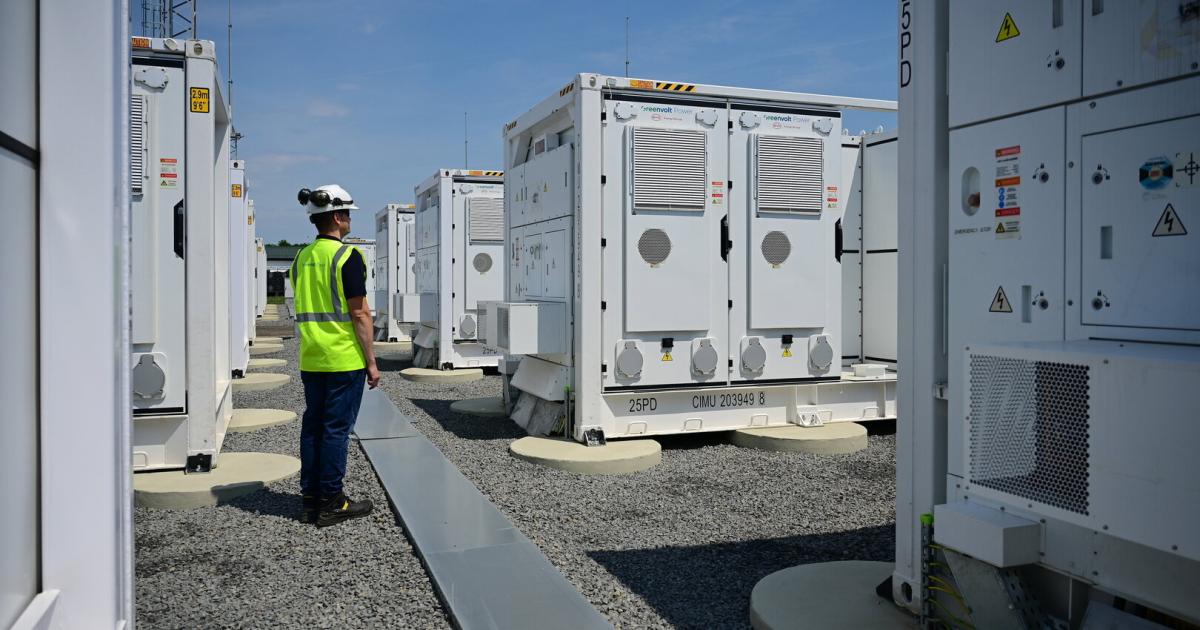
This week, E-Control presented the draft for the network fees from 2027. One of the most important innovations: large battery storage systems should be used exempt from network charges become. They are urgently needed due to the expansion of solar and wind power. Their dissemination should be encouraged. Battery storage operators should actually be happy about the exception, right? They don’t, on the contrary. They are anything but pleased.
Not all storage is created equal
The devil is in the details. System Usage Fees Basic Regulation is the name of the legal text in question. E-Control provides for an exemption from fees for storage systems that are useful to the system. This includes all energy storage systems, including pumped storage power plants. However, the draft provides for a distinction based on storage duration. Different rules apply to long-term storage (storage period over 168 hours) and medium-term storage (between 24 and 168 hours) as to short-term storage (less than 24 hours). Battery storage all fall into the latter category.
Anyone who meets six criteria is useful to the system
There are only exceptions to the network fees if storage system-serving are. The definition for this includes six criteriaall of which must be fulfilled. That’s impossible, according to representatives of the nascent battery storage industry. One criterion, for example, is that the storage device is connected to a network node that exceeds 80 percent of the transformer output 20 percent of the hours in a year.
“There is no transformer in Austria that achieves these values,” says Christoph SchmidtPresident of the Austrian Energy Storage Association. Not even substations at large wind farms in eastern Austria would achieve such values. Performance data for individual transformers has never been disclosed by network operators, notes another industry representative who remains anonymous. An energy entrepreneur tells the KURIER: “It is de facto impossible to achieve system usefulness.”
Double payment of network fees would remain
This means that in the future, battery storage systems will probably continue to have to pay network fees for both charging and discharging and feeding electricity into the grid. The double burden is the status quo that the government is creating through the new Electricity Industry Act actually wanted to change. According to Schmidt, the government outsourced the decision as to which storage facilities should be subject to exceptions to E-Control. “You could have decided it yourself in the ElWG.”
Battery storage operators actually have expected to be relieved. The ElWG provided the basis for this. If the double burden continues, it will be impossible to expand battery storage to the extent that the entire energy industry considers it necessary. The business simply doesn’t pay off, says Schmidt. “You would earn 120,000 euros a year per megawatt of output and pay 75,000 euros in network fees. But I haven’t bought any batteries and paid no one.”
Profit-hungry investors should bear costs
Industry representatives report that the regulation wouldslow down extremely“. On the one hand, E-Control’s approach is attributed to protecting pumped storage power plants. They would not be able to be operated economically with network fees. On the other hand, high network expansion costs would have to be covered. “They are trying to pass on as much of it as possible to the new storage operators,” is one assumption. In addition, battery storage operators would be viewed as profit-hungry investors in a gold rush mood.
If there are no batteries, it will be more expensive for everyone
The problem is that you cannot reduce network costs if the… Memory expansion fail. Only with much more storage capacity, especially in eastern Austria, where it is not possible to build pumped storage power plants, can temporal differences in the production and consumption of renewable energies be reconciled. Schmidt: “The requirement is that the market should build battery storage. Then operators should earn something from it and everyone pays less.“
Nothing is set in stone yet. Comments on the Basic System Usage Fees Regulation are currently being sought and there will be a specialist conference on the subject. The industry is hoping for talks with E-Control and a satisfactory agreement. There should be political support.
What is Inconel 600? Complete Guide to Inconel 600 Bars
Super Duplex Steel Round Bar: Properties, Grades & Uses
Hastelloy C276 ASTM B574, UNS N10276 Rod Supplier
Durable Hastelloy Products – Leoscor Alloys
Incoloy 800H ASTM B408 Bar Manufacturer & Supplier In India
Incoloy 800HT Screw Manufacturer and Supplier In India
Incoloy 825 Screw Manufacturer & Supplier In India, Mumbai
Inconel 600 Washer Manufacturer & Supplier In Mumbai, India
Inconel, Incoloy Products – Leoscor Alloys
Monel K500 Bolts Manufacturer & Supplier In India, Mumbai
SS WNR 1.4550 and UNS S34700 Screws and Bolt Supplier
Stainless Steel 314 Welded Tubes Manufacturers in India
310 Stainless Steel Round Bar | ASTM A276 310 Bar Manufacturer
Stainless Steel 321H Rod Supplier, Exporter in Mumbai, India
Titanium Bolts, Titanium Gr 2-5 Bolts Supplier, Exporter.
5 Benefits Of Using Glass Partition Walls In Your Office Space – Malrox
5 reasons to install Glass Partitioning in Your Workspace – Malrox
All You Need to Know about Folding Glass Partition – Malrox
All You Need to Know About Folding Glass Partitions – Malrox
Divide with solid movable partitions to Maximise Change – Malrox
Projects – Malrox
Benefits and Uses of Sliding Partitions – Malrox
The Role of Movable Partition Walls in Agile Workspaces
Trendy Folding Partition Designs to Watch in 2025
What Is Acoustic Glass? A Complete Guide – Malrox