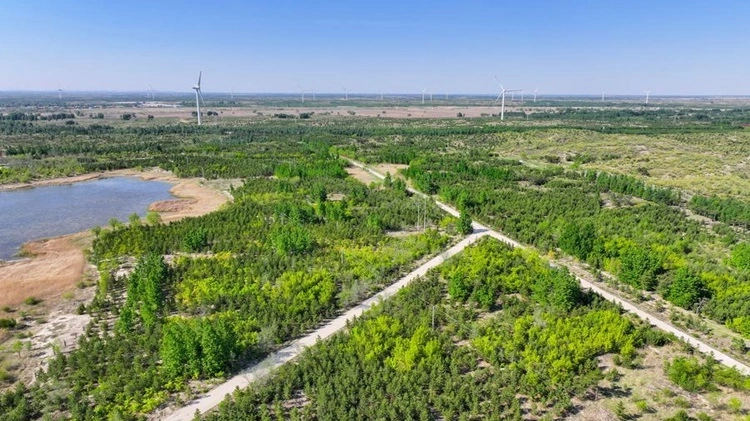
China’s “Great Green Wall” project plants more than 66 billion trees with a faster growth rate than natural forests thanks to effective CO2 absorption.
According to research published on May 28 in the journal Geophysical Research Letterstrees planted in large afforestation projects in China appear to grow faster than natural forest trees. The reason may be that crops absorb more strongly the increased CO2 in the atmosphere.
China has planted 66 billion trees since 1978 and plans to plant 34 billion more by mid-century in its ‘Great Green Wall’ project to prevent the Gobi and Taklamakan deserts from spreading. Yuhang Luo, a landscape ecologist at Peking University in Shenzhen, China, and his colleagues wanted to understand exactly how the differences between planted forests and natural forests affect their ability to absorb CO2 and respond to climate change.
Planted forests are forests created intentionally by humans such as the Great Green Wall project while natural forests grow without human intervention.
Researchers used satellite data to track leaf area index, a measure of canopy density and a key driver of carbon sequestration, to determine the growth rate of different forest types. They found that planted forests increased leaf area 66% faster than natural forests.
Much of the difference is due to the fact that planted forests are much younger than natural forests and young trees grow faster than old trees. But even when comparing forests of similar age and growing conditions, planted forests grew 4.6% faster.
Young trees in a green area in Tongliao city in the northern Inner Mongolia autonomous region. Image: Xinhua
Plantations typically include fast-growing species such as eucalyptus and birch with competing vegetation pruned and the soil layer fertilized regularly. Human interventions help reduce competition for light, water and nutrients.
The development gap peaks in planted forests with tree ages of about 30-40 years and decreases significantly after 40 years of age. In contrast, natural forests grow slowly but more stably, so they have long-term advantages. Another study published in May 2025 in the journal Communications Earth & Environment found that natural forests accumulate more carbon above ground than planted forests.
“Planted forests can be a powerful short-term tool for carbon sequestration, but this advantage is only temporary. In terms of long-term carbon storage and resilience, natural forests remain irreplaceable,” Luo said.
Luo hopes the new findings will help guide reforestation efforts to ensure maximum benefits from crops, helping to mitigate the impact of climate change.
According to China’s Forestry and Grassland Administration, since the Sanbei Protection Forest Program (commonly known as the Great Green Wall) entered its key phase in 2023, the central government invested about 13.06 billion USD and implemented 544 important projects. According to People’s Dailyin Xinjiang, the protective forest belt in the Taklamakan Desert stretches for 3,046 km. Soil erosion in deserts and large sandy areas has decreased by about 40% since 2000.
Astm A350 Lf2 Carbon Steel Forged Fittings
Duplex Steel Uns S31803 Forged Fittings
Duplex Steel Uns S32205 Forged Fittings
Hastelloy C22 Forged Fittings
Hastelloy C276 Forged Fittings
Incoloy 800 800H 800Ht Forged Fittings
Incoloy 825 Forged Fittings
Inconel 718 Forged Fittings
Smo 254 Forged Fittings
Stainless Steel 253Ma Forged Fittings
Stainless Steel 310 310S Forged Fittings
Stainless Steel 316Ti Forged Fittings
Stainless Steel 321 321H Forged Fittings
Stainless Steel 347 347H Forged Fittings
Stainless Steel 904L Forged Fittings
Super Duplex Steel Uns S32750 Forged Fittings
Super Duplex Steel Uns S32760 Forged Fittings
Sitemap
Astm A333 Grade 6 Pipes
Astm A671 Gr Cc60 Cl22 Pipes
Astm A778 Pipes
Duplex Steel Uns S31803 Pipes
Duplex Steel Uns S32205 Pipes
Hastelloy B2 Pipes
Hastelloy C22 Pipes