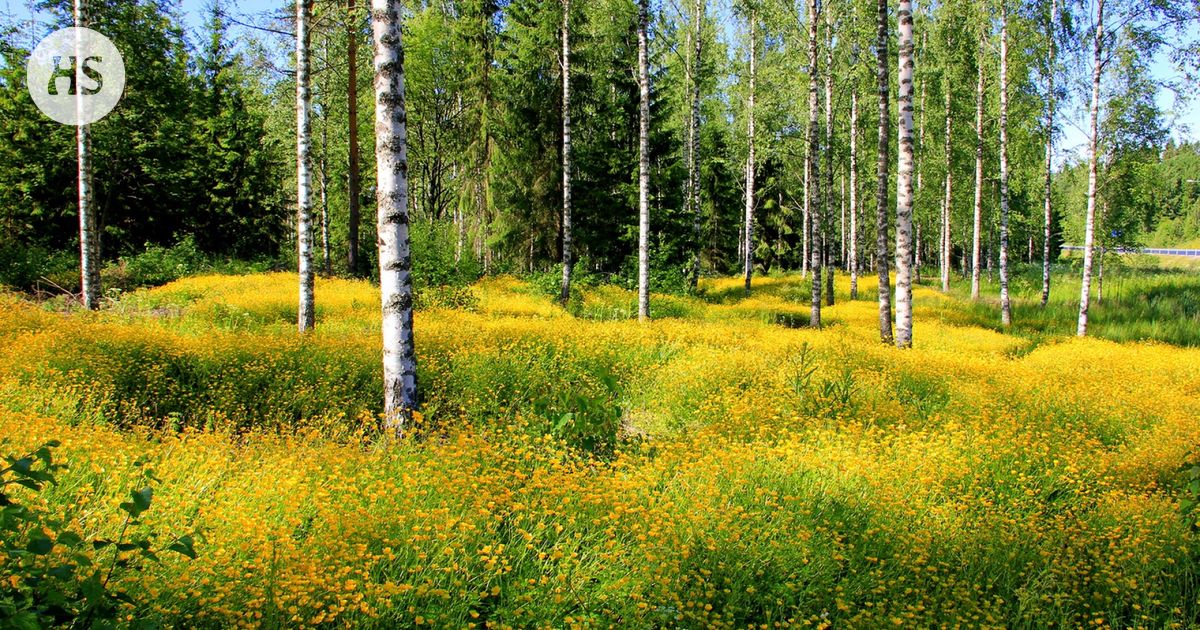
Lushly in the blooming, bright groves and the meadows bordering them, you get a better idea of the natural landscape of Europe than in the vast, densely dark forests.
The biological species of Täkää’s temperate zone did not originally develop to thrive in thick reeds, but in a mosaic where grasses break up sparsely wooded forests and occasional denser heathers.
About that reports Biological Conservation – science magazine, an international group of researchers, who determined, among other things, on the basis of fossils and ancient DNA, European habitat types from the last 20 million years.
It turned out that the most dominant environment was a mosaic, which was maintained by the grazing and trampling of large hornbills and weevils.
Mosaics were even found in the Ice Age mammoth crater. Only when the largest herbivores disappeared at the end of the Ice Age, did extensive and dense forests become common.
In addition, the researchers analyzed the current animal species in Europe, from insects to vertebrates. They found that they developed during the mosaic and still thrive best in such. It even applies to roe deer and bears, which are considered species of dense forests.
The result on the basis of this, the researchers believe that Europe’s nature conservation should be reformed.
Nowadays, the European Union uses the habitat directive of 1992, where habitat types are mainly defined as either completely uniform forests or completely open vegetation areas.
The regulation is based on the old concept, according to which forests in humid temperate climates naturally become denser.
Current situation according to the researchers, could gradually begin to improve by fencing off the experimental areas, where the populations of large herbivores would grow to an ancient density and limit the growth of tree seedlings.
As forest choppers, you could try not only moose, roe deer, wild boars and bicentenarians, but also horses and cattle that have been released into the wild, and even elephants brought from Asia or Africa.
It’s not just about restoring the past but investing in the future, the researchers emphasize.
The mosaic landscape supported the diversity of nature during the ancient great climate changes and could do the same in the future as well.
Moin zusammen, ich
Als ich gestern die
Neue Familienfotos F%C3%Bcr Die Homepage
Le Guide ultime d'Ibiza: Les meilleures choses à faire à Ibiza.
Na, alles klar hier? Ein Kumpel
Oft schaue ich abends Leuten beim Spielen zu, um vielleicht neue Taktiken für…
Durch einen Zufall stieß ich in einem regionalen Forum auf einen Thread, der genau meine Situation beschrieb. Casino Hohensyburg wurde dort als echter Retter in der Not für die Region NRW gepriesen, also musste ich das testen.
UserProfile:ScottFoster
Mutter und Autistin – (m)eine Herausforderung (Autobiographie Teil 2/3)
Ein Kollege aus
Mir war unglaublich langweilig
Oft sehe ich Leute
AI is one of the most exciting subjects I have studied, but
So gestaltest du ein anregendes und entwicklungsförderndes Kinderzimmer für dein Kind
Sorry, aber die Seite konnte nicht gefunden werden | Karteikarten online lernen | CoboCards
Casino Luzern
Lojra Online,Games Apex Casino Free, Luaj Free , Luaj Shak Shak Casino, Luaj Apex, Lojra Me Makina, Lojra per Vajza,Luaj Futboll , Motorra ,Bilardo, Poker e Tej – Forum
UserProfile:WilliamStevenson
My recent trip across
After adding Visio to a machine that already had Word, Excel
Athlete of the Month – Stuart Souter
Eutirox tabletas. Eutirox farmacia benavides – vendo Eutirox sin receta. A Coruña — España
The Electric Film Series Group | FMASU
Post-Budget Statement
I was stranded in a rented