The way we conduct wars is changing rapidly, as new technologies shake up military concepts of warfare in all areas, from the procurement of weapons to the operation of military operations.
But how far-reaching will this change be in the coming years? And will the hundreds of billions of dollars that the US, its allies and rivals invest in new tanks, planes and warships turn out to be equivalent to buying horses and arrows on the eve of the appearance of machine guns and cannons?
● The country that builds a secret military base for Israel and the USA
● First Western leader in Damascus: French President Macron visits Syria
At the beginning of the war between Russia and Ukraine, many generals in the West dismissed it as a conflict from which no significant lessons could be learned, because they assumed that if the US and its allies were forced to fight, they would enjoy air superiority and a large inventory of precision weaponry that would allow them to land a quick and devastating opening strike.
However, the failure of the US and Israel to inflict a strategic defeat on a regional power such as Iran, even though they used a significant part of their stockpile of precision armaments, undermines this assumption.
Combat based on UAVs, which brought with it the availability of precise and cheap armaments in large quantities, is here to stay. So is the expansion of additional capabilities, such as ballistic missiles and long-range cruise missiles, which were previously the property of superpowers only, and were too expensive for them to use on a large scale. At the same time, the development of autonomous systems guided by artificial intelligence heralds a significant turn.
In today’s wars, what was once considered a safe home, hundreds of kilometers from the front line, has become a battlefield, whether it is American bases in the Persian Gulf or Russian military installations far from Ukraine. At the same time, the proliferation of cheap sensors has made any large-scale maneuver, such as an armored attack in the style of the American invasion of Iraq in 2003, much more complex, because any concentration of forces can be quickly located and attacked long before it reaches the battlefield.
The lessons of combat
The defense ministries and army headquarters around the world are closely following the developments and trying to understand what lessons can be drawn from them.
“The nature of combat is fundamentally changing,” said the German Chief of Staff, General Carsten Breuer. “Armed forces must be able to adapt faster, integrate new technologies and learn quickly. If we don’t adapt, we won’t be able to win.”
His Dutch counterpart, General Ono Eichelsheim, also sounded a similar warning. “Technology changes very quickly during wartime,” he said. “If we don’t know how to change ourselves, and adopt adaptability and flexibility, we will lose already in the first weeks of the war, we will lose too many territories and too many soldiers. Later we will indeed adapt, but it will already be too late.”
Among commanders of armies, governments and defense companies there is no agreement on whether the current developments justify the definition “revolution”, which requires a fundamental change of the existing concepts of warfare.
“Revolutions in warfare are often announced, but they rarely actually happen. Most military developments, including the current trends in the use of UAVs and precision strikes, are evolutionary,” said Michael Koffman, a senior fellow at the Carnegie Institution for International Peace in Washington. “No one doubts the impact of gunpowder, but it has been used on the battlefield for centuries alongside knights and spear carriers.”
Revolution or evolution?
Whether it is a revolution or not, few disagree that the way war is conducted is undergoing a rapid change, at a rate that will only increase. Autonomous systems based on artificial intelligence have already become a key tool that helped the US identify targets in the air campaign against Iran.
In Ukraine, autonomous drones, including those provided by the German arms manufacturer Helsing, patrol the roads in occupied areas in the south of the country, using artificial intelligence to locate targets such as fuel trucks, and after receiving permission from a human operator continue to pursue them independently.
Russia, for its part, has begun to use for similar missions Mulanya UAVs that are based on artificial intelligence, and operate without a human operator in real time, because its forces do not have access to the Starlink network for guidance purposes.
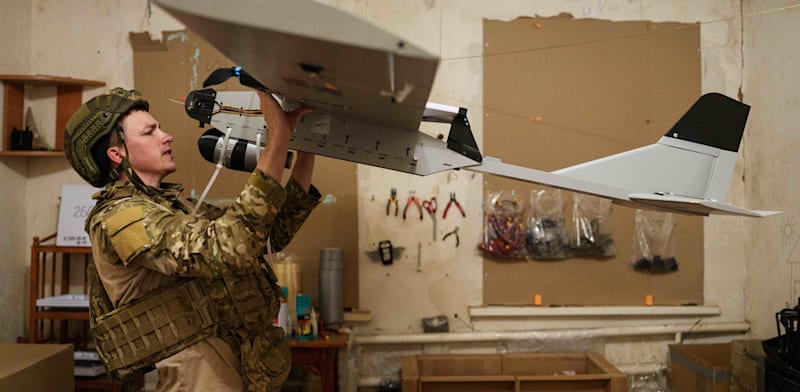
Ukrainian soldiers prepare for an attack using drones / Photo: Reuters, Valentyn Ogirenko
The rules of the game are changing
“Autonomous systems are just beginning to appear on the battlefield, but in the next fifteen years they will be the factor that changes the rules of the game more than anything else, because they penetrate every field and fundamentally change the battlefield, which until now has been based on people,” said Gundbert Scharf, co-CEO of the Helsing company.
Lewis Moseley, who heads the UK and European operations of the American security company Palantir, which was significantly involved in the campaign against Iran and provides key support to Ukraine in its war with Russia, said that this year may be marked as a historic turning point.
“I would not be surprised if the year 2026 will be remembered in the next hundreds of years as the year in which the significant breakthrough in military technology took place, similar to the invention of gunpowder and the like, which are autonomous tools,” he said.
According to him, the main characteristic of the war between Russia and Ukraine, and probably also of major conflicts in the future, is that weapons and technologies that were considered cutting edge become obsolete within a few months. “When you’re faced with an opponent who can adapt, what matters is the rate of improvement and learning, not the technology itself,” Moseley added.
The new procurement method
One of the examples of this ability to adapt is Ukraine’s new method of procuring UAVs, which are responsible for more than 90% of the enemy’s kills, as well as the method of procuring electronic warfare systems and other central means of combat.
According to the system, which was introduced last August, brigades in the Ukrainian army are assigned “electronic points” according to the number of Russian soldiers and the weapons they managed to hit. The UAVs provide photographic documentation that serves as proof of these vulnerabilities. Using the Delta Battlefield Management Network, divisions convert the points to budget, and can then quickly purchase new systems directly from manufacturers through a classified online trading platform.
As direct relationships develop between the divisions and the manufacturers, the means of warfare become in a certain sense from a product to a subscription, which is updated and redesigned regularly according to the changing conditions of the battlefield.
“A revolution of thought has taken place both in the field of procurement and at the level of the military and political leadership,” said Irina Trech, CEO and Chief Technology Officer of Fair Point, one of the leading new generation defense companies in Ukraine, which manufactures UAVs and missiles. “We abandoned the model in which engineers receive precise specifications for the development of a particular missile, tank or UAV, and moved to a model in which they are at the front, sitting with the fighters, smoking, drinking coffee and trying to understand together what the problem is and how to solve it.”
Fighting with UAVs also challenged basic concepts such as air superiority. The US may have been able to gain complete control over Iran’s skies using advanced aircraft such as the 35F, but it was unable to protect its bases and central facilities in the Persian Gulf from Iranian UAVs and missiles in March and April. Today, even a country that does not have a conventional air force at all can achieve local air superiority using UAVs.
Instead of treating UAVs as another means of warfare within the existing military structure, Ukraine recognized UAV warfare as a separate combat arena. “The arena of combat is time. The goal is to shorten the ‘kill chain’. By eliminating manual steps and reducing human involvement, at every step, making a decision about an attack and executing it will be accepted more quickly by the enemy,” said Oleg Roginsky, CEO of Uforce, a manufacturer of naval and aerial drones.
What will happen in another 5 years?
Of course, it is difficult for countries that are not actually involved in the war to adopt Ukraine’s innovative and fast-paced approach, because they do not consume large quantities of weapons that must be updated and replaced regularly.
“If we in Europe decide to start producing millions of short-range UAVs of the type that are produced in Ukraine, and within eight months they all become obsolete, what will we do with them?” wondered Mauro Gili, a professor of military strategy and technology at the Herty School in Berlin.
In such an environment, the ability to change rapidly along with technology becomes an essential component of defense capability.
“Today it is impossible to imagine a war without UAVs, but no one knows what the battlefield will look like in five years, or whether UAVs will still be the most effective means,” said the Dutch Defense Minister, Dylan Yishilgaz-Zagrios. “That’s why we need an industry, as well as an army and a government, that know how to be flexible. And to be honest, governments just don’t act fast.”
In order to keep pace, both the manufacturers of the weapons and the commanders of the armies are required to recalculate the way they operate, and to examine which elements of the equipment and traditional military concepts are still suitable for the new battlefield. “It’s still evolution, but the rate of change driven by technological development is so fast that it’s easy to make a mistake and think it’s a revolution,” said the Swedish Chief of Staff, General Michael Klasson. “We cannot completely say goodbye to the military heritage, and part of it will have to continue with us in the future.”
But the question is what legacy exactly. The problem for army commanders is that even when they try to prepare for the wars of the future, they still have to deal with the threats that exist today. For the German army and other European armies, first and foremost it is about the possibility of a conflict with Russia.
According to General Breuer, the army’s renewal process cannot come at the expense of operational competence. Germany must renew its armed forces, and at the same time preserve the necessary capabilities to defend Europe “even tonight”: “We cannot suspend deterrence and tell the adversary to return in 2039.”
New Member 122040
Group.Php
Chatting D8057 Preserved Magnolia Bonsai %96 Cheating.Html
Forum
Showthread.Php
719343 Visitor Message From Bifeyo
56812 Minimalist Desk Accessories Don%92T Look Cheap.Html
SmokinGun scored 73 on 18 holes at Gleneagles Golf Course at McLaren Park
Finding high-end "botanical art" that doesn't need watering?
Ремонт бойлеров в Украинке
Интересует ремонт бойлеров в Украинке
Ремонт бойлерів в Українці цікавить (Сторінка 1) — Новости проекта — Агро Правда Форум
Ремонт бойлерів в Українці
Ремонт бойлерів в Українці цікавить
Ремонт холодильников в Украинке
Ремонт холодильников в Украинке интересует
Ремонт холодильников в Украинке интересует
Ремонт холодильников в Украинке интересует
Ремонт холодильников в Украинке
Цікавить пемонт холодильників в Українці
Ремонт холодильників в Українці
Ремонт холодильників в Українці
Viewtopic.Php
Ремонт стиральных машин в Украинке
Интересует ремонт стиральних машин в Украинке