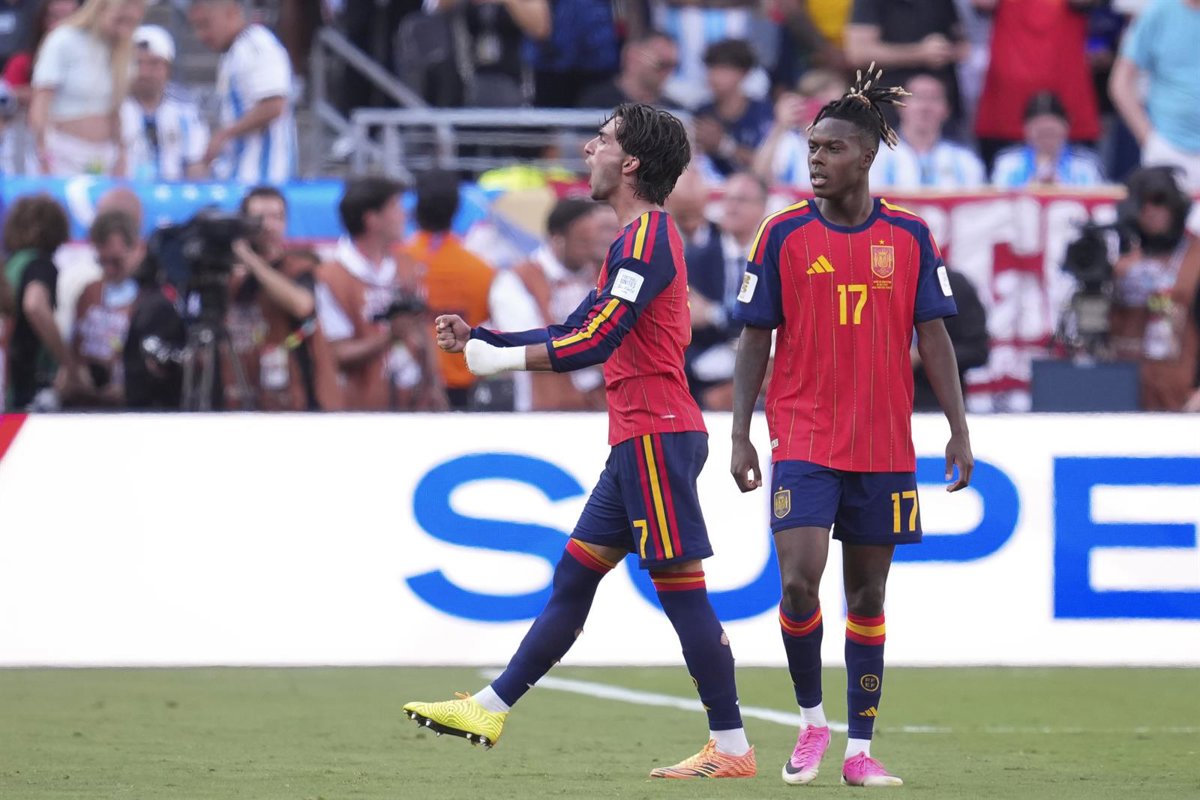
The Spanish team was proclaimed world champion last Sunday after beating Argentina in the final played at the MetLife Stadium in New Jersey, a success that the team led by Luis de la Fuente achieved based on a choral game, in which the majority of players in the group have been decisive throughout the tournament.
For the first time in World Cup history, FIFA allowed selectors lists of 26 players. A number that gave them more alternatives to configure the teams, making it possible to bring specific players for certain contexts. And in that, Spain would be one of the great beneficiaries, in part due to the large amount of talent on the payroll that De la Fuente had at his disposal.
Of the 26, the coach gave 22 minutes in the tournament, with only the two substitute goalkeepers — David Raya and Joan Garcia — Alejandro Grimaldo and Víctor Muñoz remaining without participating, the latter, in part, due to an injury. Thus, 85% of the players had minutes, a more relevant milestone if one takes into account that Spain did not play a match in the tournament with nothing at stake.
But beyond the quantity, there is the quality of the minutes. Of the 26 players, 15 have started at least one game in the tournament. Furthermore, of those who have had minutes, only Yeremi Pino, Gavi, Martin Zubimendi, Eric García, Borja Iglesias and Marc Pubill have not exceeded 100 minutes on the pitch, while Unai Simón, Pau Cubarsí and Marc Cucurella are the only ones who have played all the minutes.
In terms of goals, up to 12 internationals have participated in the goals that the Spanish team has achieved throughout the World Cup (14), with seven different scorers and nine assistants. A fact that means that more than 50% of the ‘Roja’ field players have had an impact on the goal.
Special mention deserves the ability to change important matches that the substitutes have had in the tournament. The most notable case has been that of Mikel Merino, key in the round of 16 and quarterfinals. The Navarrese needed just nine minutes on the pitch to score two goals that qualified the world champion. Furthermore, in the duel against Portugal the assist would be from Ferran Torres, who also entered the duel from the bench.
But if one goal will be remembered in the retina of Spanish fans in the World Cup in the United States, Mexico and Canada, it will be the one for the title. A bit failed by two players who had entered the final from the bench: Nico Williams and Ferran Torres. The Athletic winger, whose goal had been disallowed by Vincic a few minutes earlier due to a more than dubious foul, left a perfect ball with his head for Ferran to score what he baptized as “the goal of 47 million Spaniards.”
Spain closed the World Cup and won the title with the reflection of what it had preached throughout the competition: the importance of the team. Thus, the second star embroidered on the shirt of the Spanish men’s team will go down in history as that of the collective, demonstrating that in football, the strength of the group is capable of defeating the best individuals.