The Council of Ministers approved this Tuesday, at the proposal of the Ministry of Labor and Social Economy, the Royal Decree that regulates the special employment relationship of artists of the performing, audiovisual and musical artsas well as technical and auxiliary personnel, a rule that seeks to modernize the sector’s labor framework and incorporate new protection measures against harassment, regulates for the first time in detail the work of minors under 16 years of age and aims to strengthen intellectual property rights and remuneration transparency.
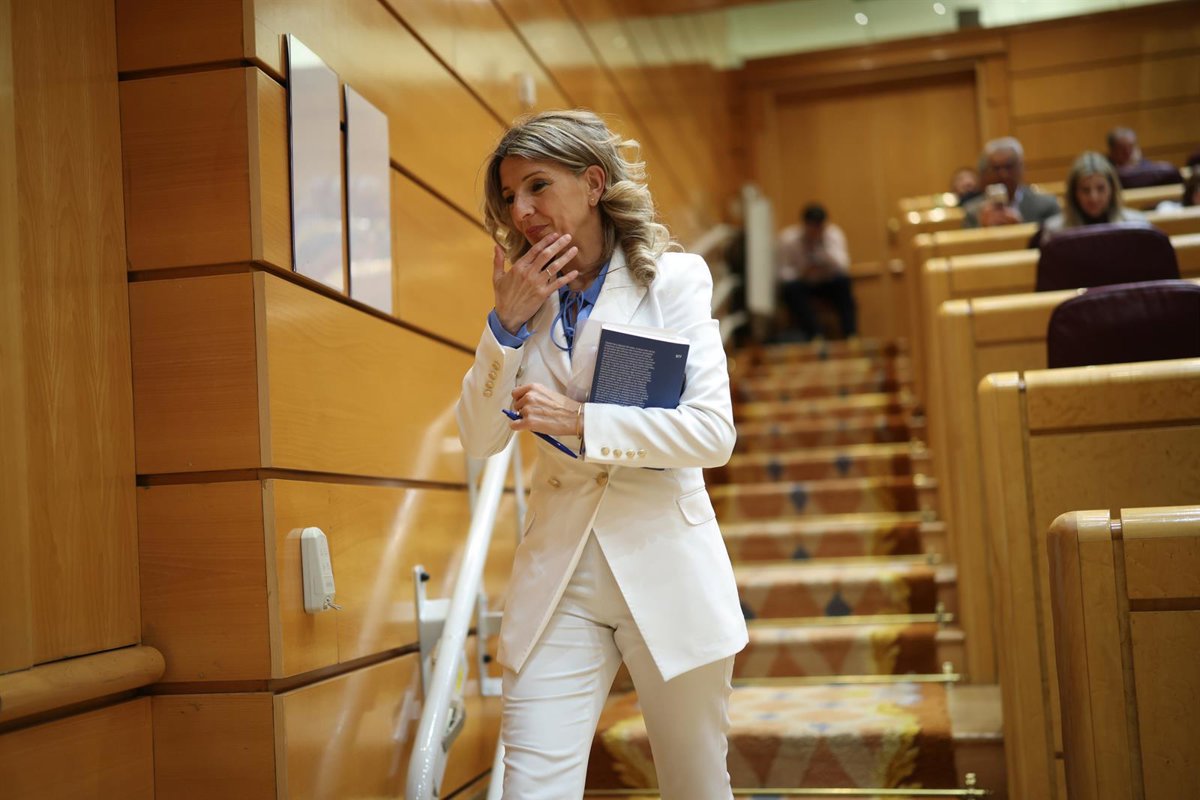
This was announced at the press conference after the Council of Ministers by the second vice president and Minister of Labor, Yolanda Diazwho has assured that the text represents “the great labor reform of people of culture” and replaces a “old” regulation from 1985 with references to the “old regulations and ordinances of Franco’s regime”.
“We change the Franco concept public spectacle and we adapt it to the 21st century. Streaming or YouTube is regulated. It is a norm that not only embraces cultural elitesbut it horizontalizes the work of culture in an extensive sense,” said Díaz.
The minister has assured that the RD will benefit 771,000 people -“3.6% of employment in Spain”- and highlighted that the standard has been negotiated for more than a year with unions, businessmen and some 80 entities in the cultural field.
Among the main novelties, the new text establishes the obligation to adapt the violence prevention protocols and harassment due to the intermittency and short duration of regular contracts in the sector and requires companies to designate a person privacy coordinator when intimate or sexual scenes are filmed or represented to guarantee consent and prevent harassment situations. In the event that they participate minors, This figure must ensure reinforced for your protection.
On this issue, Yolanda Díaz has stated that the new regulation puts end to situations like those reported years after the filming of ‘He last tango in paris’ and has defended that, from now on, “by law in Spain there must be a coordinator” in recordings or performances with intimate or sexual content.
ARTISTIC WORK BY MINORS
Likewise, the decree regulates for the first time in detail the artistic work of the minors under 16 years of age, establishing a single regime for the entire national territory. The rule establishes that the only work permitted for these minors will be as an employeeprior administrative authorization, putting an end to the possibility of developing these activities in the private or family sphere.
“If I were to talk to you about a minor under 16 years of age who work without a contract, without salaries or without regulated pricein a factory or in a workplace under these conditions, you would reject it, because you would automatically say that this is child exploitation. Well, this is over in Spain in the world of culture. Every day everyone sees advertisements featuring babies, boys, girls, and we are seeing a lot of advertising on social networks with many minors and they are watching many television series and many movies in which the protagonists are babies or minors. This is regulated exhaustively under the principle of guardianship of the minor for the first time“he explained.
The text also specifies the day and rest limits depending on age, including specific rules for young people aged 16 and 17 regarding night work, and includes a catalog of rights aimed at guaranteeing their personal, educational, social and professional development. Furthermore, it unifies the authorization procedure for actions in several autonomous communities, with the aim of streamline procedures.
“SELF-EMPLOYMENT WITH MINORS IS OVER”
“It’s over in Spain self-employment with minors. Those alleged minors on Instagram that were very controversial, exploited by their family because they gave a lot of money. This is not going to be allowed in our country, there has to be an employment relationship and, therefore, there must be a company that is responsible for this. employment relationship”, has revealed.
In terms of rights, the royal decree regulates the intellectual property protectionthe image and digital rights of the artists. Thus, it requires expressly differentiating in the payrolls the amounts received for the transfer of intellectual property rights when they are not subject to collective management and allows collective agreements to establish additional guarantees on data protection and digital rights.
The standard also pursues reinforce salary transparencyby requiring that the different remuneration, salary and non-salary concepts, appear individually. In addition, it allows vacations not taken in short-term contracts to be prorated and clarifies which periods must be counted as effective work time, including pre-production, post-production or promotion tasks.
In this sense, Díaz has highlighted that the reform recognizes as effective time of work activities such as rehearsals, script preparation or promotional actions, which until now generated conflicts in the sector, and has stressed that they must be computed for salary and contribution purposes.
Finally, the decree introduces the obligation to inform in writing and in advance of the work planstests and other activities to provide greater predictability to the execution of contracts. The Government is also committed to create technical commissions to study future training measures, professional requalification and representativeness of workers in the sector.
“LOST OPPORTUNITY” BY NOT INCLUDING GENERATIVE AI
After learning of this approval, the unions CCOO, UGT, UAA and CONARTE have shown their satisfaction about it since, as they have highlighted, “after 40 years, it will allow the current work framework to be adapted to the reality of sets, concert halls and theaters”, which is why “a key step has been taken for those they move the artistic sector forward in this country.
“This norm recognizes rights that unions have been negotiating and fighting for in collective agreements for years and that, through what is known as the ‘Statute of the Artist’become applicable to all people workers in the sector“, say the unions in a joint statement.
In any case, they regret that no limits have been set “for the use of artificial intelligence generative” when considering that “this technology puts the cultural sector before a existential riskbut, above all, it places working people in a clearly vulnerable position.
According to the unions, “an opportunity has been lost and this leaves any question about the uses of generative artificial intelligence in the hands of individual negotiation” so they say they will continue working “to achieve limits to these technologies with the tools available.”
“The law of the jungle is not an option and to avoid it we will continue defending clear and transparent protection models,” they say.