Five organizations related to Dragon Capital sold 2.5 million shares, thereby reducing their ownership ratio in PNJ to 4.55% and no longer being a major shareholder.
Dragon Capital investment fund today announced that 5 out of 8 related organizations have sold PNJ shares to reduce ownership from 25.8 million to 23.3 million shares. Among them, Vietnam Enterprise Investments Limited, an organization with total assets of nearly one billion USD, sold the most with nearly 1.4 million shares.
The divestment was carried out by Dragon Capital last weekend, when PNJ shares were at the price range of 41,000 VND. This level is down 35% compared to before the incident of the former Director of a subsidiary (P-Lab) involved in a smuggling ring of 28,000 diamonds was announced.
PNJ is still on a strong correction trend when closing today’s session at the floor price of 35,500 VND and the pending sale volume is more than 17.5 million shares. The market capitalization of the leading enterprise in the jewelry industry is only 18,200 billion VND, a loss of more than 14,000 billion VND since the incident occurred.
Before Dragon Capital, the investor group related to VinaCapital also sold more than 6 million shares to no longer be a major shareholder in PNJ. This means they do not need to announce purchase and sale transaction information in the near future if their ownership ratio does not exceed 5%.
At yesterday’s press conference, CEO Phan Quoc Cong said that before the incident happened, foreign investors always held a maximum of 49% ownership in PNJ – the ceiling of foreign “room”. Currently, most institutional shareholders continue to hold shares and there is no significant change in structure. As for VinaCapital, this group of funds sold only accounted for more than 1% of the total number of PNJ shares, so according to him, it did not cause major changes.
“Large funds still closely monitor and give strong support and trust to PNJ. They regularly encourage and contribute ideas to the company’s activities in recent times,” he added.
Despite the decline in stock price, PNJ CEO affirmed that the business foundation, people and systems of the enterprise have not fundamentally changed. He compared this difficult period to “fire tests gold, hardship tests diamonds” and believes that overcoming challenges will help affirm the company’s position and transparency, thereby strengthening the long-term trust of investors and consumers.
In a letter to shareholders and investors this afternoon, Mr. Cong continued to say that “the company’s business operations are still going on normally”, shown by this month’s jewelry retail revenue still increasing by nearly 20% compared to the same period last year.
Management said the highest priority today is to stabilize and maintain business continuity as well as preserve long-term corporate value. In particular, regulating liquidity through extending the payment schedule for buying back diamonds and gold is an essential solution.
“The current challenges do not reflect a decline in core business activities or the company’s medium and long-term financial capacity,” Mr. Cong wrote in the letter. He is also in the process of registering to buy one million PNJ shares.
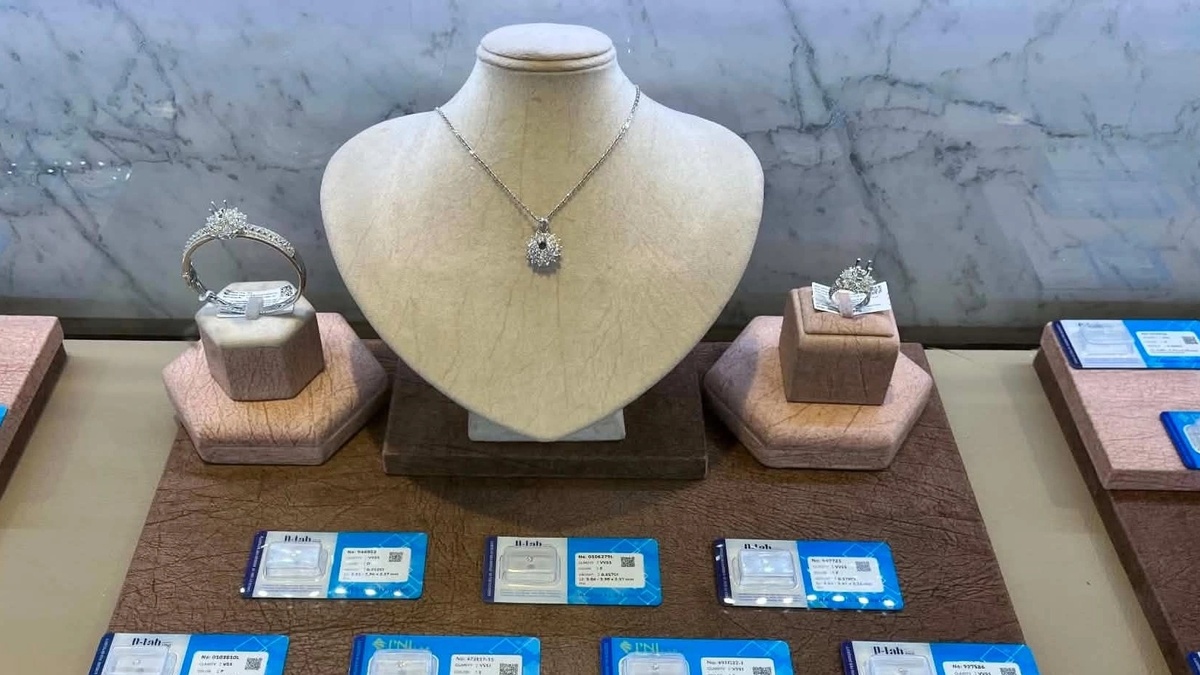
Some diamond products are displayed at the PNJ store in Ho Chi Minh City. Image: Quynh Trang
The strong correction caused many securities companies such as SSI, KIS, TCBS, FPTS, Phu Hung… to remove PNJ shares from their margin trading list. This means investors can only use cash to buy stocks.
Most securities companies believe that PNJ’s biggest challenge at this stage is restoring the trust of both customers and investors in corporate governance. In a report published in mid-July, Vietcap analysis group said that this incident could temporarily weaken consumer confidence in PNJ’s diamond-related products, leading to lower gross profit margins in the retail segment. PNJ’s profits will be under pressure in the second half of this year and next year.
“We expect these difficulties to gradually ease when consumer confidence recovers, helping profits recover in 2028 from a low base,” Vietcap analysis team wrote.