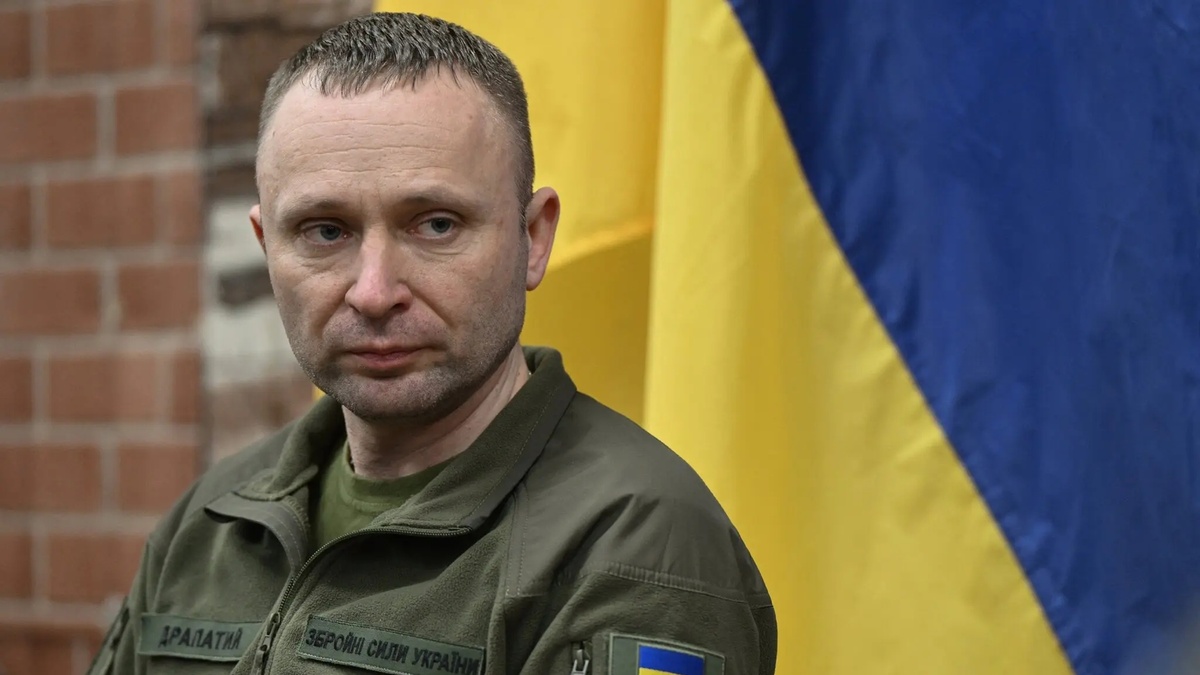
Appointed commander in chief of the army after a series of political turmoil, General Drapatyi must find solutions to a series of tough battlefield challenges.
On May 9, 2014, Major Mykhailo Drapatyi, commander of the 2nd battalion, 72nd Mechanized Brigade of the Ukrainian army, commanded a 13-ton armored vehicle to rush through the barricades of pro-Russian separatist forces in the city of Mariupol, Donetsk province.
The image of Major Drapatyi leading an armored convoy to reinforce the police station besieged by separatists in Mariupol quickly spread, turning this young commander into a symbol of Ukraine’s spirit of resistance.
The moment the armored convoy led by Drapatyi rushed through the barricade fence in Mariupol on May 9, 2014. Video: BS TV
Now, that officer has been promoted to major general, becoming commander-in-chief of the Ukrainian army in the midst of a tumultuous political and military transition, in a conflict that no one could have imagined a decade ago.
This is a war of attrition and high-tech competition, where survival depends on which side adapts faster and better integrates constantly improving equipment into the reality of fierce daily combat under skies dense with drones.
General Drapatyi, 43 years old, was appointed commander in chief of the Ukrainian army by President Volodymyr Zelensky on the evening of July 21, replacing General Oleksandr Syrsky, 60 years old. He represents the new generation of Ukrainian military commanders, who are said to be more sensitive to modern operational thinking.
Drapatyi is one of the key architects who built Ukraine’s “drone line”. Instead of relying on a trench system that requires infantry to constantly guard, Ukraine established a “kill zone” stretching right behind the front line, combining reconnaissance drones, attack drones and automatic combat robots, helping to significantly reduce the loss of soldiers’ lives.
The above tactic contributed to slowing down the advance of Russian forces, helping Ukraine regain the initiative in some areas on the front line for the first time in many years. It also rekindled hope for a country weary of war, with tens of thousands of soldiers killed.
Challenges pile up
Although the recent battlefield situation has seen positive developments for Ukraine, especially long-range raids on Crimea and deep inside Russian territory, analysts warn that Kiev needs to ensure a smooth transition of power within the military command to maintain its advantage.
The challenges were compounded by the circumstances that led to General Syrskyi’s dismissal. Ukraine has been in turmoil since President Zelensky fired popular Defense Minister Mykhailo Fedorov last week. Mr. Fedorov, 35 years old, once disagreed with General Syrsky about combat strategy, including the level of reliance on drones and robots.
Thousands of protesters took to the streets to protest President Zelensky’s siding with General Syrsky. Over the course of six days, the crowd switched from demanding Mr. Fedorov’s reinstatement to demanding Mr. Syrsky’s dismissal. On the evening of July 21, Mr. Zelensky accepted that wish when he replaced General Syrsky with General Drapatyi, who supported Mr. Fedorov because he had the same modern warfare mindset.
“The current danger is that the change in command will create a period of instability while the new leaders are still getting used to it and Russian forces can take advantage of that,” commented Mick Ryan, a former Australian army general, currently working at the Lowy Research Institute, based in Sydney.
“The first challenge with the new command apparatus is to ensure that the reform does not slow down the pace of combat both on the front line and deep offensive campaigns on Russian territory or the innovation momentum of the Ukrainian army,” he added.
Major General Mykhailo Drapatyi in an interview last year. Image: AFP
General Drapatyi also has to resolve inadequacies in Ukraine’s military recruitment system, and at the same time prepare to respond to the risk of Russia deploying a new troop mobilization.
In addition, he also has to protect Ukraine’s energy network against the upcoming winter raid campaign from Russia, while also blocking Moscow’s advance in the remaining cities in the Donbass region, eastern Ukraine.
President Zelensky’s decision to dismiss Minister Fedorov also exposed the rift in Ukraine’s leadership over war management, a problem that the new command will have to find a way to solve.
It is unclear what role Mr. Fedorov will take on in the future, but President Zelensky has proposed assigning him other positions in the government apparatus. However, Fedorov insisted that he only wanted to return to the position of Defense Minister to complete unfinished reforms.
As for General Drapatyi, dealing with the Presidential Office requires skillful calculations and balance. He will have to compromise between maintaining the operational autonomy that reform forces aim for and adapting to President Zelensky’s habit of direct direction, Taras Chmut, a famous military analyst in Kiev, commented.
General Syrsky’s willingness to follow instructions often makes him an easy partner for President Zelensky to work with. But on the contrary, General Drapatyi came to power with support from the reformists, who demanded the removal of the imposed and rigid top-down command style.
“The difficulty will be much greater than what he imagines,” Valerii Zaluzhnyi, the former commander in chief of the Ukrainian army who was dismissed by Mr. Zelensky in 2024 after the two sides disagreed on troop mobilization and counter-offensive strategy, commented on the challenges that General Drapatyi may face.
According to Chmut, the real war in Kiev lies in the defense procurement stage: what Ukraine will buy for the army with its own budget and aid from partners and which large defense corporations will lose revenue from this reform. General Drapatyi will hardly interfere deeply in those decisions, as well as in the efforts that Mr. Fedorov has initiated to fight corruption and promote the procurement of modern weapons.
Soldiers of the 148 Zhytomyr Independent Artillery Brigade of the Ukrainian army fired CAESAR self-propelled guns in Dnipropetrovsk province in June. Photo: AFP
Hope
Liudmyla Buimister, an independent parliamentarian who used to be the commander of Ukraine’s special forces, hopes that General Drapatyi will change the way of thinking at the command post, ending the excessive interference of politicians in decisions on the battlefield and helping military deployment become more methodical and unified.
General Drapatyi is expected to continue promoting many of the technological initiatives that Fedorov once pursued.
Jack Watling, an analyst at the British Royal Defense Research Institute (RUSI) in London, said that the change of general could pave the way for Mr. Fedorov’s proposal to use data to improve combat effectiveness for the army to become a reality.
General Drapatyi is also expected to empower subordinate commanders to proactively make decisions based on the actual situation on the battlefield. Under General Syrsky, junior officers were often dissatisfied because their commanders interfered too much. They can only change combat tactics or withdraw troops from dangerous positions after the General Staff gives the nod.
In the context of the lack of troops, General Drapatyi, like Mr. Fedorov, believes that the main cause lies in the cumbersome apparatus, poor training and corruption, not the lack of people. Ukraine hopes that a new breeze at the supreme command will revive public morale, causing more people to voluntarily join the army.
“We have begun to see the morale of both soldiers and people improve,” Buimister said.
“Everyone was extremely excited, creating an indescribable source of spiritual motivation,” said Sergeant Andrii Klymenko, 45 years old, who is fighting on the southern front of Ukraine. “That spirit of excitement comes from the belief that the old ‘meat grinder’ style of leadership has been replaced by a true combat leadership style.”