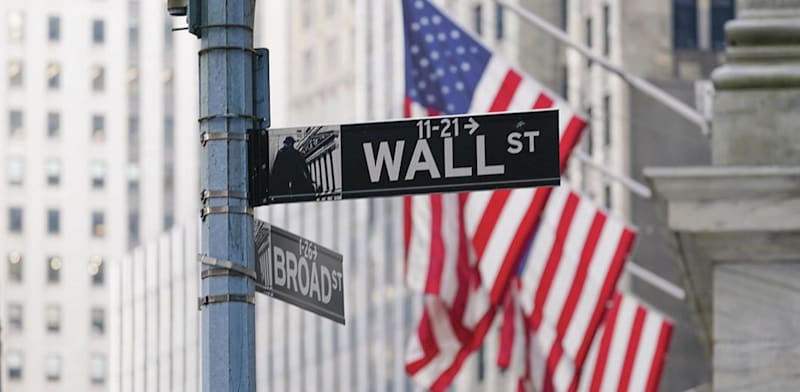
Trade review: current reports, trends, indices, stock prices, bonds, foreign exchange and commodities and analyst recommendations
15:30
In the stock markets of the world, a mixed picture emerges today – the Asian stock markets closed in declines, South Korea stood out there, which fell by over 5%. In Europe there is a positive trend.
Wall Street futures are trading slightly higher after yesterday’s sharp declines, against the backdrop of Brent oil prices falling back below $100 per barrel and some weakening in US government bond yields. Today there is a drop in the price of oil.
Contracts on the S&P 500 index are up about 0.2%, but the index is still on track to record a second consecutive week of declines – for the first time since the start of the escalation in the Middle East.
In early trade, Intel Soaring following a stronger than expected revenue forecast, while most chip stocks are trading lower. Alphabet and Tesla shares are correcting slightly upwards after the sharp realizations recorded in them yesterday.
At the same time, the price of gold is climbing moderately and the dollar is weakening by about 0.1%.
Yesterday was a red day:
The S&P 500 index fell by about 1.4% and the Nasdaq index shed 2%, within the S&P 500 the media stocks sector stood out negatively (XLC ) which contains the shares of Google, Meta and Netflix, and the cyclical consumption sector (XLY ). technology stocks (XLK ) also went down.
The sharp increase in oil prices, against the background of the escalation of the war with Iran, weighed on the markets and led to declines in stocks and bonds. The price of Brent oil crossed the $100 per barrel mark, which increased fears of the renewal of inflationary pressures and pushed US government bond yields to their highest level this year.
The question of whether Trump’s trade war is returning is also back. Tonight it was reported that the USA will impose tariffs of 10%-12.5% on imports from most of its major trading partners. The new tariffs follow an investigation that determined that approximately 60 countries did not take sufficient steps to prevent the use of forced labor in their supply chains, in a way that, according to the administration, harms American workers.
Countries found to have adopted restrictions on forced labor – including Mexico, the UK, Canada and India – will be subject to a 10% tariff on exports to the US.
The “Fabulous Seven” group recorded their sharpest day of declines since the April 2025 tariff shake-up, after reports Alphabetical (Google) andTesla Rekindled doubts about the ability of the giant’s investments in artificial intelligence to continue justifying the gains in technology stocks.
The basket fund Roundhill Magnificent Seven ETF which tracks the performance of the seven technology giants, fell by more than 4%. The Magnificent Seven – Alphabet, Amazon, Apple, Meta, Microsoft, Nvidia and Tesla – deleted, according to the Wall Street Journal, about 800 billion dollars from their market value.
Alphabetical (Google) lost about 6.5% despite posting strong results, after raising its capital expenditure forecast, andTesla Dropped by about 14% following disappointing profits.
shares of the security giants Lockheed Martin and-RTX Soared after both companies reported an exceptionally large order backlog, reflecting growing demand for weapons systems and military equipment.
Intel reported tonight (Thursday) revenues of 16.1 billion dollars, this compared to the expectations of analysts on Wall Street which stood at 14.4 billion dollars and the highest jump in almost 15 years. In addition, it provided a stronger than expected revenue forecast for the third quarter.
US government bond yields are at their highest in about a year and a half, amid the surge in oil prices following the escalation in the Middle East, which increases the fear of renewed inflationary pressures.
The 10-year bond yield, which serves as the main benchmark for funding costs in the US, rose by 5 basis points to 4.7%, after during trading it touched its highest level since January 2025. The two-year bond yield, which is more sensitive to expectations regarding the Federal Reserve’s interest rate policy, also rose to 4.343%, while the 30-year bond yield climbed to 5.188%.
The increase in yields reflects investors’ fear that the rise in oil prices could revive inflation and postpone the possibility of interest rate cuts by the Fed.
Yesterday, the European Central Bank (ECB) as expected left the interest rate unchanged in its decision for the month of July. Following the decision, the interest rate on deposits – considered the main interest rate in the Eurozone – remained at 2.25%, while the interest rate on the main financing operations remained at 2.4% and the interest rate on the marginal lending framework remained at 2.65%.
The decision was in line with market expectations and signals that the bank continues to wait for additional data on inflation and growth before deciding whether further tightening of monetary policy is necessary.
Next Wednesday, the Fed’s interest rate decision will be published, after in the previous decision, the new chairman, Kevin Warsh, left the interest rate at 3.75%. Leader Capital Markets economists and Jonathan Katz estimated this week that “moderation in inflation in the US lowers the likelihood of an interest rate increase soon”, this after the inflation rate dropped to 3.5% in June. Additional interest rate decisions to be published next week are those of the central banks in England and Japan.
For your attention: The Globes system strives for a diverse, relevant and respectful discourse in accordance with the code of ethics that appears in the trust report according to which we operate. Expressions of violence, racism, incitement or any other inappropriate discourse are filtered out automatically and will not be published on the site.
People Who Get It Are Easier to Find Online Than in Real Life
What Is Considered A Long-Distance Relationship? 9 Key Facts
10 Easy Ways To Reduce Waste In Your Everyday Life
Choosing the Right Contractor: Red Flags and Smart Questions – Enthralling Gumption
Comment créer des connexions fortes en ligne et les consolider dans la vie réelle
Voyager en Europe hors des sentiers battus : nos idées pour des souvenirs mémorables
Digital Equilibrium: How Game Studios Use Telemetry to Balance Gameplay
Are Energy Drinks Helping Performance or Just Masking Fatigue and Bad Sleep
Top 12 Bookmarks for a Trader to Have
From Red Days to Real Gains: My Two-Year Path as a Day Trader – Coinranking Blog
313068
zelenstore
France-IOI – Personal page: zelenstore
Zelen Store – watch faces for Apple Watch, WearOS, Galaxy Watch, Pixel Watch, Huawei Watch, and more – Facer
Zelenstore Anime-Profil
Making sure you're not a bot!
Zelen Store
Zelen Store – dasauge®
@Zelenstore 5136985
Activity
Andrii Stankin · GitLab
Zalen Store
Zelen Store
266366
263Dea33 3Ee4 4991 A595 7148321B98D7