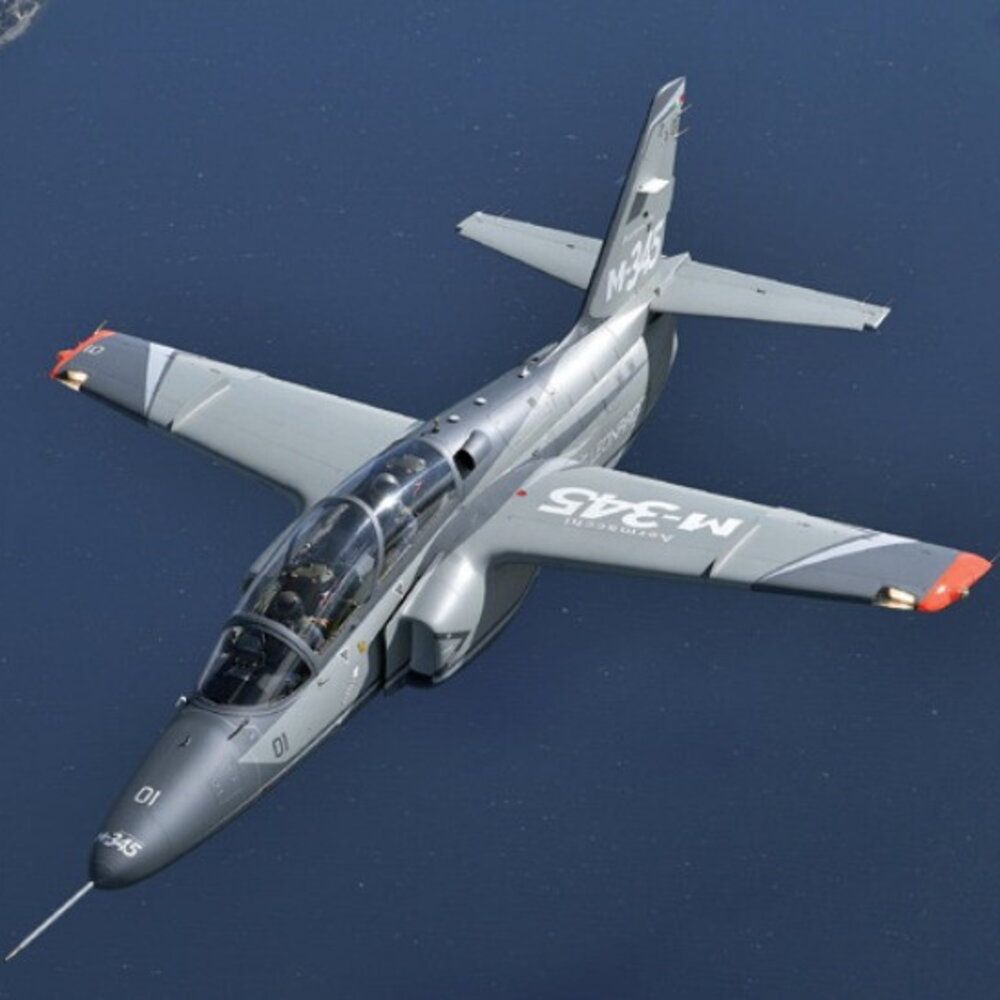
Leonardo presented the innovations and advantages brought by the M-345 at the Farnborough Air Show, jet aircraft for basic and advanced military training. The aircraft is at the center of an integrated training system that includes ground simulators and Live-Virtual-Constructive technologies, capable of recreating complex tactical scenarios for pilot preparation.
The advantages of the new jet aircraft
“The first is that it is designed to be very easy to maintain and fly. It is equipped with direct controls and is therefore deliberately without a fly-by-wire system, precisely because the aircraft must remain light and be able to take off again a few minutes after a landing, thus generating a large volume of hours”, he underlines to AGI Giacomo Iannelli, Head of Trainers Project Test Pilot Aeronautics Division di Leonardo. “The other big advantage – he adds – is the economy in using the aircraft. By producing oxygen autonomously, it eliminates the need for cylinders or external systems for refueling the pilot. This also makes it very ‘redeployable’, it can go out without the need for any support”.
Not to be underestimated, Iannelli explains to AGI, is the issue of consumption. “With a full tank of 700 kilos of fuel – an amount that for a pilot represents almost an emergency level – the M-345 completes practically an entire flight mission. The savings data reported by the Air Force are impressive“. The innovations brought by Leonardo’s simulators also fit into this context.
Simulated flight scenarios
“Unlike the past, when it was necessary to accumulate many hours of flight to become familiar with the airplane, the current systems are so realistic that minimize the actual missions needed for a student. Linked to this is a further advantage: thanks to on-board equipment such as GPS navigation (the so-called PBN, Performance Based Navigation), in a few hours of flight the student is exposed to scenarios that he would usually only face on the final aircraft. The pilot therefore arrives ready, knowing how to manage procedures required for fighters such as the Eurofighter and the F35 or for transport aircraft. Once on board, therefore, “he will naturally have to adapt the information at his disposal to the specifications of the new aircraft”.
The data and input received by the student also increases in a shorter time. “The on-board simulation allows you to recreate a real tactical situation, managed by artificial intelligence and specific programming. Previous generations of pilots needed real planes in the air for this type of training because there was nothing like it, whereas today students train to the same level through simulated scenarios. Thus they arrive at the operational departments with the right skills already acquired and guaranteeing, in the meantime, considerable economic savings”, concludes Iannelli.