HCMCA 4-year-old boy with acute liver failure and blood clotting disorder after being given paracetamol to reduce fever by his family many times about 3 hours apart, was saved thanks to plasma exchange with continuous dialysis.
On July 31, Doctor CK2 Nguyen Minh Tien, Deputy Director of the City Children’s Hospital, said the boy weighed 17 kg, living in Tay Ninh, three days of continuous fever with abdominal pain, vomiting, and no diarrhea. The family bought their own medicine for the baby, including paracetamol 325 mg, taken about every three hours. The total dose of paracetamol the child used was about 210 mg/kg.
When admitted to the City Children’s Hospital, the child was lethargic, drowsy, and blood oxygen saturation decreased. Yellow skin and conjunctiva of eyes. Tests showed that liver enzymes increased more than 50-70 times the normal level, with blood clotting disorders and increased blood ammonia.
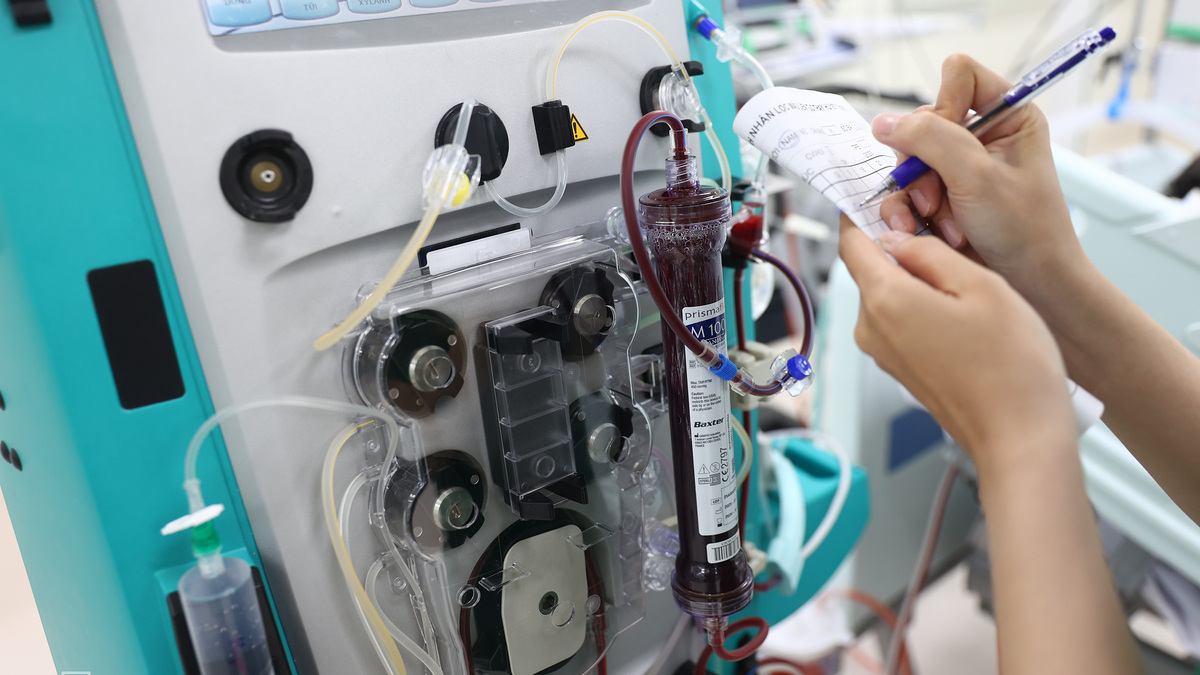
Doctors diagnosed the child with paracetamol poisoning, acute liver failure, and monitored sepsis. The baby received mechanical ventilation, supportive treatment and liver detoxification medication. Due to severe liver failure, the child received plasma exchange combined with three rounds of continuous dialysis.
Plasma exchange is a technique of taking blood out of the body, removing the patient’s plasma and replacing it with new plasma, helping to support the removal of abnormal substances in the blood and improving blood clotting disorders. After more than two weeks of treatment, the condition gradually improved, liver function tests returned to normal, the child was weaned off the ventilator and breathed fresh air on his own.
Dialysis of blood for patients. Photo: Quynh Tran
According to Dr. Tien, paracetamol is a fever-reducing drug commonly used for children, but it needs to be used in the right dose and at the right distance. Taking an overdose or too many times in a short period of time can cause poisoning, liver damage, and acute liver failure.
For children, the dose of paracetamol is usually calculated based on weight, about 10-15 mg/kg each time, repeated after 4-6 hours as needed. The total dose should not exceed 60 mg/kg per day. Parents should not arbitrarily increase the dose or shorten the interval between doses because the child still has a fever.
When the child has a fever, it is necessary for the child to wear loose clothes, drink enough water and monitor the temperature. If a child’s fever lasts for more than 24-48 hours, it is necessary to take the child to a medical facility to determine the cause and receive appropriate treatment, instead of buying medicine at home.
Especially, when it is suspected that the child has taken an overdose of paracetamol or many times in a row, it is necessary to take the child to a medical facility early, even if there are no obvious abnormalities. Paracetamol poisoning can cause serious liver damage before symptoms become apparent.
The structural design of heavy-duty interactive entertainment platforms
Can you assist me in navigating the notice game in terms of early retirement? | Fairygodboss
Viewtopic.Php
Las batallas que las Fintech le están ganando a la banca mundial
Fault-Tolerant Microservices Design for Global iGaming Operations – Huayra
Group.Php
Are.na
Tommeder
https://www.sololearn.com/en/Discuss/2783986/solved-calculating-wins
paizo.com – Paizo People: Relondoewf244
NoahHarrington | Profit.ly
BandLab – Make Music Online
Sidhupdjagrut
Mecabricks.com | Modello senza titolo
Play on PC and Android | Throne Forum
Que faire comme plat unique facile pour 10 personnes
Profile – Hanson
Asynchronous State Synchronization In Enterprise Igaming Backends Ac6D8Fb76550
Low Latency Event Sourcing In Scalable Igaming Infrastructure
Forum
WP Tavern
nolaer
Vacehap596
John Benderon – Watch Faces for Apple Watch, Apple Watch Ultra, Wear OS, Galaxy Watch, Pixel Watch, and more | Facer
Suzann | POTOFU | POTOFU