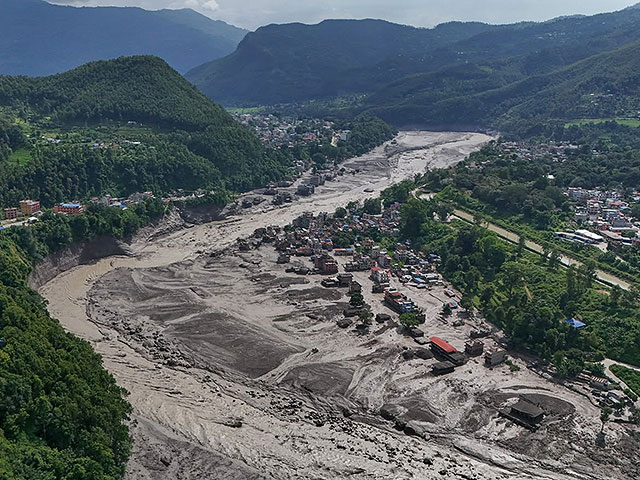
After devastating floods in Nepal’s Rasuwa district, on the border with the Tibet Autonomous Region of China, 384 tourists and travelers are missing, including 291 foreigners and 93 Nepalese citizens. These preliminary data were published by the Nepal Tourism Board. Authorities emphasize that the list was compiled based on information from travel companies and is currently being verified.
The foreigners include at least 105 Indian citizens, 12 British citizens, four South African citizens, three US citizens, 17 Malaysian citizens, as well as citizens of Australia and the Netherlands. The nationality of many missing people is being established. In addition, 37 non-resident Indians appear on the lists.
Nepalese law enforcement agencies report 16 deaths. But, most likely, the number of victims will increase significantly.
The flood occurred on the morning of August 26 on the Bhote Koshi River. The flow of water came from Tibet and hit the Timure, Rasuwagadhi and Syabrubesi regions particularly hard. Residential buildings, markets, roads, bridges, police posts and hydroelectric power facilities were destroyed; Communications and power supplies have been disrupted in a number of areas.
Nepalese security forces serving in the border area are also reported missing. The army, police and aviation are involved in the search and rescue operation; Nepal turned to India and China for help.
The reason for the sudden rise in water has not been fully established. It was initially thought that the flow came from a glacial lake outburst or landslide on the Tibetan side. However, experts from the International Center for Integrated Mountain Development consider the most likely cause to be an ice-rock avalanche that blocked the Bhote Koshi tributary, after which the natural dam broke.
The Nepal Tourism Board asks relatives not to consider the preliminary list as confirmation of the death or disappearance of people: some tourists may simply be without communication due to the destruction of infrastructure.
– Kawthar Learning Courses
Activity – Wiggins Eason – Records Of Racial Slurs
Porte blindée ou renforcement de porte : quelle solution choisir — SerrurierParis
Quels signes indiquent qu’une serrure doit être remplacée
View As Owner
Beylikduzu Escort | Esenyurt Escort | İstanbul Escort
oiaedu.com
Social Security Disability Attorney in Grand Blanc, MI | SSDI | ANDRUS LAW FIRM, PLC
Activity – Davis Locklear – ChessGuide.com
certified stem cell clinic
Activity – Gentry Balling – PBMA
Understanding the Role of Construction Finance Advisory Services in Today's Market
smiledahlia91
Startup Tax Planning: Navigating the Financial Landscape for New Businesses
Hausvergleich
Youtube Icon
Activity – dugoutback16 – DL
Team App | News | Regen Med Expert | News | How to Recognize Misleading Stem Cell Treatment Claims
nosehat4
Unlocking Growth: The Rise of SaaS CFO Services
How to Program the Perfect 5-Day Singapore Plan?
Serrurier Paris | GetListedUAE
Activity – McLain Abrams – ChessGuide.com
Disqus Profile – disqus_Rc96o1OKuo
primary