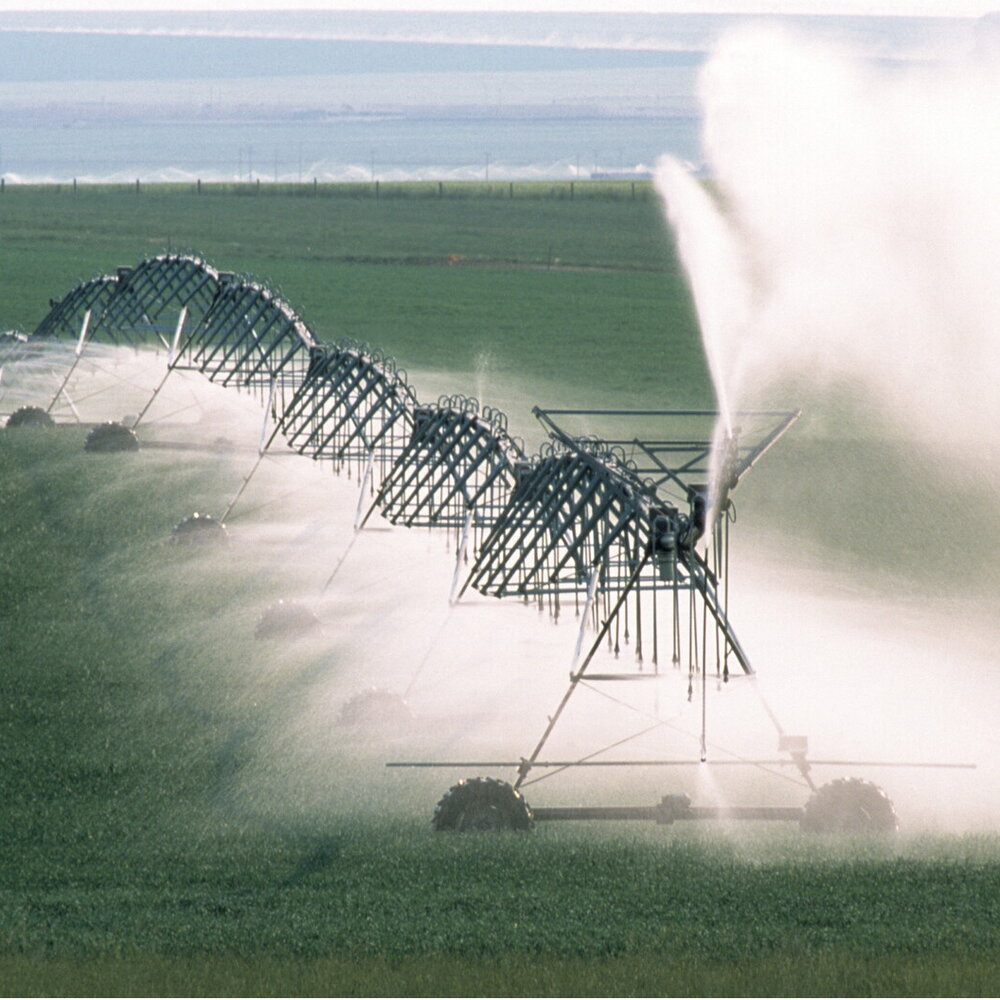
Human activities have significantly changed Earth’s water reserves in at least 40 areas of the planet and freshwater losses attributed to humans could be 33% higher compared to previous estimates.
By reanalyzing satellite measurements of Earth’s gravity collected between 2002 and 2025 with a technique capable of increasing their spatial resolution, Mary Michael O’Neill, Matthew Rodell and Bryant D. Loomis, of NASA Goddard Space Flight Center, have 40 hotspots identified in which changes in water reserves are associated with activities such as groundwater exploitation, irrigation, building and filling reservoirs, deforestation and rain-fed agriculture.
Water loss in the monitored hotspots
In the 40 hotspots, net losses reached overall during the analyzed period 3,122 gigatons of waterexceeding the 2,432 gigatons of increase in reserves. The findings, published in the Proceedings of the National Academy of Sciences, PNAS, also indicate that groundwater depletion associated with agriculture may be more severe than previously estimated.
Measuring the amount of water stored on land is possible by observing very small variations in the Earth’s gravitational field. When a region loses or stores large amounts of water the distribution of mass also changes and this change can be detected by satellites. Satellite gravity measurements have provided important information about water movements through the global hydrologic cycle, but their spatial resolution has historically made it difficult to discern trends attributable to human activities.
I have been studying it for the last 23 years
The overall balance of the 40 hotspots shows a prevalence of losses. In the period considered – between 2002 and 2025 – 3,122 gigatons of net loss of water reserves were estimated, against 2,432 gigatons of net increase. The analysis also leads to an upward revision of the extent of fresh water losses associated with human activities: according to the researchers they would be 33% higher than previous estimates. One of the most relevant results concerns groundwater. The new reconstruction suggests that the depletion of aquifers linked to agriculture is more serious than indicated by previous assessments. However, the human impact does not manifest itself exclusively through a decrease in reserves. The increased resolution of the analysis also made it possible to identify localized increases in the amount of stored water, associated with rainfall-fed agriculture, surface water irrigation and the filling of artificial reservoirs.
The picture that emerges is therefore geographically differentiated: some activities remove large quantities of water from terrestrial reserves, while others can lead to local accumulation. The common element is the possibility of distinguishing more precisely the imprint of human activities within the variations recorded by satellites. According to the authors, these activities explain a significant part of the main trends observed in water reserves on five continents. The result also shows how the global availability of fresh water cannot be rebuilt considering only climatic and natural variations.
The main causes of water loss
Irrigation, groundwater withdrawal, transformation of vegetation and construction of water infrastructure can produce changes large enough to be recognizable in satellite measurements of water mass. The greater ability to localize these signals also allows us to distinguish phenomena that in previous reconstructions could have been overlapping or difficult to attribute. In particular, the analysis of agricultural areas suggests that the withdrawal of groundwater necessary for irrigation represents a more important component of global losses than previously quantified. However, the study it does not indicate a uniform decrease in water resources across the planet. The results concern specific hotspots and include both areas in which reserves are decreasing and areas in which they are increasing. However, the balance of the 40 hotspots remains negative: the 3,122 gigatons of losses exceed by 690 gigatons the 2,432 gigatons of increase recorded in the same period. The new methodology, according to the authors, offers a tool to better separate the anthropic components from other variations in the water cycle and to identify the regions in which the use of resources is producing the most marked changes.
Poser – 3D Rendering & Animation Software
iu1vrvc3hp | B31 Voices
iiu1vrvc3hp
The Yeshiva World
Backloggery
1752640
⇪ pinboard-pinboard-profile
Men onlayn kazino tanlashda avvalo platformaning qanchalik qulay va tushunarli…
Profile
Vil7V8Vodobltiwd Com
BrickLink About Me Pages – About briannap
Taylor Strecker Show & Kenny Zimlingshow Fans » pin up uz casino
pin up casino
WP Tavern
Lkcutf Cutf's | Portfolium
lkcutf40030b | Vocal
Poser – 3D Rendering & Animation Software
lkcutf40030b
Lkcutf40030B
casino PhSky online | carlostucker | Cal.com
Bio
paizo.com – Paizo People: lu4gyxun6s
play PhSky casino online
my-dynamite-site-f8c04c.webflow.io
nphljrs2120b
nphljrs2120b#145739 user profile
Bio
Mockplus | Online design collaboration tool & hand-off design
Mlwcvv Lwcvv's | Portfolium
Find A Spring – Members