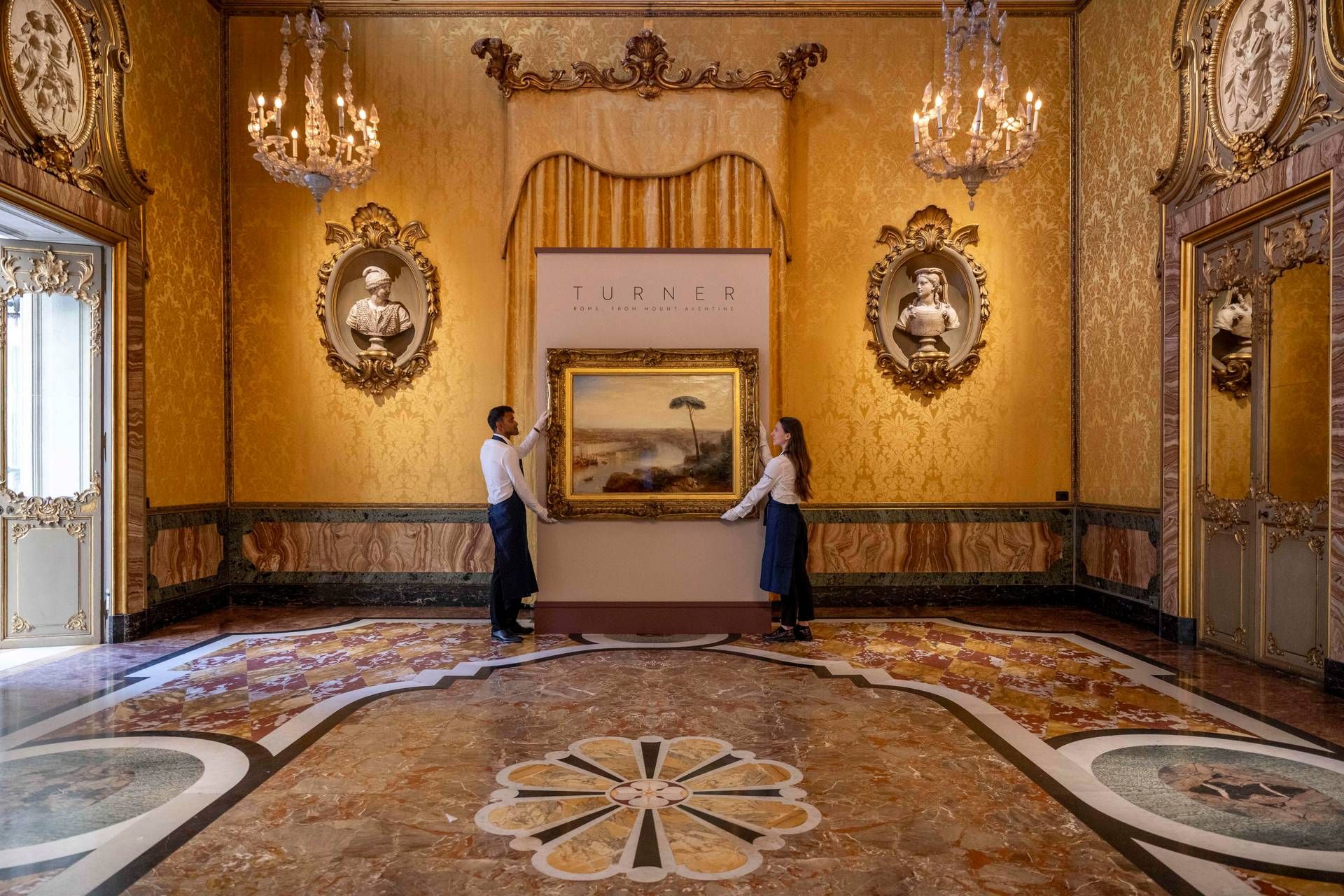
A masterpiece by the English painter Joseph Mallord William Turner (1775.1851), one of the greatest exponents of Romanticism, returns to Rome, almost two centuries after being conceived right on the banks of the Tiber. It is “Rome, from Mount Aventine”, a painting from 1836 and among the most famous works of the artist’s maturity, which Sotheby’s is exhibiting from today to 1 October in the baroque rooms of Palazzo Rondinini. With an estimate in the order of 50 million pounds (about 58 million euros), the painting will then be offered on 9 December in London and could set a new auction record for Turner, twelve years after that already set by the same work, sold at the time for 30.3 million pounds.
For three days, therefore, Rome returns to be the backdrop to one of its most famous representations in the history of art. The exhibition also takes on particular importance due to the economic value of the painting: according to Sotheby’s, it is the most valuable work of art ever exhibited in Italy by an auction house. But above all it is the return to the Eternal City of a canvas born from its own light, its landscape and its history that gives the event an almost circular meaning. Turner in fact conceived “Rome, from Mount Aventine” starting from the studies carried out during his second stay in Rome, between 1828 and 1829. The composition would be defined and transferred to the canvas in Italy, before the artist completed it in London some time later. Today, almost 190 years later, the work returns to the place that inspired its creation.
The history of the canvas is also out of the ordinary. It was commissioned by Hugh Andrew Johnstone Munro of Novar, Turner’s great friend, collector and patron, as well as an amateur artist. Munro accompanied the painter on several trips dedicated to drawing and studying from life and would later become one of his executors. After Munro’s death, “Rome, from Mount Aventine” entered the orbit of one of the most important families of the British aristocracy. In 1878 it was purchased by Archibald Primrose, 5th Earl of Rosebery and future Prime Minister of the United Kingdom, who chose it as a wedding gift for Hannah de Rothschild, heiress and at the time considered the richest woman in the country. At the sale of the Munro collection, Rosebery paid £6,142: a figure significantly higher than that achieved by the other paintings at the same auction. Since then the path of the canvas has remained unusually linear. The painting changed owners only once, remaining in the Rosebery family for over a century. In 2014 Sotheby’s auctioned it again and “Rome, from Mount Aventine” reached £30.3 million. It was a new record for Turner, who still remains unbeaten twelve years later. It is precisely that precedent that makes the next London auction particularly eagerly awaited. The estimate of around 50 million pounds places the painting at the top of the international art market and opens up the possibility of a new record for the artist.
What makes the work even rarer is its state of conservation. “Rome, from Mount Aventine” is still on the original canvas and is preserved in the original frame. During its long history it has never been relined or subjected to restoration work. The pictorial surface thus preserves traces of Turner’s creative process that rarely reach us with this clarity: from fingerprints to spatula marks, up to the brush hairs that remained incorporated into the paint when it was still wet. These are details that transform the canvas from a simple image of Rome into a sort of material document of the artist’s work. The brushwork, the layering of color and the construction of light remain legible directly on the original surface, providing particularly close access to the way Turner worked.
“Rome, from Mount Aventine” belongs to the most innovative phase of Turner’s career, the one in which the English painter increasingly pushed the boundaries of representation. Light, color and atmosphere become autonomous elements of the composition, while the shapes become progressively more fluid. It is also for this reason that Turner has often been considered one of the first modern painters. His research would have a profound influence on subsequent generations, from impressionist painters to the experiences of twentieth-century art. In the case of “Rome, from Mount Aventine”, this research finds particularly fertile ground in the Roman light. In fact, the painting does not limit itself to recording a view: it transforms the landscape into an atmospheric experience, in which the city progressively emerges from the brightness of dawn.
“Few paintings encapsulate Turner’s genius as vividly and completely as this extraordinary vision of the timeless beauty of Rome,” observes Julian Gascoigne, senior specialist in British Paintings at Sotheby’s London. For Gascoigne, bringing the work back to the city that inspired its creation represents “one of the most significant moments” of his career.
At the base of the painting are five studies made by Turner during his Roman stay in 1828-1829. Munro had asked him for a view of contemporary Rome capable of uniting the daily life of the city with the memory of its ancient greatness. Turner therefore started from the precise observation of the landscape, but did not limit himself to reproducing it. The studies became the starting point for a freer composition, in which topography and imagination coexist. The result is a Rome recognizable in its monuments, but at the same time filtered through the sensitivity of the artist. The Emilio Bridge occupies the center of the scene; in the background you can see St. Peter’s Basilica, the Roman Forum, the Palatine Hill, the Circus Maximus and the Colosseum. A large domestic pine dominates the city skyline, while along the Tiber you can recognize Ripa Grande and the Hospice of San Michele. It is a precise and, at the same time, deeply personal view. The real city thus becomes pictorial material: its architecture, vegetation, water and light combine to build an image in which history seems to dissolve in the atmosphere.
No other city Turner visited probably played a comparable role in his imagination. The artist arrived in Rome for the first time in 1819 and returned in 1828, staying for a long time and working intensely from life. The city represented for him much more than an artistic destination. It was the place where past and present coexisted, where the ruins of antiquity, papal Rome and the daily life of the modern city could come together in the same image. In “Rome, from Mount Aventine”, this overlap becomes particularly evident. The monuments of antiquity are not presented as isolated finds, but as part of a living city, crossed by people, commercial activities and traffic along the Tiber.
The observation point, the Aventine Hill, adds a further symbolic level. Since ancient times associated with the political history of Rome and the claim to freedom, it becomes in the canvas a privileged observatory from which Turner looks at a city suspended between memory and transformation. When the painting was exhibited at the Royal Academy in London in 1836, it aroused mixed reactions. His pictorial freedom seemed daring, if not unsettling, to many contemporaries. But some critics immediately saw its strength. The “Morning Post”, on May 3 of that year, called it one of the extraordinary paintings with which Turner managed to “dazzle the imagination”. Nearly two centuries later, that same ability to transform a view into a visual experience is what makes “Rome, from Mount Aventine” one of the most contested paintings of Turner’s output. (by Paolo Martini)
Olymposwin Casino Mobile App (2026) – Παιχνίδι σε Android, iOS & PWA
Μπόνους Olymposwin Casino 2026 (GR) – Κατάλογος προσφορών, VIP & Sports
Επικοινωνία | Olymposwin Casino (2026) — Contact Us
Olymposwin Casino εμπειρίες 2026 – Online καζίνο στην GR
Olymposwin Casino Login 2026: Εγγραφή, Μπόνους & Πρώτη Κατάθεση (GR)
Πολιτική Απορρήτου | Olymposwin Casino (2026)
Υπεύθυνο Παιχνίδι | Olymposwin Casino (2026)
Όροι & Προϋποθέσεις | Olymposwin Casino (2026)
Olymposwin Casino εμπειρίες 2026 – Online καζίνο στην GR
Σχετικά με εμάς | Olymposwin Casino (2026)
Πολιτική AML (Καταπολέμηση Νομιμοποίησης Εσόδων) | Olymposwin Casino
Olymposwin Casino Mobile App (2026) – Παιχνίδι σε Android, iOS & PWA
Μπόνους Olymposwin Casino 2026 (GR) – Κατάλογος προσφορών, VIP & Sports
Επικοινωνία | Olymposwin Casino (2026) — Contact Us
Olymposwin Casino εμπειρίες 2026 – Online καζίνο στην GR
Olymposwin Casino Login 2026: Εγγραφή, Μπόνους & Πρώτη Κατάθεση (GR)
Πολιτική Απορρήτου | Olymposwin Casino (2026)
Υπεύθυνο Παιχνίδι | Olymposwin Casino (2026)
Όροι & Προϋποθέσεις | Olymposwin Casino (2026)
TheSlotz Casino Ελλάδα (2026) – Κριτική, Μπόνους 100% έως €700 & 8200+ Παιχνίδια
Σχετικά με εμάς | TheSlotz (2026)
Πολιτική AML (Καταπολέμηση Νομιμοποίησης Εσόδων) | TheSlotz (2026)
TheSlotz Casino Mobile App (2026) – Παιχνίδι σε Android, iOS & PWA
Μπόνους TheSlotz Casino 2026 – Κατάθεση, Τακτικές Προσφορές & VIP
Επικοινωνία | TheSlotz Casino (2026)
TheSlotz Casino Ελλάδα (2026) – Κριτική, Μπόνους 100% έως €700 & 8200+ Παιχνίδια
TheSlotz Casino: Εγγραφή, TheSlotz casino login & Μπόνους Καλωσορίσματος (2026)
Πολιτική Απορρήτου | TheSlotz (2026)
Υπεύθυνο Παιχνίδι (Responsible Gaming) | TheSlotz Casino 2026
Όροι & Προϋποθέσεις | TheSlotz (2026)