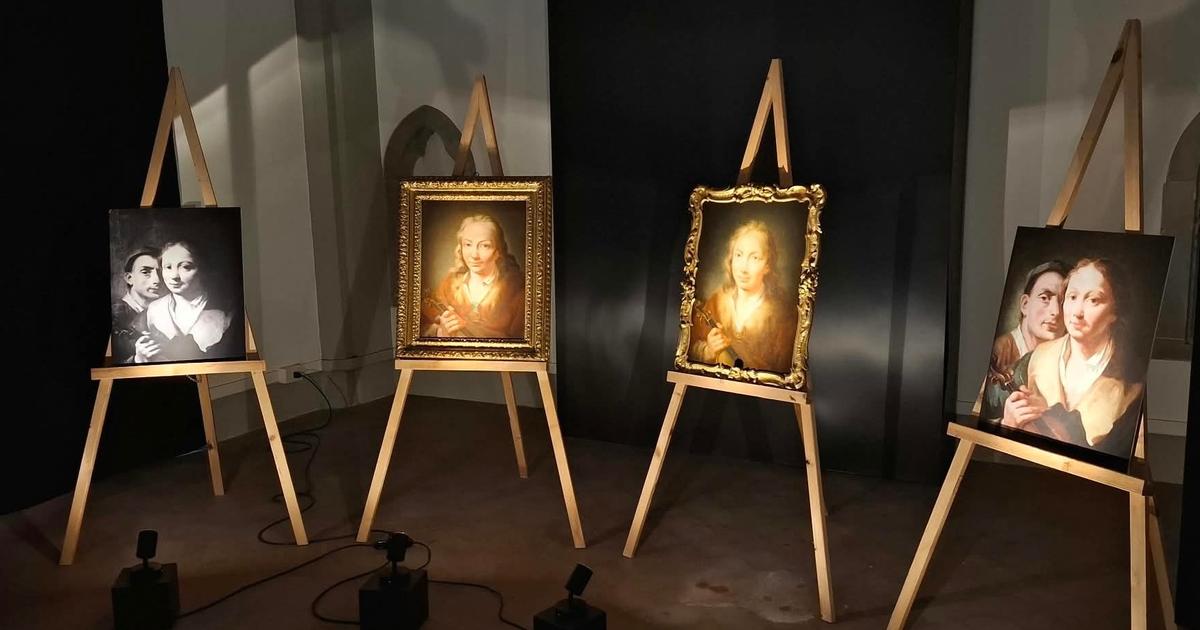
Until now only three paintings representing the 18th century virtuosoe century were known to experts. The discovery by Federico Maria Sardelli, renowned Italian musician, of four new paintings provides new details on the author of The Extravagance.
If everyone knows Vivaldi’s four seasons, many fewer visualize the artist at the origin of this baroque concerto. It is now possible to (re)discover him through four new portraits on display until October 31 at the Medici Museum in Florence.
A discovery made possible thanks to the investigative work of Italian virtuoso Federico Maria Sardelli. Passionate about the work of Antonio Vivaldi (1678-1741), the conductor is already the author of two books on the red-haired priest, including The Vivaldi Affair which traces the discovery in 1926 of two manuscripts written by the composer.
Skip the ad
The story of the four paintings begins when an Italian luthier and collector approached Federico Maria Sardelli to present him with an oil on canvas. Painted in a rococo style, the work depicts a man in an unbuttoned shirt, round cheeks with a rounded forehead adorned with arched eyebrows and a well-defined nose. Characteristics resembling in every way Vivaldi’s previous already known portraits. The canvas, signed by the 18th century Venetian paintere century: Giuseppe Nogari(1699-1763), was accompanied by a certificate from 1982. This indicated its sale by an Italian luthier from the 20the century, Leandro Bisiach (1864-1946), to a family of Italian nobility, the Durazzo-Da Passano.
Medici Museum of Florence
But during a press conference given on October 3 at the Medici Museum in Florence, Federico Maria Sardelli explained that he had doubts about the authenticity of the painting. “From a historical point of view, everything matched”he said, but some “stylistic dissonances” persisted. The drawing does not “seemed not to be by the hand of this Venetian painter from the beginning of the 18th centurye century “. Indeed, the painting represents the composer born in 1678, in his late thirties. The work must therefore have been produced at the beginning of the 18th century.e century. However, Giuseppe Nogari was born in 1699 and he only began painting in the mid-1720s.
Skeptical, the musicologist and creator of the baroque ensemble Modo Antiquo undertook to continue his research on the painter. The investigation revealed the existence of a second painting, in every way equivalent to the first, but of a higher quality. The painting, belonging to the conductor Francesco Molinari Pradelli, ultimately turns out to be the original work. The concert artist thought he owned a work cataloged as a « simple » Portrait of musicianwithout knowing its true value. By comparing the two paintings, it was established that the first was a period copy of the Portrait of musician by Pradelli, made “by a less skillful hand”. The 18th century virtuosoe century is represented with “reddish-blond hair, light gray-green eyes and a witty smile”. This is the most realistic and vivid image of all those already known to the “redhead priest”, attests Federico Maria Sardelli.
Medici Museum of Florence
The most astonishing revelations then arrive with the unearthing of two new portraits. Both represent the violinist, in the same position with his neck open and his instrument in his hand. But this time, he is accompanied by a second person, quickly identified as Giovanni Battista Piazzetta (1683-1754), a renowned Venetian painter known during the same period of Vivaldi. The first, named Allegory of music, made its reappearance at a Maison Cambi auction in 2020, in Genoa. Signed by the hand of Domenico Fedeli (1713-1794), known as Maggiotto, disciple of Giovanni Battista Piazzetta, the portrait is dated 1710. The last painting, entitled Couple of young people is also attributed to Maggiotto. It is a black and white replica of the original work.
Medici Museum of Florence
For Federico Maria Sardelli, these four paintings suggest a hypothesis: Antonio Vivaldi would have posed in front of a mirror with the painter Giovanni Battista Piazzetta, which explains why the musician holds his violin in his right hand. The double portrait would have been made at the beginning of the 18th century.e century. Maggiotto is said to have made copies of the painting. And the works of Giuseppe Nogari would be a simplified version of the original commissioned by Vivaldi himself from the Italian painter. Thus the four portraits would all emanate from one and the same portrait. This theory could also solve a chronological puzzle because Maggiotto and Nogari were too young to have painted Antonio Vivaldi when he was only thirty years old.
Skip the ad
These findings highlight three points. They expand the small corpus of lines already known by the composer and confirm the features of his face. Until now only three portraits of Antonio Vivaldi were known: a painting kept at the Music Museum in Bologna, the engraving by François Morellon La Cave, and the famous caricature created by Pier Leone Ghezzi. Finally they reveal the existence of a hitherto unknown personal relationship between Antonio Vivaldi and Giovanni Battista Piazzetta, one of the most important Venetian painters of the early 18th century.e century. Which makes these four new works valuable testimonies to the composer and his era.
Webanketa.com
LarisaLomova – Просмотр профиля
SortMet
30 30 T54370.Html
AvdeiPavlov — Сделай.ру
/
Рита Амлеева | Форум Estetmedicina.ru
Kuzinstas
sortmet.ru competitors – Top 7 similar sites like sortmet.ru and alternatives
Информация — Профиль RomaGlebov — FlashBoot.ru
Профиль ArturSkabeev на Пикабу
Sortmet.Ru
danavasileva (Dana Vasileva)
О проекте | Сергей Елистратов
Presentations by sortmet
5Zsrrpyu7Yfgawe.Html
Bahamas Local : Profile : DaniilKhomov
Dreevoo.com | SortMet
СОРТМЕТ by EnnMaller – Infogram
GenaSobolev | Content Creator on Zupyak
Profil uživatele SortMet – Programujte.com
1473858
Lev Anisin | Marketing Resource Directory
Elena Molotova,
SortMet's profile – Read the Docs Community
SortMet
Arturkuzin
@Sortmet
Apple iPhone Forum und Community – Profil von KireevaSveta
https://expathealthseoul.com/profile/david-amosov/