Trade overview: current reports, trends, indices, stock prices, bonds, foreign exchange and commodities and analyst recommendations
12:15
The war with Iran is not only a security incident, but a trigger for a profound change in the global markets. This is according to a recent analysis by State Street Investment Management, the investment arm of State Street Bank, and one of the largest asset managers in the world.
According to the report, geopolitical risk is being repriced in almost every financial asset, with energy prices becoming the main focus of influence on inflation, interest and growth. This means that the markets no longer ask if there will be damage, but how deep and lasting it will be.
According to the State Street report, the surge in oil and gas prices since the outbreak of the war is already directly reflected in inflation expectations and monetary policy: Brent oil prices are up to 75% higher than at the end of 2025, and European gas has almost doubled – data that return inflation to center stage.
As a result, the markets are rejecting the expectations of interest rate cuts in the US, and are even pricing in further tightening in Europe. “Energy has become the main communication channel between geopolitics and the markets – through inflation, interest rates and currencies,” the report states.
The report states that the potential beneficiaries of the situation are energy and oil companies, defense and cyber industries, infrastructure, and renewable energy. The AI supercycle continues, even if in the short term it is expected to slow down due to supply chain constraints. However, over time, economies’ adjustments to supply shocks may improve productivity and accelerate AI adoption.
The losers are energy-intensive industries, leveraged companies, and economies dependent on energy imports, primarily Europe. “Europe remains structurally exposed,” the report claims. “The solution is a combination of investment diversification, inflation protections and adaptation to a world of frequent shocks.”
10:44
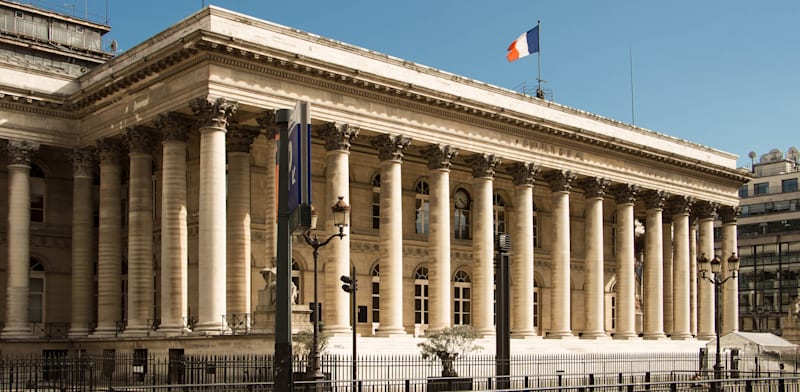
With the exception of the Paris Stock Exchange, which is down by 0.6%, the stock exchanges in Europe are stable, in particular the London and Frankfurt stock exchanges.
Luxury stocks fall afterKring (Kering), the owner of Gucci, andHermes International (Hermes) reported the results of the first quarter that disappointed the investors, against the background of the conflict in the Middle East which is hurting the sales of the luxury sector.
The company updates also clouded the broader luxury sector, with Burberry, Christian Dior, LVMH and Moncler the worst performers on the pan-European Stoxx 600 index, down between 2% and 3% each.
“Despite the slowdown in the flow of tourists related to the situation in the Middle East, sales in the group’s stores increased by 7%,” Hermès said on Wednesday as it reported sales of 4.1 billion euros ($4.8 billion) in the first quarter. “Wholesale activity was significantly affected by lower sales to franchise stores, especially in the Middle East and airports,” the company added.
Meanwhile, Kering late yesterday reported sales below expectations, with the luxury conglomerate’s biggest brand, Gucci, remaining a drag despite new CEO Luca De Meo’s efforts to turn the company around.
08:40
In Asia this morning there is a positive trend as mentioned. The Kospi index in South Korea jumps by about 3%, the Hang Seng and Shanghai indices by 0.5%, the Tokyo Stock Exchange by 0.7%.
The contracts on Wall Street are trading stably now that yesterday, the renewed hopes for the agreement dampened optimism and the Nasdaq, which rose by about 1.8%, regained all the retreat recorded since the outbreak of the war in Iran – and before that, against the background of fears of the “AI apocalypse”. And now it again shows a positive return since the beginning of the year, 1.7%.
The index recorded its 10th consecutive day of gains, its longest streak since the end of 2021. During this streak, the index climbed more than 12%, the highest point gain in this time period, ever.
The S&P 500, which rose 1%, also surged back to pre-war levels, posting gains of more than 7% during a seven-day streak of gains. Now the index is within touching distance of its peak, about 0.1%. The Dow Jones rose 0.7%.
Shares that gathered interest:
Investors received financial results for the first quarter yesterday, JPMorgan Chase shares weakened despite record quarterly revenues from the trading division. stock Wells Fargo fell by 5%, while a share Citigroup climbed
Nvidia Yesterday announced the world’s first family of open quantum AI models, called NVIDIA Ising, designed to help researchers and organizations develop quantum processors that can run useful applications. The quantum shares in the lead I.ON.Q. jumped up The latter even announced today that it achieved a technological milestone by photonically connecting two independent quantum systems based on trapped ions. Also shares Regetti Computing andD-Wave Quantum jumped up
The ETF for the chip shares iShares Semiconductor ETF ( SOXX ) rose to a new intraday high. The increase in the fund was led by stocks like cardo andMarvel Technology
On the other hand, a share Intel It fell after registering its ninth positive trading day yesterday with a cumulative increase of 58% in a week and a half, and according to CNBC it is on its way to its best streak since at least the 1970s.
With the increase in demand for electricity related to artificial intelligence, the company Bloom Energy expands its cooperation with oracle . The new agreement allows Bloom to deliver up to 2.8 gigawatts of fuel cell capacity, with 1.2 gigawatts already under contract and in the process of being deployed.
Amazon Acquires the satellite operator Globalstar in a deal worth about 11.6 billion dollars, a move that will strengthen its efforts to build an independent satellite array.
In the debt market – there was a certain relaxation in the 10-year US government bond. Their yield to maturity, which was already 4.4%, before the ceasefire with Iran on March 27, has since dropped to 4.27%.
in the commodity market – Oil prices are on the decline: contracts for WTI crude oil for delivery in May fell by 7% to a price of 92 dollars per barrel, the price of Brent oil, which is the international index, fell to 95 dollars per barrel for delivery in June.
The British investment giant Shroders has updated its recommendations in the commodities sector. Although the price of an ounce of gold has weakened by about 4.8% in the past month, falling from the symbolic price of $5,000 per ounce to $4,785, but at Schroders they actually believe in gold, and it is the only asset among the commodities that maintains a positive recommendation. The investment giant sees it as a “critical hedging tool against fiscal risks”, which receives “structural demand from central banks in emerging markets”.
Bitcoin climbed to its highest level in four weeks, while risk assets posted gains amid hopes that the US will be able to reach an agreement with Iran to end the conflict between them. The largest cryptocurrency rose 3.5% to $74,900, its highest level since March 17. Smaller currencies also posted gains, with Ether jumping 5.5%, $2,340.
Macro in the US, data published by the Bureau of Statistics of the US Department of Labor (BLS) yesterday showed that wholesale prices in the US rose less than expected in March, despite the spike in energy costs related to the war in Iran. The producer price index (PPI) increased by 0.5%, while the core index (which excludes food and energy) increased by only 0.1%. Economists predicted a 1.1% increase in the core index compared to the previous month.
These data follow on from last week’s data, which showed that consumer prices in the US jumped in March due to the rise in gasoline prices, even when core inflation remained below estimates.
The International Monetary Fund lowered its growth forecasts for this year, while warning that the outbreak of war in the Middle East could derail the global economy. According to the fund, the global economy is expected to grow by 3.1% this year and 3.2% next year, this is a slower rate than global growth in recent years and a reduction of 0.2 percentage point in the forecast for 2026.
At the same time, overall global inflation is expected to rise to 4.4% this year, due to increases in energy and food prices. The IMF estimates that if the war ends soon, only a moderate lowering of the forecasts is possible, but in more negative scenarios a significantly weaker growth rate and higher inflation are expected.
Two of the most senior people on Wall Street issued stark warnings to the markets yesterday.
The CEO of JP Morgan, the largest US bank, Jamie Dimon, said in a statement yesterday that the American economy has been resilient in recent times, thanks to consumer and business spending as well as debt repayment, but noted that the uncertainty is increasing.
“There is a complex and growing set of risks, such as geopolitical tensions and wars, energy price volatility, trade uncertainty, large global fiscal deficits and high asset price levels,” Dimon said. “While we cannot predict how these risks and uncertainties will ultimately develop, they are significant and emphasize why we are preparing for a wide variety of scenarios,” he added. The bank lowered the net interest income forecast for the entire year 2026, a key driver of banks’ profits, from $104.5 billion to approximately $103 billion.
Citadel CEO Ken Griffin predicts that the global economy is headed for a recession if the Strait of Hormuz remains closed for an extended period of time. “Let’s assume the strait is closed for the next six to 12 months – the world will end up in a recession,” Griffin said from the stage at the Semafor World Economic Conference in Washington, DC. “There’s no way around it.”
“The world is about to see a massive shift towards alternative fuel sources, including wind, solar and nuclear energy,” he added. At the same time, the hedge fund manager believes that the consequences of the war would have been worse if the US had delayed its attacks until Iran’s military capabilities had increased.
“The stock markets managed to recover back to the levels they were in before the first US attack on Iran in February, but the optimistic sentiment among investors is conditioned by the duration of the war in the Middle East. Many expect that the risks of escalating tensions between the two countries are not reflected in the market prices at all,” he said.
Griffin added that “world economies, and especially those in Asia, remain vulnerable to spikes in oil prices, which remain high around the $100 per barrel level.”