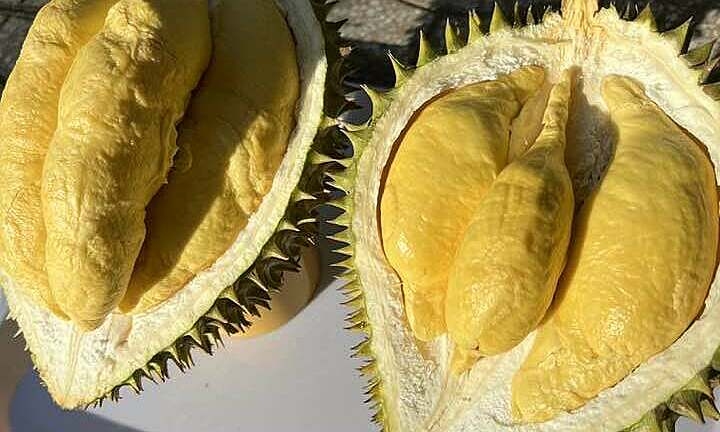
The price of Ri6 durian plummeted, with some gardens selling for only 20,000-35,000 VND per kg, due to weak demand and concerns about cadmium contamination affecting exports.
Since the beginning of April, durian prices have continuously decreased as supply increased rapidly, pulling the price level of many varieties to the lowest level in many years. In some gardens, Ri6 bought buckets for 20,000-35,000 VND per kilogram, down about half compared to the beginning of the year. Musang King also retreated to 60,000-65,000 VND, while Monthong decreased slightly, fluctuating around 65,000-75,000 VND.
Similar developments were recorded at the warehouse purchasing stage. Ri6 type A (2.7 boxes) is paid about 40,000 VND per kg, type B (2.5 boxes) is 28,000 VND. For Musang King, the price of type A is currently at 80,000-85,000 VND, the lowest in the past two years. The deep decline puts many gardeners in a difficult position even though this year’s output is quite abundant.
Ri6 durian at the Western garden house. Image: Manh Khuong
In Dong Thap, Ms. Xuan in Hiep Duc commune said her family had more than 1 hectare of Ri6 ready to harvest, but prices dropped rapidly, making profits almost gone. Traders currently only pay about 35,000 VND per kg for grade A goods and 20,000 VND for bulk goods, while fertilizer and care costs have increased sharply. According to her, this is the lowest price ever.
From a market perspective, Mr. Vo Tan Loi, Chairman of the Dong Thap Durian Association, said that the decrease between varieties has a clear distinction. Monthong keeps its price better thanks to its suitability for Chinese consumer tastes with its thick rice, low fiber, and easy to preserve characteristics. In contrast, Ri6 and Musang King are at a disadvantage in terms of storage and transportation quality.
The production picture also reveals bottlenecks. Dong Thap currently has more than 20,000 hectares of durian, producing about 550,000 tons per year, but only about 10% is exported. Most of the area is Ri6, domestic consumption at low prices, making the added value not high and vulnerable when the market fluctuates.
Pressure also comes from technical barriers. According to Mr. Loi, the problem of cadmium residue continues to affect output when some tested samples exceed the allowable threshold, causing businesses to be cautious in purchasing. According to Mr. Loi, not all growing areas are affected, but fear causes transactions to slow down. The main cause is determined to be the accumulation of heavy metals in the soil due to prolonged use of phosphate fertilizers, while soil improvement takes a long time.
From a broader perspective, Mr. Dang Phuc Nguyen, General Secretary of the Vietnam Fruit and Vegetable Association, said that the current price decline is also influenced by the regional crop cycle. Thailand is in full harvest season in April-June, the large output causes prices in this country to also decrease, thereby pulling the general price level down. Meanwhile, domestic production is still fragmented, residue control is uneven, and depends on the testing system, which is under great pressure during peak season.
However, the situation is expected to improve from mid-year. When the East and Central Highlands enter the harvest season with a high percentage of Monthong varieties, suitable for the export market, prices may recover. In fact, customs data shows that in the first quarter, durian exports reached nearly 222 million USD, an increase of 128% over the same period, continuing to be the product that leads the growth of the fruit and vegetable industry. However, to maintain this momentum, the problem of quality and production organization still needs a fundamental solution.