Despite the war, Israel’s economy in 2026 is forecast to grow by 3.5-3.8%, outperforming G7 countries thanks to high-tech exports and strong capital attraction.
Earlier this month, the Central Bank of Israel reduced its 2026 GDP forecast, citing the impact of the conflict in the Middle East. However, the country’s economy is still expected to grow by 3.8%, after adjusting down 1.4 percentage points.
The International Monetary Fund (IMF) also forecasts that Israel’s economy will grow at 3.5% this year, compared to 2.3% for the US and 1.3% for the EU. This speed also means that Israel’s GDP will grow faster than other G7 countries this year.
In 2027, the IMF forecasts that Israel will grow by 4.4%, continuing to be higher than many developed economies. According to Governor of the Central Bank of Israel Amir Yaron, if the conflicts end, the country’s economy can recover to 5.5%.
Forecast of GDP growth of economies in 2026 and 2027 by IMF. Graphics: CNBC
Israel is in a spiral of conflict since October 2023 with Hamas, Hezbollah and many forces in the Middle East. Keren Uziyel, senior analyst at the Economist Intelligence Unit (EIU), said that the Israeli economy has grown below its potential after years of war, but the pace is still high thanks to low inflation, high-skilled labor and the resilience of the private sector.
“Exports of high-tech goods and services have been the key factor behind two decades of strong growth and wealth creation,” she said.
Last year, two record foreign investment deals in this country were both in the field of cybersecurity, including Google’s $32 billion acquisition of Wiz and Palo Alto Networks’ $25 billion acquisition of CyberArk.
Ms. Keren Uziyel noted that Israel also grows thanks to the development of gas resources and defense exports. “The energy sector will see significant investment inflows in the 2026-2027 period, both in domestic renewable energy and expanding natural gas production and export capacity,” she said.
The population structure with an average growth rate of nearly 2% per year over the past two decades is also Israel’s advantage. By the standards of developed countries, the country’s population is relatively young. If the ceasefire agreements are maintained, albeit weakly, Ms. Uziyel forecasts that the economy will recover quite strongly by mid-year and reach about 3% this year.
At the same time, money is still pouring into the Israeli capital market, according to Karen Schwok, founder and CEO of family investment office Lucid Investments in Tel Aviv. Since the beginning of the year, the Tel Aviv 35 index (including the 35 largest companies listed on the Tel Aviv stock exchange, TASE) has increased by 20%, continuing the upward momentum of 51.6% last year. This level exceeds many major developed markets, including Wall Street’s three major indexes (DJIA, S&P 500 and Nasdaq Composite).
“Foreign capital flows are returning, focusing on the fields of technology, finance and defense,” she said. The Tel Aviv 125 index – including the 125 largest companies – is up 17% since the beginning of the year.
Ms. Schwok also pointed out the driving force to attract cash flow comes from the strong economy, population factors and large deals. At the same time, Israel’s defense industry is expected to continue to boom thanks to winning international contracts.
The Israeli shekel has risen about 4% against the dollar over two months of fighting and nearly 7% so far this year. According to Ms. Schwok, the return of foreign capital shows investor confidence, helping the shekel increase in value. “There has been a clear shift from a state of ‘shock’ to ‘normalization,'” she said.
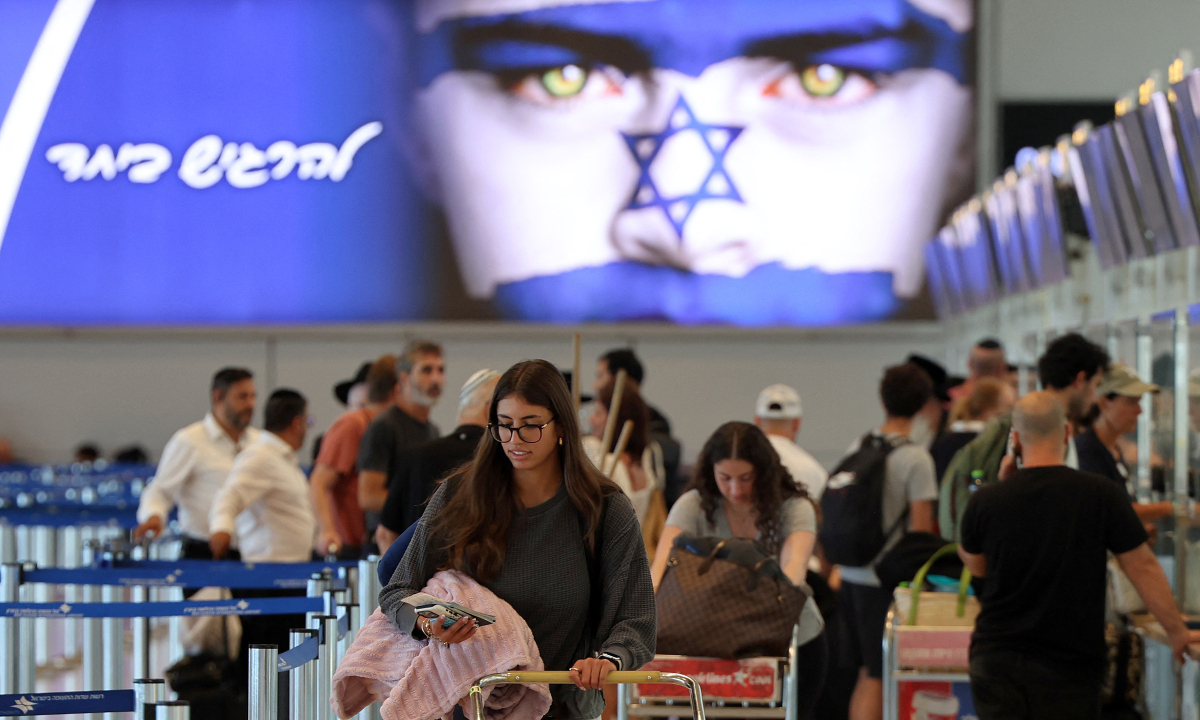
Passengers at Ben Gurion International Airport in Tel Aviv, Israel, June 2025. Image: AFP
However, Joao Gomes – Professor of Finance at Wharton School of Business, University of Pennsylvania (USA) – said that Israel’s economy is starting to absorb the effects of the conflict. There is a shortage of labor due to mobilization to participate in hostilities, and consumer spending is down because of security concerns.
The tourism industry has also been severely affected, weakening growth and revenue collection. According to him, public debt has increased significantly but can still be controlled if the Middle Eastern country reaches a peace agreement. Because this helps them significantly and sustainably reduce defense spending, maintain foreign investor confidence and high-quality human resources. “If not, the Israeli economy will face more difficulties when facing the risk of a weakening domestic currency, rising inflation and foreign capital withdrawing from the market,” he said.
Expert Keren Uziyel at the EIU said that although the macroeconomic foundation remains strong, the conflict is expected to harm many aspects of the Israeli economy. Recently, the government had to lift the order to close non-essential services because of concerns about a decline in growth and budget revenue. “We still forecast a significant decline in consumption in March-April, the peak tourist season of the year,” she said.