The cement industry is difficult to achieve Net Zero because it produces one ton of clinker – the key raw material – from the process of burning limestone and clay at 1,400-1,500 degrees Celsius, emitting more than half a ton of CO2.
Mr. Luong Duc Long, Vice President and General Secretary of the Vietnam Cement Association, stated the industry’s difficulties in reducing emissions at a seminar on green construction materials organized by the Ministry of Construction on the afternoon of May 5.
According to Mr. Long, cement production cannot move towards the net zero emissions roadmap (Net Zero) by 2050, because of technical limitations.
Cement includes clinker, gypsum and additives such as fly ash, blast furnace slag… Of which, clinker accounts for 75-85%. This material is created from the process of heating a mixture of limestone and clay at a temperature of 1,450-1,500 degrees Celsius. “Producing one ton of clinker emits up to 525 kg of CO2. It cannot be reduced further,” Mr. Long said.
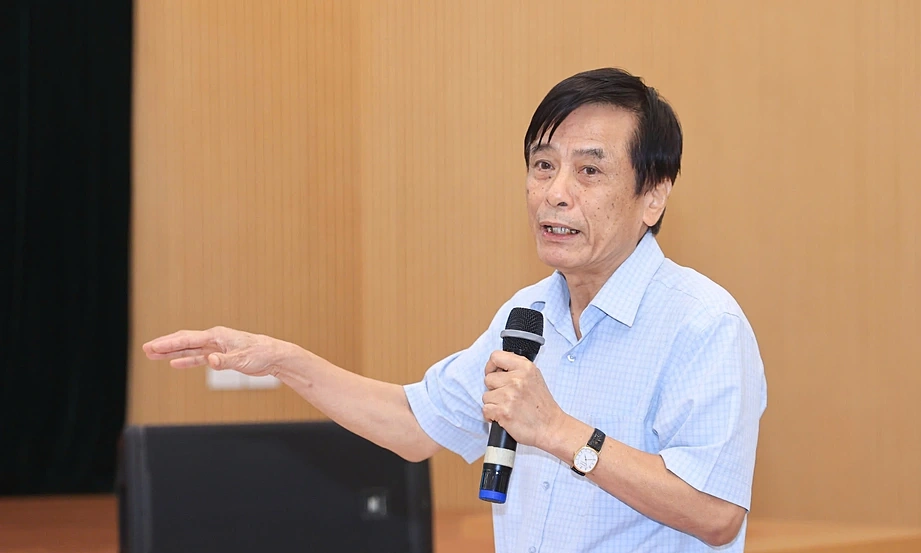
Mr. Luong Duc Long, Vice President and General Secretary of the Vietnam Cement Association. Image: Construction Newspaper
Cement, thermal power and iron and steel were piloted by the Prime Minister to allocate emissions quotas earlier this year, with a total of 243 million tons of CO2 for 110 enterprises in 2025. Of which, cement includes 51 enterprises, Mr. Long said the industry was assigned nearly 70 million tons of CO2. The pilot allocation process lasts until the end of 2028, while forming a domestic carbon market. That is, they only have three years left before their quotas are officially tightened.
While it is difficult for the industry to reduce emissions in clinker production, the carbon capture (CCS) option is not financially viable. A ton of landfilled CO2 is quoted at 132 USD, nearly four times higher than the export price of a ton of finished clinker. “If we lose this amount of money to bury emissions, the cement industry will certainly have to close,” Mr. Long emphasized.
However, this industry is reducing fossil fuels in clinker firing operations, replacing them with waste. To date, nearly 20 businesses have burned waste instead of coal, some reaching a replacement rate of up to 40%. Mr. Long recommended that the reduction of methane (CH4) gas from landfills should be deducted from the quota.
Because, if this waste is not burned at a cement factory, it will emit CH4, a “super polluting” gas with a global warming rate 27 times higher than CO2. According to the United Nations Industrial Development Organization (UNIDO), the cement industry accounts for about 7-8% of Vietnam’s total greenhouse gas emissions. Promoting emission reduction solutions in this sector will contribute significantly to the implementation of national climate goals.
Construction materials are an industry that provides basic inputs for infrastructure, urban and housing development, and is also a field that consumes a lot of resources and energy and generates large emissions. Deputy Minister of Construction Nguyen Van Sinh said greening this industry has become an urgent requirement.
In fact, the field of construction materials has recorded positive results in developing green and energy-saving products. For example, the market for unburnt building materials products is gradually formed and developed, such as aggregate cement bricks, autoclaved aerated concrete, foam concrete… This group of products helps reduce the use of fired clay, save agricultural land, limit emissions, and contribute to the reuse of ash, slag, gypsum – waste from other industries.
To promote the green materials market, the Ministry of Construction is completing the legal framework on standards. Mr. Le Van Ke, Deputy Director of Science, Technology, Environment and Construction Materials (Ministry of Construction), said that in the fourth quarter, the Ministry plans to issue a circular on energy labeling for this material, including details on the list of labels and registration procedures. This label is expected to be a “passport” for businesses in the green materials market.