Taking advantage of vans as mobile warehouses, flexible routing and backup delivery capacity, J&T Cargo Khanh Hoi post office maintains J&T’s top 3 operating performance in the South.
The development of e-commerce is expanding the demand for delivery to large-sized and large-volume items such as milk, rice, paper, diapers or household appliances. This trend poses new requirements for logistics units when transporting heavy goods and large packages requires a different organization of personnel, vehicles and delivery routes than normal delivery.
Right in the first months of the year, the J&T Cargo network in the southern region recorded a series of post offices with excellent operational achievements thanks to flexible post office management and operation plans, for example Khanh Hoi post office.
According to business statistics, J&T Cargo Khanh Hoi post office is in the top 3 most efficient post offices in the South, with on-time delivery rate reaching 100% and on-time delivery rate in the first delivery reaching 99.7%, belonging to the group of excellent operations in the southern region. To achieve this number, the unit applies many solutions for handling bulky goods suitable for specific areas, becoming a reference experience for other post offices in the system.
According to Mr. Nguyen Trung Kien (born in 1989), manager of J&T Cargo Khanh Hoi post office, understanding the specifics of the area and flexibility in operations are two factors that help maintain delivery efficiency. Accordingly, if a shipper can deliver 100-200 small orders per day, for bulky goods, this number is only about 50-60 orders due to larger size and volume.
“Therefore, the post office must balance goods, personnel and delivery routes so that operations are not overloaded,” Mr. Kien said.
J&T Cargo Khanh Hoi members received certificates of merit and gifts from the corporation for excellent performance. Image: J&T Cargo
Currently, Khanh Hoi post office is in charge of the old District 4 area, which now includes three new wards. This is an area with high population density and many small alleys, making it difficult for vans or trucks to access deep inside. This characteristic forces the unit to strengthen its motorbike delivery team and organize more detailed delivery routes to meet the demand for heavy deliveries in residential areas.
According to a representative of J&T Cargo Khanh Hoi, the number of orders at the post office has increased rapidly recently. Compared to the previous month, output increased by more than 100%, while the on-time delivery rate at the first delivery reached a record of 99.7%.
One of the operating principles applied by the post office is not to exploit the maximum delivery capacity of the shipper. On average, an employee can deliver about 50 heavy orders per day, but the unit only allocates about 40 orders.
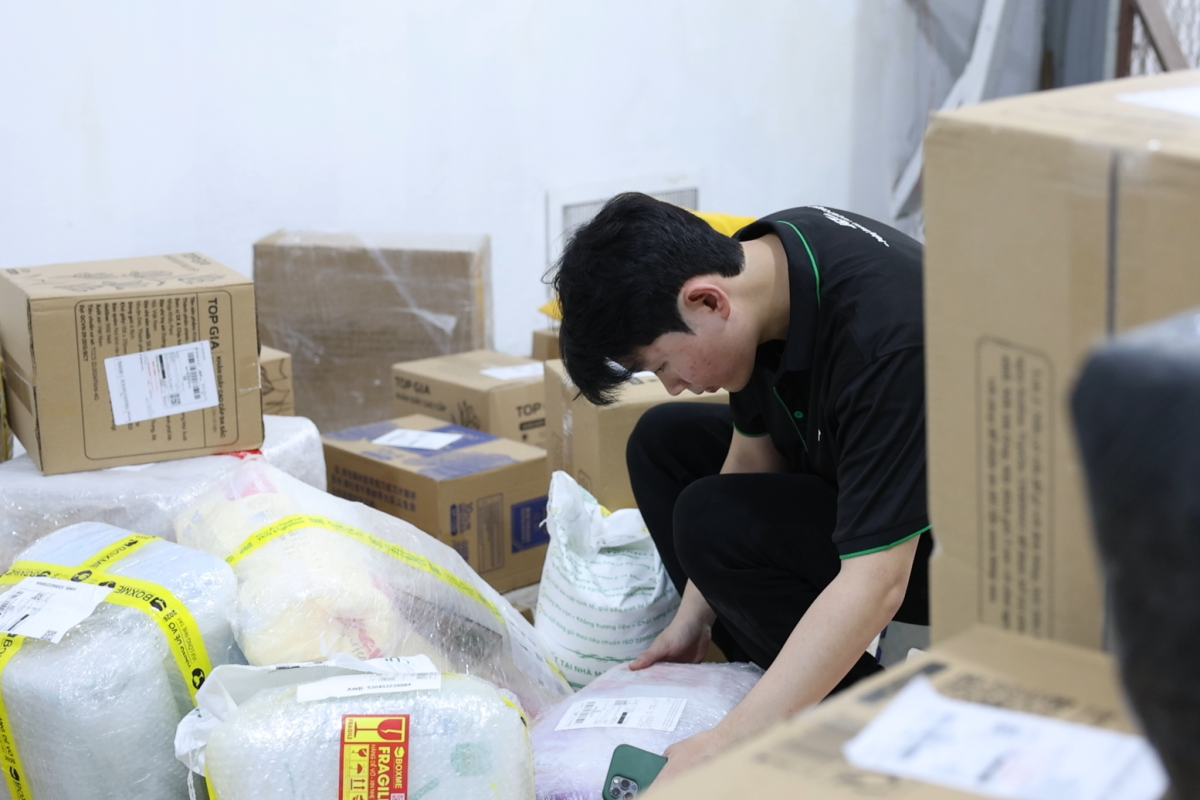
Khanh Hoi Post Office staff are handling goods. Image: J&T Cargo
The backup time helps shippers handle orders arising on peak days or major promotions. “The most important thing is not to leave orders unsold for days. If you allocate close to maximum capacity, when output suddenly increases, it is easy to overload, so you always have to make provisions,” Mr. Kien said.
Besides capacity backup, the post office also uses vans as a “mobile warehouse”. Instead of requiring shippers to return to the warehouse after each delivery, vans are dispatched to collection points near the delivery area.
When all the goods are delivered on the motorbike, the shipper only needs to return to the van to receive more orders instead of going to the post office. According to him, this model helps shorten travel distance, increase the number of deliveries per day and is suitable for areas with many small alleys.
At the same time, the office department takes on the role of coordinating and classifying goods according to each route before delivery. When output increases, pre-divided goods help shippers receive and depart immediately, reducing processing time at the warehouse.
According to the owner of Khanh Hoi post office, operating the delivery model of heavy and small goods is different in both the number of orders, personnel and vehicles. With the same 1,000 orders per day, small goods may need about 8-10 shippers, while heavy goods need 20-25 people to ensure progress.
Mr. Nguyen Trung Kien, owner of Khanh Hoi Post Office (HCMC). Image: J&T Cargo
Regarding vehicles, trucks or vans must also be arranged appropriately because bulky goods take up more space. Each trip cannot carry a large number of orders like normal goods.
Even though the number of orders delivered is less, the shipper’s income is still guaranteed because shipping costs are often proportional to the volume and size of the goods.
From practical experience, Mr. Kien believes that investors who want to operate post offices specializing in handling large parcels need to carefully prepare facilities, personnel and coordination plans according to the characteristics of each area. As output grows, proactively expanding the delivery team and adding vehicles is an important factor to maintain service quality.
“Delivering heavy goods cannot be operated like small goods. To be effective, you must understand the area, know how to divide routes, reserve personnel and have flexible transit plans,” he said.
In a context where consumers are increasingly accustomed to online shopping for bulky items, the ability to adapt to each region’s conditions is considered an important factor for delivery units. The case of J&T Cargo Khanh Hoi post office shows that operational efficiency at the final delivery stage still plays a significant role in the experience of sellers and buyers.
https://totalcasinopl.net.pl/
https://totalcasino-pl.net.pl/
https://pl-totalcasino.pl/
https://totalcasino-pl.org.pl/
https://totalcasinopl.com/
https://pl-totalcasino.net/
https://pl-totalcasino.eu/
https://total-casino-pl.eu/
https://total-casino-pl.eu.com/
https://bwins.biz/
https://ice-casino-si.com/
https://icecasino-si.si/
https://icecasino-sk.eu.com/
https://icecasino1.sk/
https://ice-casino-si.org/
https://ice-casino.com.lv/
https://ice-casinos.com.lv/
https://ice-casinos.lv/
https://icecasino-si.net/
https://icecasino-si.org/
https://icecasinos.com.lv/
https://icecasino-sk.org/
https://icecasino-sk.sk/
https://icecasino7.sk/
https://ivibet-casino.si/