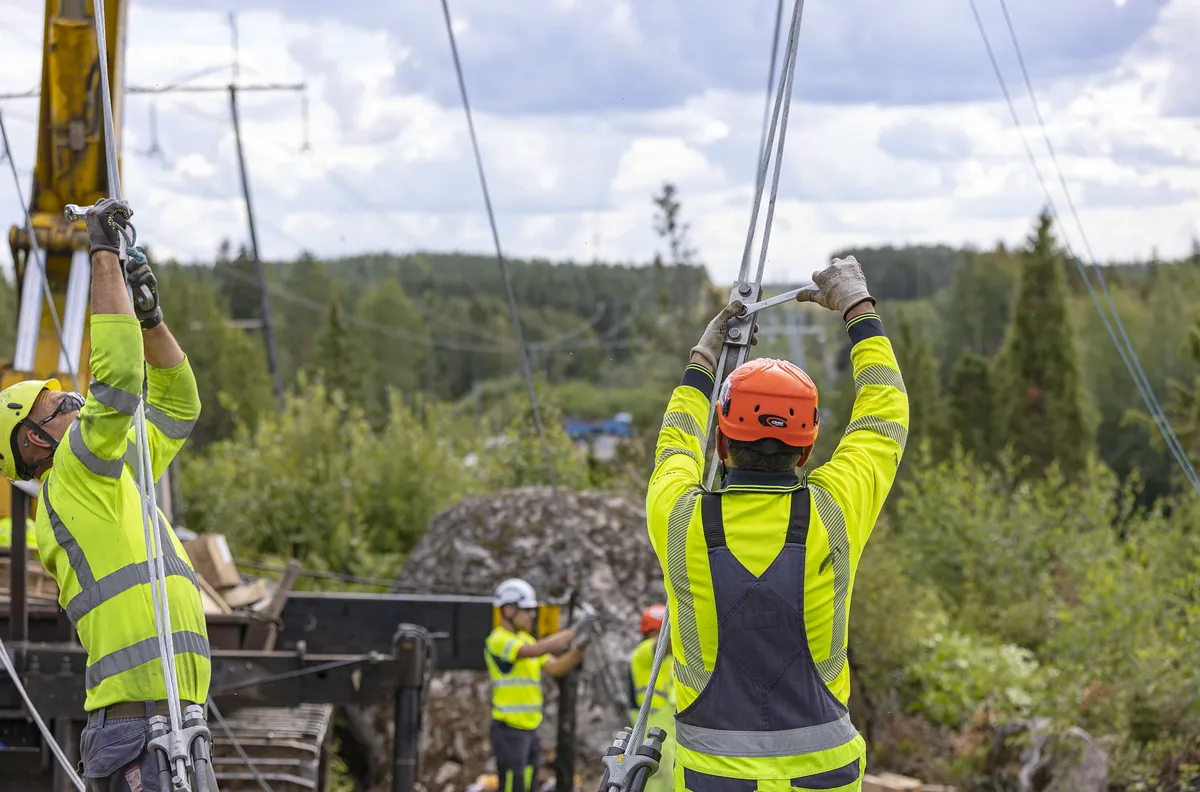
The experiences of the war in Ukraine show that electricity networks have become the target of direct influence and a security issue. Finland should quickly prepare for this and dimension the electricity networks for crises instead of normal conditions. This would mean investments in networks, spare parts warehouses, cyber security and skilled personnel, according to a recent report mapping the security of Finland’s electricity networks.
“Attacks on electricity can paralyze society without traditional warfare. In the era of cyber attacks, sabotage and drone threats, what matters is not only what can be protected, but how quickly society can recover from a disruption,” the utility company Caruna’s managing director Jyrki Tammivuori says in the press release announcing the report.
The electricity network report published last week was commissioned by Caruna, and was carried out by Nordic West Office, a consulting firm focused on security and geopolitics.
The report highlights how in Finland it would be worthwhile to prepare much more carefully for sabotage, a military attack or a cyber attack, in addition to preparing for extreme weather phenomena and network failures. At the same time, we remind you that the threat picture is not new, but that Russia launched an effective cyber attack on Ukrainian electricity companies already in 2015 and managed to cut off electricity from more than 200,000 consumers for several hours.
The report also mentions that the military threat has been raised in the latest strategy of the Service Security Center as one of the three most important scenarios that Finland should be prepared for in security of supply arrangements.
“As the security situation tightens, the system must withstand disruptions, damage and exceptional situations, without jeopardizing society’s ability to function. Resilience (recovery ability) arises from extra capacity, backup connections and the ability to quickly restore electricity after disruptions,” says Tammivuori.
According to the report, Finland would also have a good chance to become an international pioneer in electricity network security.
This is how we prepare now
Target?
Due to their poor availability, transformers have been the main targets of Russian attacks in Ukraine. In the picture, the transformer station connected to the grid company Fingrid’s Estlink submarine cable in Porvoo.
PHOTO: PAULA NIKULA/KL
In addition to Ukraine, the electricity network report raises examples from Estonia and the Netherlands, whose events provide key lessons on how advance preparation for new and developing threats has helped countries to cope with threats to electricity networks. In addition, in terms of success, the forecasting of production and consumption growth and a clear division of responsibility between the state, authorities and network companies have been decisive.
In Finland, the development of electricity networks has so far focused on responding to the most common threats. The technical development of networks and maintenance work have aimed to reduce the risk of failure. On the other hand, the effects of extreme weather phenomena have been reduced, for example, by diligent ground cabling of overhead lines.
“Since it is difficult to protect the electricity network that is thousands of kilometers long, its nodes, such as substations, have been prioritized in physical protection measures. They are protected from damage with fences, guards and camera surveillance, among other things,” the report says.
Key preparedness measures in Finland have also included ensuring the availability of sufficient repair personnel and vehicles.
According to the report, plans aimed at protecting substations in emergency situations have been drawn up in Finland, and access control has been strengthened at central nodes of the electricity network.
With the start of the war in Ukraine, cyber security has also been invested more than before. Key preparedness measures in Finland also include, among other things, comprehensive and close cooperation with authorities and regular training for exceptional situations.
3 new threat factors
The recent report lists three key factors that now affect the operating environment of the electricity system and network:
1. Power grids have become the target of military influence and sabotage. Russia’s attacks on Ukraine’s electricity system and damage to the energy and telecommunications infrastructure running under the Gulf of Finland have led to the realization of threats to critical infrastructure. The more society’s activities rely on electricity, the greater the effects of damage.
2. With the energy transition, the economy and society become electrifiedwhich increases electricity production and consumption. At the same time, electricity must also remain affordable and reliable. This creates pressure to expand and invest in electricity production and storage, which in turn requires investment in electricity transmission. Insufficient electricity transmission and distribution capacity slows down the energy transition and, in the worst case, economic growth.
3. The energy crisis and the war in Ukraine awakened Europe to the risks of external energy dependence. Dependence on imported Russian energy concretely demonstrated the risks associated with energy imports and especially excessive dependence on a single importing country. This emphasizes the importance of electrification and increasing own electricity production in order to reduce external energy dependencies.
Challenges in preparation
According to a recent report, despite different preparations, the challenge in the security of electricity networks is to focus the repair only on immediate actions.
“Even a quick repair naturally does not help to strengthen a part of the network for the next attack, unless durability is also strengthened in connection with the repair. In a war situation, it is unlikely that all damaged parts will be able to be repaired or have time to repair them,” the report states.
Network repairs can also turn out to be very expensive and time-consuming, depending on the target. The report cites the damage to the underwater Estlink 2 marine electricity cable as an extreme example of this. Due to the difficulty of the repair work, the cable was not restored until half a year later.
The costs of the repair rose to more than 50 million euros for Estlink. Although in practice repairing the electrical grid above ground is probably more affordable than this, the sums of money required for the repair can grow quickly, especially in a war situation.
Warning.
The report warns that repairing the networks can be really slow and expensive, as was the repair of the Estlink 2 submarine cable to Estonia.
PHOTO: ABB
The report also points out that the availability of spare parts and spare equipment is important for repair work. This applies especially to system-critical, difficult-to-repair and replaceable parts of the power grid, such as transformers. Their manufacturing and delivery times are long, and getting them quickly has proven to be difficult in Ukraine. Due to the long delivery times of transformers, they have been selected as one of the main targets of Russian attacks in Ukraine.
According to Eurelectric, the interest association of the electricity industry, European energy companies have identified the lack of spare parts stocks as one of the current weaknesses of preparedness.
Little anticipation
Scenarios.
In the report reviewing the security of electricity networks, examples of various realized threats are highlighted.
PHOTO: electricity network report / Nordic West Office
According to the report, another aspect of security is the proactive protection of the more critical parts of the electrical network, which can be used to prevent the destruction of parts or mitigate the effects of shocks. However, these activities have remained very few in Finland.
“Some of the security measures belong to the Defense Forces, not to the electricity network companies. This includes, for example, anti-aircraft defense. In the physical protection of parts of the network, for example with protective structures or nets that prevent drones, the responsibility for the implementation may fall mainly on the electricity network companies, although funding can be shared with the state,” the report states.
In contrast to improving repairability, protection structures designed with sabotage and military attacks in mind may not be directly useful against other threats, although, for example, power station protections can strengthen the network’s resilience against extreme weather conditions.
“Since protective structures are expensive, it is important to prioritize the most critical objects when choosing sites, which also affects the scope and strength of the protective structures to be implemented.”
The report presents how the transmission companies in Poland and Lithuania have said that they prepare for sabotage and a war situation by moving substations or parts of them to bunkers, by installing nets and concrete protections to protect key parts of the power grid from drones, and by accumulating stocks of critical spare parts. The companies invest in the activities themselves, and the countries have also applied for EU support for them.
In Ukraine, electricity transmission networks have been protected from attacks with, for example, stone baskets, sandbags, nets and concrete protective structures. The most critical targets are also protected by placing anti-aircraft and anti-missile systems in their vicinity.
Important lessons
According to the report, the electrical network objects to be protected in an exceptional situation must be prioritized.
After this, the corrective measures can be planned.
PHOTO: Fingrid
The report highlights several important points based on the disconnection of Ukraine and, for example, Estonia, from the Russian electricity grid. One is to ensure the functionality of the electrical system in different exceptional situations.
“Electricity networks must function regardless of the situation. Operators should consider and plan well in advance how to take care of the operation of the networks in exceptional situations and in a full-scale war situation, where, for example, repair personnel must be protected.”
Another essential principle is the prioritization of protected sites. According to the report, the main objects of the electricity network must be classified based on their importance and, for example, the duration of repair work. Based on this, targets can be prioritized in the planning of protection and repair measures.
“When prioritizing, it is necessary to understand which objects, especially the attacking entity, sees as critical, which may differ from the view of the defending entity. At the same time, it is necessary to decide how protection and repair responsibilities are divided, for example, between companies and the Defense Forces.”
The authors of the report remind that Russia’s role has been highlighted in the examination of various threats. However, it is an open question how widely another country would try to damage another country’s electricity system or, in a war situation, attack it, even though energy systems more widely can be the target of attacks.
“As has happened with the war in Ukraine, the emphasis of the attacks can depend a lot on the goals of the attacker. An attack on the power grid can appear as an attractive way to weaken the opponent’s society, if the war is not aimed at conquering another country, the report warns.”
Anonymous sources
The report, entitled The changing operating environment of electricity networks, is based on the research work done by the consulting company Nordic West Office and eight expert interviews, which were carried out between November 2025 and February 2026.
According to the report, the interviewees are experts in electricity networks and security of supply from the private and public sectors. Experts or their organizations are not named in the report.
Finland separated from Russia’s electricity transmission in the spring of 2022.
Currently, there are fixed electricity connections to Estonia, Sweden and Norway. In the picture, the Aurora line of the electricity main grid crossing the Tornionjoki to Sweden.
PHOTO: Fingrid
https://hitnspin-lt.com
https://hitnspin-lt.com/apk
https://hitnspin-lt.com/app
https://hitnspin-lt.com/bonus
https://hitnspin-lt.com/casino
https://hitnspin-lt.com/deposit
https://hitnspin-lt.com/download
https://hitnspin-lt.com/faq
https://hitnspin-lt.com/legal
https://hitnspin-lt.com/login
https://hitnspin-lt.com/mirror
https://hitnspin-lt.com/mobile
https://hitnspin-lt.com/payments
https://hitnspin-lt.com/problems
https://hitnspin-lt.com/promocode
https://hitnspin-lt.com/review
https://hitnspin-lt.com/slots
https://hitnspin-lt.com/support
https://hitnspin-lt.com/withdraw
https://hitnspin-ro.com
https://hitnspin-ro.com/apk
https://hitnspin-ro.com/app
https://hitnspin-ro.com/bonus
https://hitnspin-ro.com/casino
https://hitnspin-ro.com/deposit