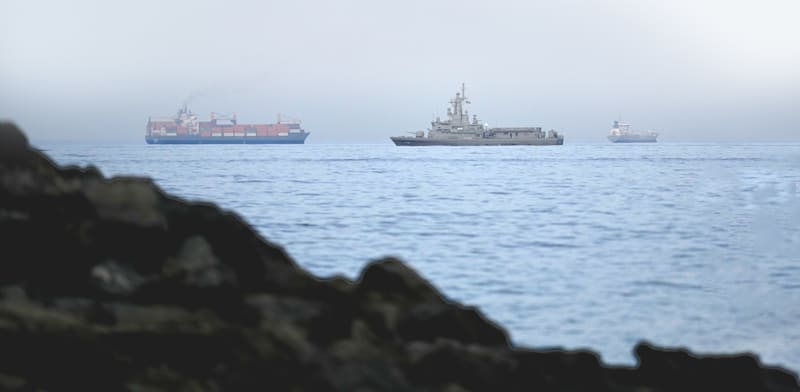
A day after Iran announced the closure of the Strait of Hormuz following Israel’s attacks on Lebanon, claiming a violation of the cease-fire agreement, uncertainty continues surrounding one of the world’s most important trade routes. While in Tehran they claim that only Iranian vessels are allowed to pass through the strait, according to the Iranian news agency WANA, in the US they insist that the traffic has not been stopped.
Yesterday (Saturday), US Vice President J.D. Vance denied this before leaving for talks with Iran that are expected to continue in Switzerland. In practice, most shipping companies are still refraining from returning to full activity, and hundreds and perhaps even thousands of ships continue to wait in the Persian Gulf until the situation is clarified.
● After reaching an agreement with Iran: Trump lands a blow on Russian oil
● This is how the mediators used Trump’s birthday to promote the agreement with Iran
Despite the contradictory statements, movement in the Strait remains very limited. According to the Hormuz Tracking website, which is based on the visible identification broadcasts of the vessels in the area, the number of crossings in Hormuz today is zero. Some of the ships that choose to leave the bay do so in the dark while turning off their identification transmitters. US President Donald Trump claimed last week that US forces escorted about 200 ships out of the Gulf in this way.
Also according to the maritime intelligence agency Lloyd’s List, ships continue to pass through the strait despite the Iranian statements. “Ships continue to pass through the Strait of Hormuz over the weekend despite new Iranian claims that the road has been closed, and threats to act against ships that do not comply,” the report said. At the same time, the US continues to escort vessels in the region, but sources in the industry estimate that significant maritime traffic will not resume until security and commercial certainty is achieved.
Many concerns and challenges
The agreement signed by the United States and Iran last week should include the lifting of the American embargo on Iran and the reopening of the Strait of Hormuz, which has been closed since the beginning of March following the joint Israeli-American attack on Iran. However, even if the parties continue to implement the understandings, the shipping industry estimates that the road to normalcy will be long.
The insurance agencies continue to define the area as having a high level of risk and require insurance in an extremely high amount or refuse to insure at all. In practice, this is a significant barrier preventing the return of many shipping companies to full activity. As long as the situation continues, the ability to export oil and gas from the Gulf countries is also affected. Despite this, oil prices are currently trading around 75-80 dollars per barrel, significantly lower than the peak levels recorded during the war.
Even if certainty is achieved, it is not clear what the return to normal will look like. Yehuda Levin, director of research at the Israeli start-up Freitos, which deals with sea and air shipping pricing, explains: “The answer is that no one knows how it will work, whether there will be a comprehensive body, etc. But there is definitely not enough room for everyone at once. In addition to being narrow to begin with, the Strait of Hormuz will actually be even narrower due to the suspicion that Iran has made the central axis more difficult.”
According to him, the fear of exploitation left in practice only two main transit routes: one along the Iranian coast and the other off the coast of Oman. “Only these remain in use and are considered mine-free,” he says.
In a meeting with shipping industry executives organized by Lloyd’s List, additional concerns were raised. Very large oil tankers (VLCC) may find it difficult to pass through the narrow passages that remain open, and are at increased risk of running aground. In such an extreme scenario, they may even block some of the sailing routes that remain available.
Beyond that, the oil industry emphasizes that the main challenge is not only the departure of the tankers loaded with oil from the Gulf, but rather the entry of empty tankers. Only their return will make it possible to start emptying the reserves of crude oil that accumulated in the Gulf countries during the war.
For your attention: The Globes system strives for a diverse, relevant and respectful discourse in accordance with the code of ethics that appears in the trust report according to which we operate. Expressions of violence, racism, incitement or any other inappropriate discourse are filtered out automatically and will not be published on the site.
Scrolling through my social – Main Forum – American Girl Ideas Forum
The First Sustainable Healthcare Day
Team and Staff | Ithape Institute
best
Website Design Services Tailored for Calgary Businesses
Fan Group | FGB 904 Elite Basketball
Gaming discussions: I was watching a hockey
Home – I was searching for – Dynamite Sports
A colleague of mine was playing – Fishing Zone
Benefits of Repairing Laundry Appliances in Toronto
CINITY Group | CINITY
I was at a local bar | Pearltrees
USB Audio,USB audio chip,Voice command,Sound technology–C-Media Electronics, In
Pag 2, Una Cordobesa en el camino #120 – Vivecamino
Teoría del Color. La importancia del Color en Composición
Iba en el metro hacia on Notebook.ai
Página del grupo | laclase.mx
Google Analytics and Social Media: What Marketers Need to Know – SaaS Invaders
Tiempo
Teoría del Color. La importancia del Color en Composición
Website de Ronald Ramírez Olano – Foro
Grupo profesional | alfdelatorref
Sexualität in dauerhaften Beziehungen: Frust statt Lust? Statt GEIL, GÄHN?
socalwomenconference Group | socalwomenconference
http://www.LuajOnline.de.tl Lojra Online,Games Apex Casino Free, Luaj Free , Luaj Shak Shak Casino, Luaj Apex, Lojra Me Makina, Lojra per Vajza,Luaj Futboll , Motorra ,Bilardo, Poker e Tej – Forum