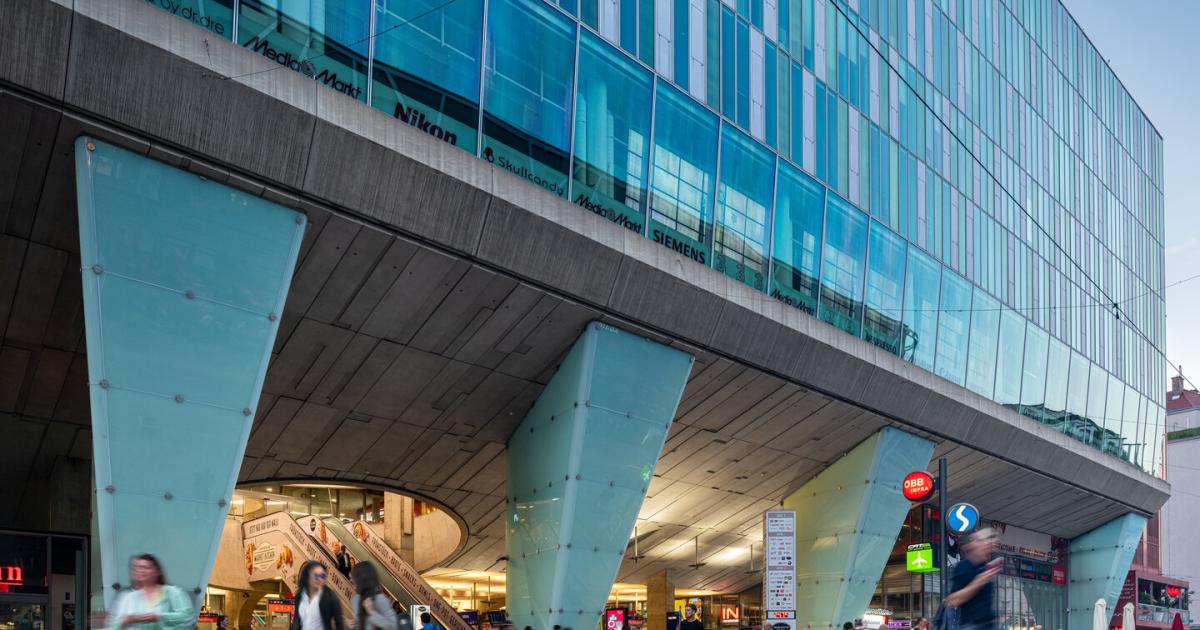
High inflation, loss of purchasing power and economic turbulence are shaping the European retail market. “The problem is not the number of visitors, the problem is shopping behavior per se and purchasing power,” says Fabian Kaufmannfounder of CC Real. The company owns the in Austria Millennium City, Vienna center The Mall and shopping Center Graz West and operates internationally. “People go shopping, but they buy differently than before and treat themselves less,” observes Kaufmann. For shopping properties, this means that the individual stores need more people in order to achieve similar sales.
For shopping centers in particular, this means: They have to be constantly on Trends be adjusted. “The advantage compared to the shopping street is that we can react to changes in the market because we use an entire building. We can also decide on one Mediamarkt to shrink and one TK Max Kaufmann gives an example. It’s not just about a business space: “We know that TK Max is the perfect addition to this center and we can use it to help the other stores.”
Open/close copyright notice
© Mitja Kobal for 3MPG
View of the Millennium City in Vienna
The Branchenmix in the malls is generally changing. All CC Real centers are geared towards everyday needs Local supplierdrugstores, service providers. “That’s why we also took out clothing,” emphasizes Kaufmann. Entertainment works well in Millennium City, for example, where the company has its headquarters in the office tower. The expert also counts on the topic of local supplies Health facilities. “For me, this is one of the basic needs. We have medical facilities in almost every center. These are one reason why people go there.”
In shopping centers are By arrangementn connected to public transport, barrier-free access, you can also park there. “If customers come to the doctor regularly, they also come to have a coffee,” says Kaufmann Synergy effects.
Open/close copyright notice
© CC REal
Fabian Kaufmann is the founder of CC Real, investor and operator of retail properties.
Kaufmann is critical of the fact that retail space is simply used for ordinations. “In the Millennium City there is access via the mall, but also a separate entrance from the outside. This means you can go to the doctor without having to expose yourself to everyone and everything, the point is that Customers feel good.” Medical facilities are worth it. “You can see that this area is growing, especially in other countries, such as Scandinavia. There, centers are viewed differently. In Helsinki, for example, the shopping center houses the city’s facilities, a center for the unemployed, and libraries.
Of course there are regional differences. “We see shopping centers as location-basedalways want too local tenantssmall traders, get in, not just anonymous big companies. “But that’s only possible if you work intensively on site,” says Kaufmann. He cites Split in as an example Croatiawhere the Fish market was taken to the mall.
Open/close copyright notice
© City Center One
the City Center One in Split, Croatia.
What investors are looking for
According to experts, investor interest in retail is returning. When looking for suitable properties, investors clearly differentiate between Austria Wien and the rest, the expert is convinced. Because: Vienna is the one second largest German-speaking City. “Investors are looking at Germany and also Vienna.” This after Linz or Graz However, bringing it is difficult.
Austria is also dependent on foreign investors because there are not enough of them liquidity available locally, too few Austrian ones Pension insurancewho could invest big. “Since times are not easy, investors find it easier to go to regions where there is local liquidity,” says Kaufmann.
The joy of buying varies depending on the country
Does CC Reel have other malls in mind? Fabian Kaufmann: “We have a hard time in Austria, the beautiful properties are owned for the long term.” Outside Austria Italy exciting, because the purchasing behavior and the ratio of rents to rents are right salescompared to countries in Norden Europe. “Because they are in Germany, Benelux and England Rent “It has risen illogically high in recent years,” explains Kaufmann. This has a big impact when purchasing power is not right. Basically, CC Real acts cautiously when shopping. “We said no more often than yes.”
Basically, people give in France and Southeastern Europe Spending more money on fashion, explains Managing Partner Markus Bodner. “That is a Key-Indicators for deciding where we go,” says Kaufmann. „In Germany, Austria and Northern Europe People are not used to going through difficult times. In Eastern Europe a difficult time is something normal for many. People know that there is a tomorrow. They haven’t stopped treating themselves to something.” That’s why CC Real is looking at where rents are healthy compared to sales, because that’s the only place where there will be increases.
The Austrian retail market is in a phase of consolidation, retailers and investors are acting selectively. Shopping centers and inner-city locations are therefore increasing gastronomy-, leisure and entertainment offerings to create additional frequency. Classic retail spaces are becoming increasingly popular Fitness center, Health facilities and entertainment concepts. At the same time, retailers are increasingly integrating gastronomic elements directly into their stores. “Stationary retail is developing more and more towards experience. Customers today expect more than just a product – they are looking for inspiration, service and quality of stay,” says Christoph Ecker, Director Retail at CBRE Austria. Growth drivers are primarily food retail and e-commerce, while furniture, sports and electronics remain under pressure.
At the same time, energy and personnel costs are rising Margendruck and a continued market shakeout reflected in bankruptcies and space reductions. In Vienna, new brands are entering the market while existing retailers are strategically adapting their locations. Linz benefits from its above-average purchasing power; rents are between 40 and 70 euros per m². Salzburg, on the other hand, scores with its charisma Tourismusdestination as well as a consistently high frequency in the old town. The rents are 50 and 110 euros per m² per month. In Graz, Herrengasse is the central shopping street. Here, prime rents are stable at 40 and 80 euros per square meter per month.
Open/close copyright notice
© CBRE
The Golden Quarter between Tuchlauben, Bognergasse and Am Hof in Vienna.
Anyone in Austria on a real estate shopping spree big style If you want to go, there is currently a good selection on the market. Especially in the area of Rene Benko’s real estate treasures. Sooner or later, the Benko Protz villa (2,000 square meters of living space, 5,500 plots) will come onto the market in Innsbruck-Igls, which belongs to the insolvent Laura Private Foundation and is said to be worth around 60 million euros.
The luxurious ones Commercial real estate from the Signa Group play in a league of their own. Last did that Nobelhotel Park Hyatt headlines in Vienna. The potential buyer is said to be the Upper Austrian investor Josef Rainer. He already has the Renngasse, the Constitutional Court and the former Bank-Austria-Kunstforum houses, purchased for 100 million euros. The Park Hyatt was on Signa’s books in 2022 for 440 million euros; the market value is estimated at 330 million euros. This is one of the most valuable pieces of fillet Golden Quarter in the city of Vienna. The listed luxury property between Tuchlauben, Bognergasse and Am Hof comprises 18,000 square meters of rentable space, of which 9,600 square meters are offices, 7,200 m² are retail areas and 876 m² are restaurants. The Golden Quarter brings in 18 million euros in rent annually and has a sales value of 458 million euros. The same is true Post parkone of the most important Art Nouveau buildings in Vienna, for sale. The insolvent owner has debts of 324 million euros.
Horoscop și Astrologie - Blog de antreprenor
Lifestyle - Blog de antreprenor
Sănătate - Blog de antreprenor
Ultimele știri și recenzii din tech & gadgeturi
Articole promovate – PR și Comunicare
Casă și grădină – PR și Comunicare
Comunicate de presă – PR și Comunicare
Familie – PR și Comunicare
Fashion – PR și Comunicare
Frumusețe – PR și Comunicare
Horoscop și Astrologie – PR și Comunicare
Lifestyle – PR și Comunicare
Sănătate – PR și Comunicare
Tech – PR și Comunicare
Articole promovate – HotWeek.ro
Turism – HotWeek.ro
IT/Stiinta – HotWeek.ro
Lifestyle – HotWeek.ro
Sport – HotWeek.ro
Horoscop – HotWeek.ro
Examene – HotWeek.ro
VIDEO – HotWeek.ro
Comunicate de presă – HotWeek.ro
Citate-Bancuri – HotWeek.ro
Filme – HotWeek.ro