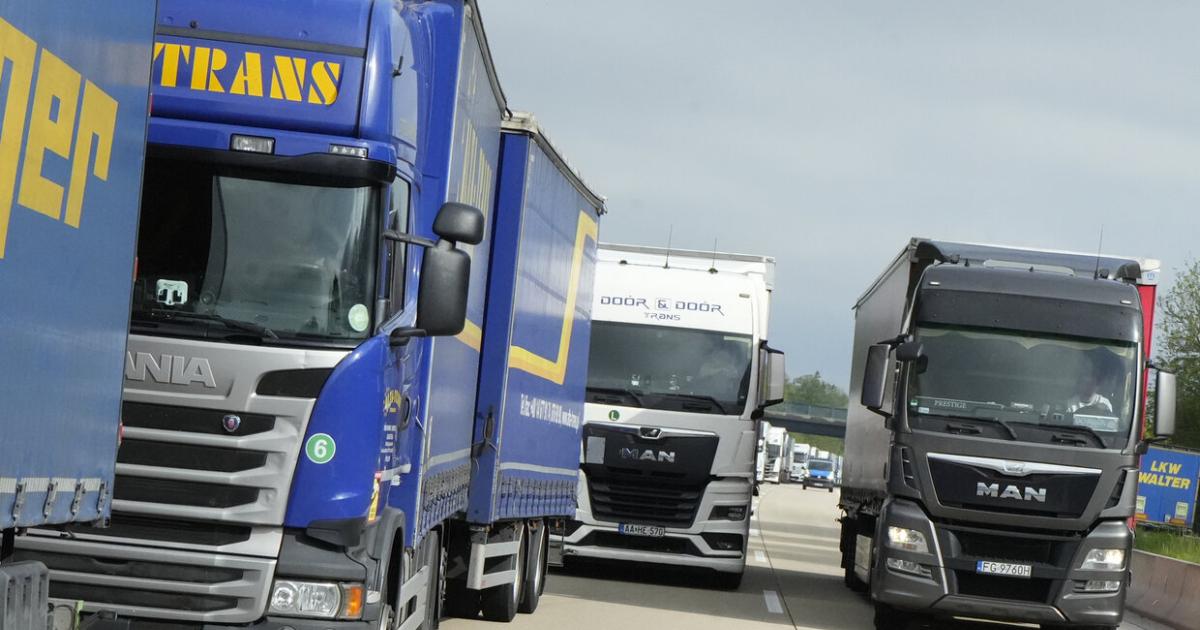
Sharp criticism of the Ministry of Transport’s planned Renewable Energy Transport Act (EEGV) comes from Alexander Klacska. The chairman of the transport and traffic division in the Chamber of Commerce, which represents 40,000 member companies with 220,000 employees, warns against over-fulfillment (“gold plating”) of EU requirements.
“The bill is not just gold plating, it is already platinum plating with diamonds,” Klacska said on Thursday. The draft law concerns the implementation of the EU Renewable Energy Directive RED III. It stipulates that Austria will have to replace 35 percent of fossil energy with renewables by 2030 – the EU only requires 29 percent. While the EU directive ends in 2030, says Klacska, the Austrian draft continues the requirements until 2035 – with a substitution rate of 65 percent.
From January 1, 2027, distributors of fossil fuels will be required to replace 18 percent of their energy with renewables.
“This is a special law for traffic and is causing great unrest. The economy is being taken hostage,” criticizes Klacska. “We already knew that this law was coming, but we didn’t know that the law would come like this. We cannot accept a frontal attack on the Austrian economy via energy prices.”
The situation in the industries
There are problems on the street. Demand for the next three months is clouded. The situation is made worse by the labor shortage. But it is also a fact: 60 percent of transport companies describe their order backlog as “at least sufficient”. According to Barbara Adametz-Schneller, managing director of the trade association, rail freight transport is showing a slight upward trend: 1.8 percent more goods were transported in 2025 than in 2024.
Klacska calls for a clear commitment to freight transport by rail – not just in Austria, but throughout Europe. In Austria the share of total freight traffic is almost 30 percent, 40 percent would actually be desired.
Freight transport by ship is declining
“The conditions for freight transport by rail have become worse over the last few years,” says Klacska. Free routes for rail freight transport are in short supply. As is well known, passenger traffic has priority. However, the expansion of rail freight transport is extremely important for achieving the climate goals.
The situation on the Danube is dramatic: 2025 was “a new low”. Freight transport by ship fell by 11.6 percent compared to 2024. In total, only 5.8 million tons of goods were transported. The slump is mainly due to less freight transport to Austria and less transit traffic through Austria.
“In order to get back into positive waters, there certainly have to be more concrete goals: What do you want to achieve and what measures should you use to achieve it?” says Adametz-Schneller.