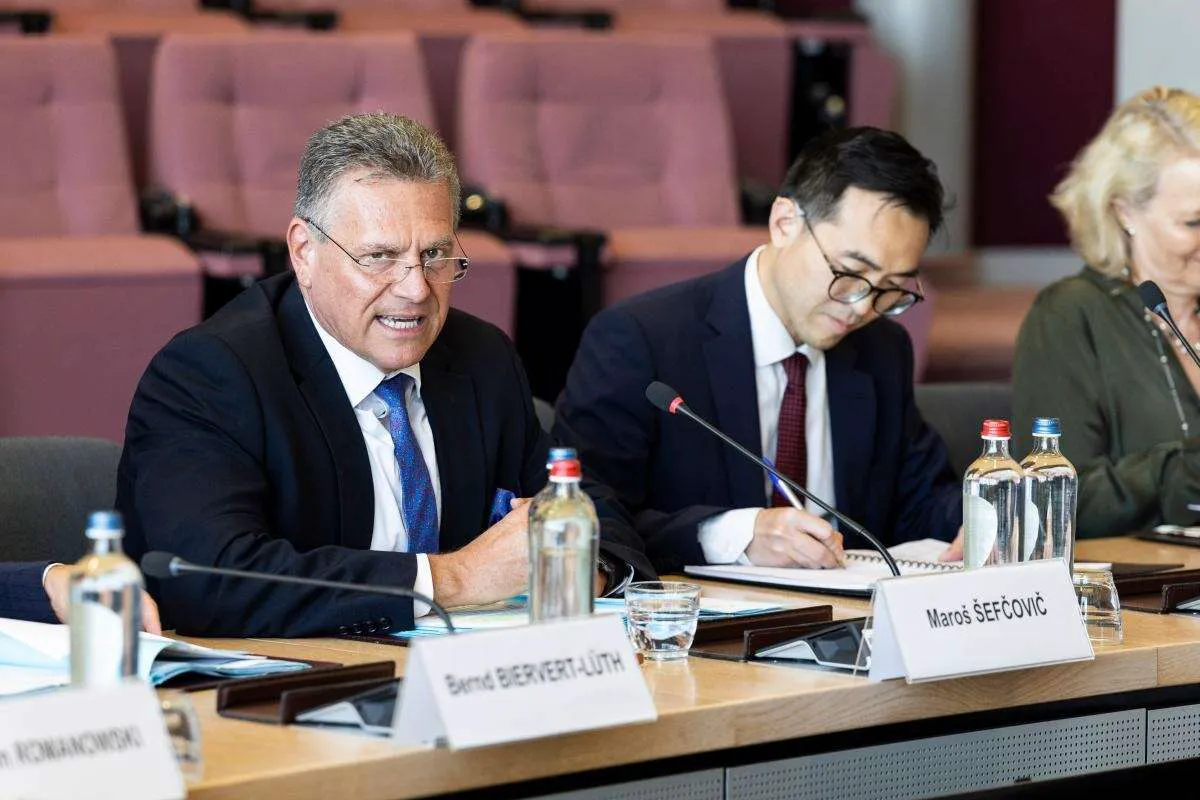
The credibility of the EU’s China line was put to the test today when the trade commissioner Maroš Šefčovič met the Chinese Minister of Commerce Wang Wentaon in Brussels. In the meeting between the two, it was crucial for the EU to see whether China is genuinely ready to respond to the EU’s growing concerns or whether the parties are drifting towards a deepening trade conflict.
The background of the negotiations is a rapidly growing imbalance in the trade balance. Last year, EU countries imported over 360 billion euros more goods from China than they exported there.
At the heart of the China problem is the country’s production model, where strong government subsidies enable massive overcapacity and the export of cheap products to Europe. This can be seen concretely in the fact that the European car, steel and chemical industries, as well as the forest industry, are under great pressure, and there is a justified fear of the loss of jobs and industries in Europe.
Trade Commissioner Šefčovič said at his press conference in Brussels on Monday that the current situation cannot continue.
“The gap is growing, while China’s exports to the EU continue to grow, our market share in China is shrinking,” the commissioner described.
Industry to be protected
The Commission’s main goal is to protect European industry and ensure fair competition globally. You don’t want to get into a too tight saber-rattling game with the giant from the East, because China can quickly hit Europe back even harder.
“The EU remains open for business, but we must defend our industrial base so that our industry has a fair chance to compete,” Šefčovič said.
For this, the EU and China are establishing a new negotiation format, where key issues will be discussed in four entities. They are: trade balance, export controls, intellectual property rights and the reform of the World Trade Organization (WTO).
According to the commissioner, the negotiations with China will also help manage political tensions.
“They help us avoid unnecessary tension.”
According to Šefčovič, the negotiating teams have an ambitious schedule, and concrete results are expected by October, when the commissioner will travel to China to assess the progress of the situation.
China’s attitude?
Trade Commissioner Šefčovič, who has already met the Chinese Minister of Trade four times, said that China approached the negotiations more constructively than before and showed an increased understanding of the EU’s concerns.
“The discussion is really constructive. I see that the understanding of common challenges is greater than before.”
One concrete signal was China’s assurance about export restrictions on rare earth metals and magnets, as the Chinese minister had given an assurance, according to Šefčovič, that the current export restrictions will not disturb EU supply chains.
“However, I have also proposed ways to further facilitate the licensing procedure for EU companies,” the commissioner continued.
Another tangible result of the negotiations is a common trade flow monitoring system that alerts if imports from China grow too fast. The EU considers this a key way to prevent market disruptions and react quickly.
“If we see a sudden increase in imports, that is a clear signal that we need to act politically.”
The commissioner also listed as a step forward the joint press release made with the Chinese Minister of Trade, which has not been done for years, as the previous joint release was last published in 2019.
READ ALSO
With these means, the EU’s China deficit will be brought under control
The EU and China aim to correct the trade imbalance by strengthening ministerial-level dialogue in the new trade and investment consultation (TIC) and by launching concrete actions in several areas.
The purpose is to balance trade, improve market access, reduce trade barriers and increase trade transparency through a joint monitoring mechanism. In addition, there are plans to develop cooperation in export control, protection of intellectual property rights and reform of the WTO, and to deepen the exchange of information on critical raw materials in order to secure the stability of supply chains.
Four lines of work:
At the first meeting, four key areas of cooperation were identified, within which work will be started immediately at the official level: They are trade and investment balancing, export control, intellectual property rights (IPR) and reform of the World Trade Organization (WTO)
Šefčovič and Wang gave officials a mandate to promote these entities and agreed to meet again at the ministerial level in October.