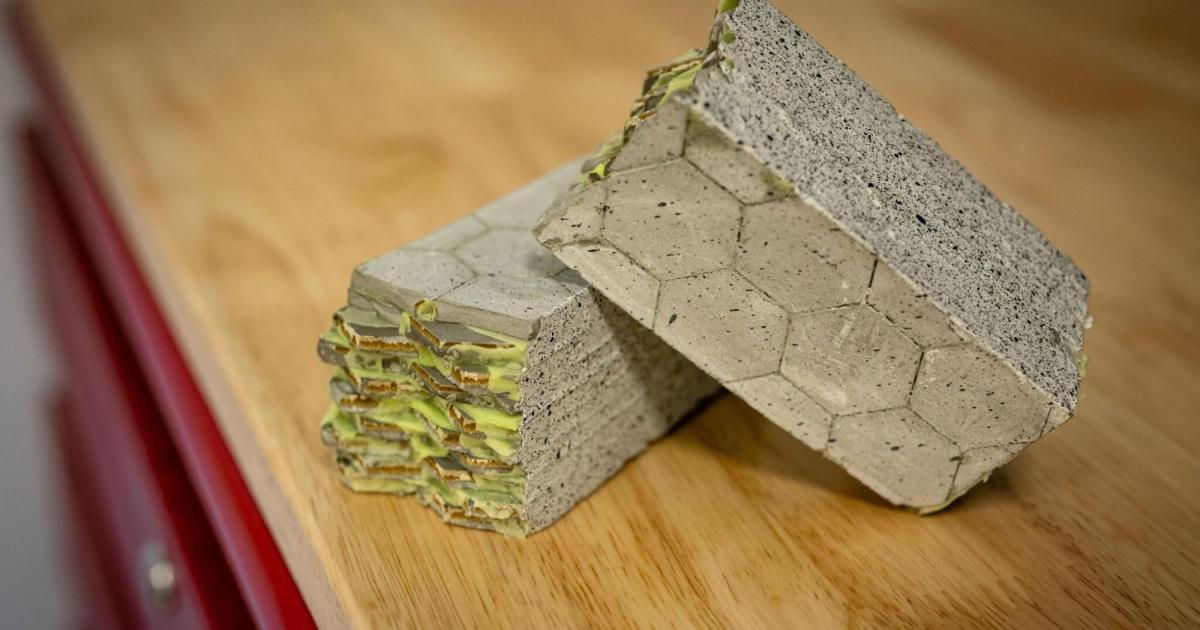
The local one cement market since the end of the construction boom over the past three to four years 25 percent broke in. The cement industry association announced this in response to an APA request.
Nevertheless, the plants produced 4.53 million tons of cement last year, 0.4 percent more than in 2024. Although less than 470 kilograms of CO2 were produced per ton of cement for the first time, the industry’s total CO2 emissions rose by 2.6 percent to 2.14 million tons.
In Deutschland and France is the Cement consumption most recently fallen to the level before the Second World War. It’s similar in Austria, says the managing director of the Association of Austrian Cement Producers (VÖZ), Sebastian Spaun.
“The fact that the Austrian factories have recently produced slightly more is entirely due to additional exports. However, this strategy cannot be used sustainably.” Cement is the main component of concrete.
467 kilograms of CO2 per ton of cement means low emissions
The fact that emissions increased more than cement production itself is explained by higher clinker production. However, CO2 intensity is the key indicator for assessing progress in the transformation, as it reflects emissions in relation to the amount produced. With 467 kilograms of CO2 per ton of cement, domestic production is one of the lowest-emissions in the world, emphasizes the Association of Austrian Cement Producers (VÖZ). However, you have to compete with products from countries whose companies are subject to much lower requirements.
Clinker production is central to the cement industry and the main cause of CO2. Raw materials such as limestone and clay are fired at more than 1,400 degrees Celsius. Most emissions arise chemically through the deacidification of limestone.
“The Austrian cement industry has done its homework and has been investing hundreds of millions of euros in decarbonization, circular economy and innovative CO2 capture technologies for years,” says VÖZ managing director Spaun.
You are successful in doing so. “Local waste cycles now provide the energy for clinker production; around 90 percent of fossil fuels have been displaced from cement plants.”
The VÖZ leading companies thus secured the basis of modern infrastructure and regional value creation with local raw materials, on short routes and with increasing use of recycled materials.
The association puts the substitute fuel quota at 88.8 percent. Fossil fuels would largely be replaced by waste materials that can no longer be recycled. In addition, alternative raw materials are used in clinker and cement production. 25 percent of the raw materials used came from recycled construction waste from old buildings. In total, the domestic cement industry uses around 550 kilograms of substitute materials per ton of cement produced.
The alternative fuels and raw materials mainly come from the region, replace fossil resources and make an important contribution to climate protection. Residual materials are used to create a high-quality building material for sustainable construction and long-lasting, robust infrastructure.
“Zero emissions” without CO2 storage and pipelines are just a “pipe dream”
The transformation towards “zero emissions” is planned and technologically feasible, says Spaun. But the main challenge lies outside the cement plants.
“The industry is ready to invest and is clearly committed to the climate goals. Politicians are now required to create the necessary framework conditions. Without CO2 storage, pipelines and affordable industrial electricity, zero emissions by 2040 remain a pipe dream.”
“Political lip service for years”
A cement plant that has neither a connection to a CO2 pipeline nor suitable storage sites – such as exploited natural gas or oil fields in the immediate vicinity – faces insurmountable hurdles on the path to decarbonization towards “zero emissions”. In addition, the transport and storage of CO2 in Austria will not be available until 2040 at the earliest, “because key prerequisites are missing and Austria is blatantly lagging behind in developing the necessary infrastructure”.
A legal framework and the planning of a CO2 pipeline system including storage facilities are still missing. The industry has been listening to political lip service for years.
Titanium Gr.2 Bolts Supplier & Manufacturer in India
Titanium Gr.2 Fasteners Manufacturers and Suppliers in India
Titanium Gr 2 Flanges
Titanium Grade 2 Nut Manufacturer, Supplier in Mumbai, India
Titanium Gr 2 Pipe Supplier & Manufacturer in India
Titanium Gr 2 Round Bar Supplier & Manufacturer in India
Titanium Gr 2 Sheets and Plates Supplier & Manufacturer
Titanium Gr 2 Wire Supplier & Manufacturer in India
Titanium Gr.5 Bolts, Fasteners Manufacturers in Mumbai, India
Titanium GR.5 Fasteners Manufacturers and Suppliers In India
Titanium Grade 5 Nut Manufacturer, supplier in Mumbai, India
Titanium Grade 5 Pipe Fittings Supplier & Manufacturer
Titanium Grade 5 Seamless Tubing Suppliers In Mumbai, India
Titanium Gr 5 Sheets and Plates Supplier & Manufacturer
Titanium Gr 5 Tube Manufacturer & Supplier in India
Titanium Gr 5 Wire Supplier & Manufacturer in India
Titanium Pipe Fittings Supplier & Manufacturer in India
Titanium Round Bars Supplier & Manufacturer in India
Titanium Wire Supplier & Manufacturer in India
17-4PH Round Bar | ASTM A564 Type 630 Supplier India
Alloy 59 Round Bars | ASTM B574 UNS N06059 Supplier India
Difference Between Nitronic 50 and Nitronic 60
Duplex S31803 Pipes Fittings Supplier | ASTM A789
Duplex Steel S31803 & S32205 Fasteners Supplier in India
Duplex Steel S31803 / S32205 Sheets & Plates Supplier in India