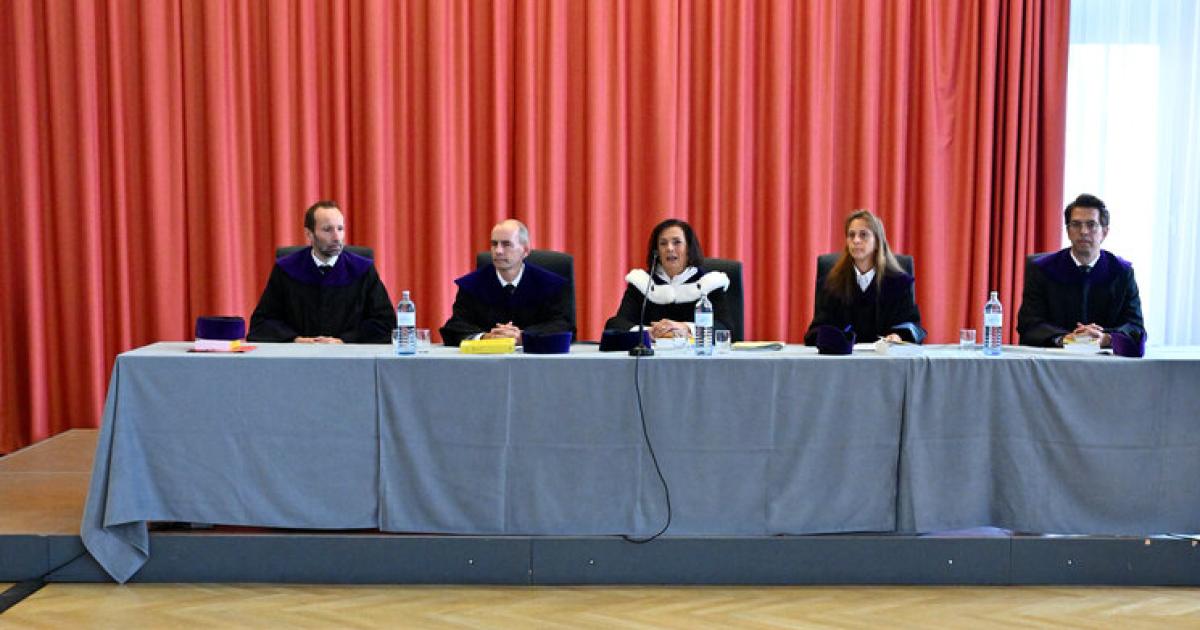
In contrast to Karl-Heinz Grasser, who gave a fiery speech on his own behalf in the Buwog case before the Supreme Court (OGH), Signa founder René Benko did not exercise his right to present his personal view before the Supreme Court on Thursday. He did not come to Vienna, but remained in the prison in Innsbruck. He was legally represented by Thomas Pillichshammer from the Wess law firm. Main defender Norbert Wess was also conspicuous by his absence. According to rumors, he is currently in Los Angeles for the World Cup.
There was also a lot of excitement in the OGH ballroom on the second floor of the Palace of Justice. The Supreme Court dealt with two appeals for nullity.
One came from René Benko’s defense against his sentence to two years in prison for fraudulent Krida causing damage of 300,000 euros. The other came from the Economic and Corruption Public Prosecutor’s Office (WKStA). She fought an acquittal in the same proceedings regarding advance rent payments (360,000 euros).
Complaint number one
The Signa founder was convicted because he reduced his assets by donating 300,000 euros back to his mother Ingeborg and thereby disadvantaged his creditors. The defense argued that Benko only temporarily transferred the money to his mother. He regularly received large donations from her to cover his living expenses.
He only paid back the 300,000 euros because he was unable to pay any further liabilities at the time. This 300,000 euros was included in later donations from the mother. Therefore, the creditors did not suffer any damage.
“A gift remains a gift”
The Supreme Court did not follow this argument. Supreme Court judge Christa Hetlinger stated: “A gift remains a gift.” The only decisive factor is the interest of the creditors. As a result of the transfer, Benko’s assets were reduced – the money was no longer available to the creditors.
Whether the mother’s donations were “needs-oriented,” as the defense claimed, or what motives were behind them, is legally irrelevant. Even later payments from the mother could not reverse the reduction in assets that had already occurred.
“The facts have already occurred,” said Hetlinger. In this case, the guilty verdict is now final.
acquittal fought
Meanwhile, in its appeal for nullity, the WKStA criticized Benko’s acquittal in the matter of advance rent payment. Benko had paid an advance rent of 360,000 euros for four years for a second luxury villa in Innsbruck’s Hungerburg, where his family currently lives – at a time when he was already experiencing a liquidity bottleneck. The defense argued that Benko had a right of termination, which would have resulted in a refund of the advance payment if exercised. So no damage for the creditors.
“Reduction in assets occurred with the advance payment”
The Supreme Court disagreed: It depends on whether the creditors have “the same security and satisfaction options” after payment. The reduction in assets occurred with the advance payment. However, the Supreme Court saw deficiencies in the first court’s reasoning on the subjective side of the crime – i.e. on the question of whether Benko acted intentionally.
The first court had denied intent because Benko had understandably intended to move into the rental property with his family and had made large investments.
“Incomplete and inadequate”
This justification was “incomplete and inadequate,” criticized OGH judge Hetlinger. The planned use of the apartment has nothing to do with whether Benko knew or accepted that the payment would disadvantage his creditors.
In addition, the first court did not sufficiently evaluate witness statements according to which the initiative for the high advance payment did not come from the landlady, but from Benko himself.
Because of these deficiencies in reasoning, the Supreme Court overturned the acquittal and referred the matter back to the first court for a new hearing. This must re-examine whether Benko acted intentionally. “We are quite optimistic about the second legal process. There are still a few arguments that we didn’t even consider in the first case,” says Benko’s defense attorney Thomas Pillichshammer from the law firm WKK Law (Wess).
As a result of this renegotiation, the extent of the sentence for both cases must also be reassessed.
Indictment in Italy
Benko also has bad cards in Italy: the Trent public prosecutor’s office has brought charges against the Signa founder and 36 other people for forming a criminal organization. The authority announced this on Thursday. At the end of 2024, the investigations into the “Romeo” affair uncovered a suspected political and business network in Trentino-South Tyrol.
At the center is a suspected criminal organization that is said to have influenced public tenders. In addition to Benko, among others: the Bolzano tax advisor and Benko’s ex-governor Heinz Peter Hager, the entrepreneur Paolo Signoretti, ex-senator Vittorio Fravezzi and the former mayor of Riva del Garda, Cristina Santi, were indicted. The preliminary hearing is scheduled for October 23rd in Trento.
Investigators suspect Benko of being “the leader of a mafia-like criminal organization” that wanted to obtain concessions and permits in order to make unjustified profits. He is said to have worked with Hager and Signoretti.
The suspects deny the allegations and are presumed innocent.
Mașini second hand Ilfov – Danove Auto
Mașini second hand Maramureș – Danove Auto
Mașini second hand Mehedinți – Danove Auto
Mașini second hand Mureș – Danove Auto
Mașini second hand Piatra Neamţ – Danove Auto
Mașini second hand Olt – Danove Auto
Mașini second hand Prahova – Danove Auto
Mașini second hand Satu Mare – Danove Auto
Mașini second hand Sălaj – Danove Auto
Mașini second hand Sibiu – Danove Auto
Mașini second hand Suceava – Danove Auto
Mașini second hand Teleorman – Danove Auto
Mașini second hand Tulcea – Danove Auto
Mașini second hand Vaslui – Danove Auto
Mașini second hand Vâlcea – Danove Auto
Mașini second hand Vrancea – Danove Auto
Alfa Romeo second hand cu garanție – Mașini second hand Alfa Romeo
Audi second hand cu garanție – Mașini second hand Audi
BMW second hand cu garanție – Mașini second hand BMW
Chevrolet second hand cu garanție – Mașini second hand Chevrolet
Chrysler second hand cu garanție – Mașini second hand Chrysler
Citroën second hand cu garanție – Mașini second hand Citroën
Dacia second hand cu garanție – Mașini second hand Dacia
Dodge second hand cu garanție – Mașini second hand Dodge
Fiat second hand cu garanție – Mașini second hand Fiat