A carbon tax of 15 USD per ton of CO2 will help Vietnam reduce emissions by 3%, but it may come at the expense of economic growth, if there is a lack of appropriate support policies, according to a professor at the University of Copenhagen.
On July 13, the Institute for Policy and Strategic Studies (IPSS) in collaboration with the United Nations Development Program (UNDP) announced the results of the study “Evidence-based policy implications for a just energy transition in Vietnam”.
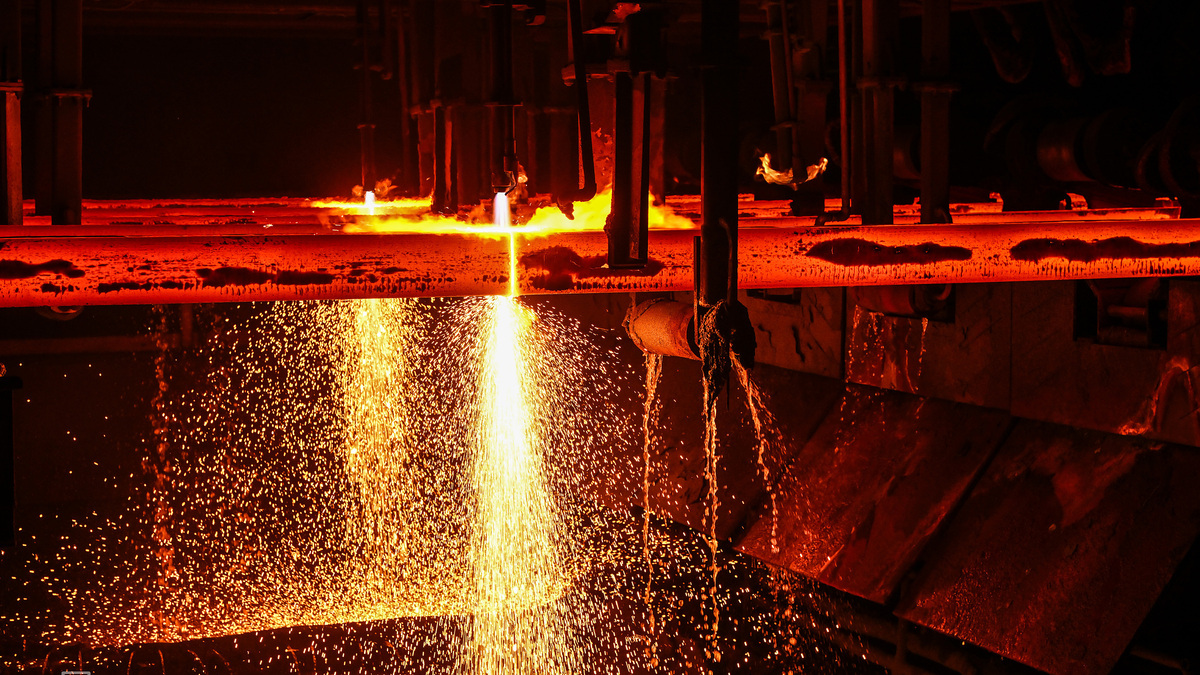
Hoa Phat steel factory in Dung Quat, April 2024. Image: Giang Huy
The research team quantified the impacts and trade-offs of green transition policies on the economy and society. Specifically, Professor Finn Tarp, University of Copenhagen (Denmark) – an academic support unit, said that if the government imposes a carbon tax at 15 USD per ton of CO2, the economy’s emissions will decrease by 2.9%.
According to the research team, the above mentioned tax rate of 15 USD is large enough for businesses to be afraid of polluting activities. Besides, this level is within the recommendation range of the World Bank in the Vietnam 2045 report.
However, experts also warn that GDP could decrease by 0.8% if there are no appropriate compensation measures. Of which, import and export decreased by about 0.9%, investment decreased by 1.3%, and indirect taxes also decreased by 1%. The only increase in the carbon tax scenario is in government revenue, at 0.41%.
Carbon pricing has the greatest impact on industries that use fossil fuels, including coal power. Meanwhile, this is the power source that accounts for a large proportion. This also results in household income being affected, mainly due to increased electricity bills. “High-income households often use more electricity. That is, this is also a way for us to tax richer people more,” Mr. Tarp said.
The impact of a carbon tax of 15 USD per ton of CO2 on the macroeconomy. Source: IPSS
Dr. Vo Tri Thanh, former Deputy Director of IPSS, noted that the GDP in the above research data has not been green accounted, which means calculating factors of resource depletion and environmental damage. That is, if environmental factors are fully accounted for, a carbon tax actually helps GDP grow more positively and sustainably. He affirmed that carbon tax is a highly market-based tool and the most effective resource mobilization.
To reduce the negative impact on the economy during the green transition, experts recommend that the allocation of carbon revenues should be directed towards low-income groups. When properly allocated, poor rural households can increase their income, making the transition more equitable among population groups. Danish experts note that only 30% of carbon tax revenue can offset the income of the 50% of households with the lowest income.
Associate Professor. Dr. Vu Sy Cuong, Deputy Head of the Department of Financial Policy Analysis, Academy of Finance, noted that the revenue distribution mechanism needs to be balanced between parties. He gave the example of electric vehicle conversion, electric vehicle manufacturing enterprises are the beneficiaries of the most incentives, with special consumption tax reduction. Meanwhile, an important component in the electrification process is the power transmission grid, but the locality “hardly benefits”
Specifically, Dr. Nguyen Ngoc Hung, Head of the Energy Economics Department of the Institute of Energy, said that the Central region is a sunny and windy area, suitable for developing renewable electricity to supply to the Northern region, which has high demand. However, localities collect very little land tax money for building foundations, columns, and power grid safety corridors, while spending resources on power transmission affects other economic activities in the locality.
Experts agree that carbon taxes need to be accompanied by other tools to avoid negative effects on short-term economic growth. For example, IPSS research also shows that saving and using energy efficiently by 10% helps Vietnam’s GDP increase by 1%, which is a “win-win” solution for economic growth, emission reduction and household income.
In case the government wants to protect a domestic industry, the operator can use other subsidy tools. Mr. Tarp used the example of a cement factory in his hometown of Denmark – where he and his friends worked as floor cleaners and loaders during their student days. Even though many of his friends died early from cancer, the government still exempted these factories from carbon taxes, due to concerns that businesses would shift polluting production to other localities. He emphasized that every decision comes with certain trade-offs, forcing policymakers to calculate carefully.
Besides taxes, carbon exchanges (ETS) are also a carbon pricing tool. At the end of last month, Vietnam piloted this floor, with 92 thermal power, iron and steel, and cement enterprises participating. In particular, the total greenhouse gas quota, which is the amount of emissions allowed by the above group of businesses, is at 511 million tons of CO2e in 2025-2026, forcing them to find ways to reduce emissions.
According to the report Vietnam 2045 – Greener Growth published by the World Bank last year, Vietnam’s greenhouse gas emissions per unit of GDP are 45.6% higher than the level of middle-income countries. The power, industrial and agricultural sectors are the main sources of emissions. Efforts to save energy, accelerate the decarbonization process in industries, and create carbon sinks can help cut greenhouse gases by 74% by 2050.
KOBET 신규 슬롯게임 소개 – 토토벳
Water Restoration Phoenix AZ Flood Damage Repair Company
Water Damage Repair Phoenix AZ Emergency Restoration Experts
Water Extraction Phoenix AZ | Premier Flood Cleanup Services
Water Mitigation Phoenix Services For Flood Damage Restoration
Water Damage Clean Up Phoenix | AZ Repair Professional Services
AvandaMobil – Situs Jual Beli Mobil Baru & Bekas di Indonesia
Tentang AvandaMobil – Cara Kerja untuk Pembeli & Sales
Berita & Tips Mobil Terbaru – AvandaMobil
Daftar Harga Mobil Baru 2026 – Semua Merek – AvandaMobil
Jual Beli Mobil Bekas Berkualitas – AvandaMobil
Harga Mobil per Daerah – 514 Kota/Kabupaten di 38 Provinsi – AvandaMobil
Daftar & Mulai Berjualan di AvandaMobil – Lapak Sales Resmi & Iklan Mobil Bekas
Cara Kerja AvandaMobil – Untuk Pembeli, Sales, dan Penjual Mobil Bekas
Hubungi Kami – AvandaMobil
Muhammad Avanda Alvin – CEO & Founder AvandaMobil
Peta Situs – Cari Berdasarkan Kategori – AvandaMobil
Jual Mobil BYD 2026 – Daftar Model, Harga OTR & Sales – AvandaMobil
Jual Mobil Chery 2026 – Daftar Model, Harga OTR & Sales – AvandaMobil
Jual Mobil Daihatsu 2026 – Daftar Model, Harga OTR & Sales – AvandaMobil
Jual Mobil Honda 2026 – Daftar Model, Harga OTR & Sales – AvandaMobil
Jual Mobil Hyundai 2026 – Daftar Model, Harga OTR & Sales – AvandaMobil
Jual Mobil Isuzu 2026 – Daftar Model, Harga OTR & Sales – AvandaMobil
Jual Mobil Jaecoo 2026 – Daftar Model, Harga OTR & Sales – AvandaMobil
Jual Mobil Mitsubishi 2026 – Daftar Model, Harga OTR & Sales – AvandaMobil