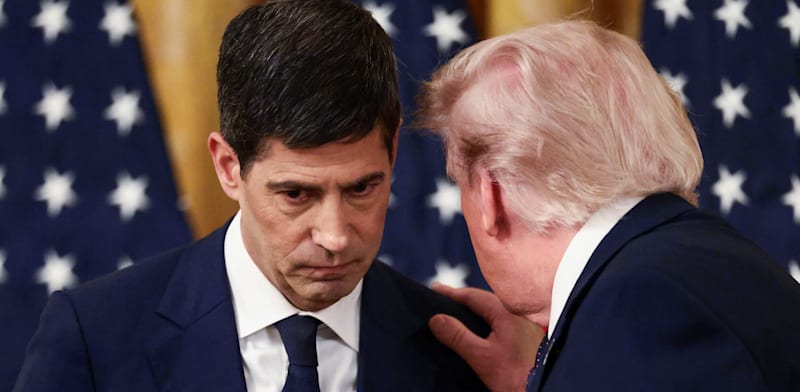
Kevin Warsh took up his position as chairman of the Federal Reserve Bank at the end of May 2026, setting himself a clear goal: to return inflation to 2%, the central bank’s official target.
After the inflation data was released on Tuesday, Warsh came to Congress, unveiled his plan to fight inflation, and raised questions about his relationship with US President Donald Trump.
In his first testimony before the US Congress since taking office, he made it clear to lawmakers that for him it is too early to declare victory in these areas, even if the latest inflation figures were better than forecasts.
“There will be those who will look at the (inflation AU) data released this morning and say that the mission is accomplished,” he told members of the Congressional Financial Services Committee on Tuesday, “that is not my position.”
According to him, “If we make the right decisions, and we will, the wave of inflation of the last five years will become a thing of the past.”
The annual inflation rate in the United States fell to 3.5% in June, a figure that was lower than forecasts mainly due to the drop in energy prices, following the momentary halt in the US-Iran war.
Dr. Gali Ingber, Head of the Department of Finance and Economics at the Faculty of Business Administration at the College of Administration, explains that “when Warsh defines the prevention of inflation as his uncompromising goal, he is actually signaling that achieving price stability is a top priority, even if the tools to achieve it will weigh on the market.”
The markets interpreted the data as a sign that the chance of raising interest rates in the upcoming decision of the Federal Reserve has significantly decreased. And the consensus according to the CME website is 83.4% who believe that the interest rate will remain unchanged in the upcoming decision, on July 29. This is compared to 16.6%, who expect an interest rate increase of 0.25%.
Alongside the fight against inflation, Warsh indicated another target: a significant internal change within the central bank. He said that he intends to promote reforms that will strengthen the Fed’s ability to meet the two goals for which it was established – maintaining price stability and supporting a strong labor market.
According to him, the Fed must improve the way it makes decisions in order to better deal with the challenges posed by the American economy.
The fight for Fed independence
A large part of the discussion dealt with his relationship with President Donald Trump. Members of Congress, mainly from the Democratic side, wanted to know how he would act if the president tried to put pressure on him to lower interest rates, as he did repeatedly with his predecessor, Jerome Powell.
Warsh did not shy away and said that “if I become a target personally, I will continue to do my job.” Then he added a sentence that seemed intended to convey a clear message to the White House. “Outside the four walls of the Federal Reserve there is a lot of politics. My goal is that inside the central bank there will be no politics. And if there is, we will get it out of there.”
He emphasized that the independence of the central bank is a basic condition for its credibility. “The independence of the Federal Reserve is a sacred value,” he said. “We can only do our work if we become – and are perceived – as an independent body.”
The relationship with Trump
Trump, who appointed Warsh to the position, has made it clear over the years that he prefers lower interest rates, and also said during Warsh’s nomination process that he wanted to choose a chairman who would support this approach.
But so far Warsh is not delivering the goods that Trump might have hoped for. Already at the first interest rate meeting he presided over, there was no suggestion at all to reduce the interest rate, and he also signaled that he intends to continue making decisions based on economic data only.
Dr. Ingeber believes that “the gap between Trump and Warsh is not just a professional debate about interest rates. This is a frontal fight for the independence of the most important financial institution in the world. The administration’s attempt to bend the Fed creates enormous uncertainty in the markets, which are watching closely to see who will blink first in this historic confrontation.”
Even outside the Federal Reserve, people get the impression that at this point Warsh is signaling independence. Many economists quoted in the US media in recent days point out that the work teams he appointed are made up of highly experienced professionals, not political figures, and that the messages he has delivered since taking office are more similar to those of his predecessor than to the expectations expressed by Trump.
Will the warm relationship between the two last? This is the question in the economic media in the US. But it is still too early to answer it.
But if inflation remains high and the Fed is forced to keep interest rates high, or even raise them, Warsh could find himself in the same place as Jerome Powell. A central bank chairman who is required to choose between the president and his professional judgment.
“From the point of view of the chairman of the Fed, lowering interest rates too quickly could be a mistake that will lead to the return of inflation,” says Prof. Alice Barzis, head of the Macroeconomics Forum in Israel, and a researcher at Bar-Ilan University.
“This is precisely where the gap between him and President Trump lies. Trump is interested in lower interest rates and faster growth, especially at a time when the US is trying to bring industries back to its territory, strengthen investments and maintain its technological advantage. The Fed, on the other hand, is mainly focused on the inflation target,” she explains.
The gap with China
“But it is possible that the debate is deeper than the question of interest,” Barzis adds. “As of today, inflation in the US hovers around 2-3%, while in China it is close to zero and sometimes even negative. At the same time, the growth rate in China is extremely high, and the country is investing huge sums in technology, AI, chips, energy and infrastructure.
“The USA is still the leader in many areas, but the gap between the two superpowers is narrowing. Conventional economic theory assumes that a central bank should focus on inflation, unemployment and financial stability. But is it possible to conduct a normal monetary policy when the world is in the midst of a struggle for economic and technological leadership?”
“It is possible that in a world of power struggles, the loss of technological leadership is much more dangerous than slightly higher inflation,” Barzis suggests. “History shows that superpowers do not lose their status because of a temporary deviation of one or two percent in inflation. They lose it when they stop leading in innovation, investments and technological development.”
For your attention: The Globes system strives for a diverse, relevant and respectful discourse in accordance with the code of ethics that appears in the trust report according to which we operate. Expressions of violence, racism, incitement or any other inappropriate discourse are filtered out automatically and will not be published on the site.