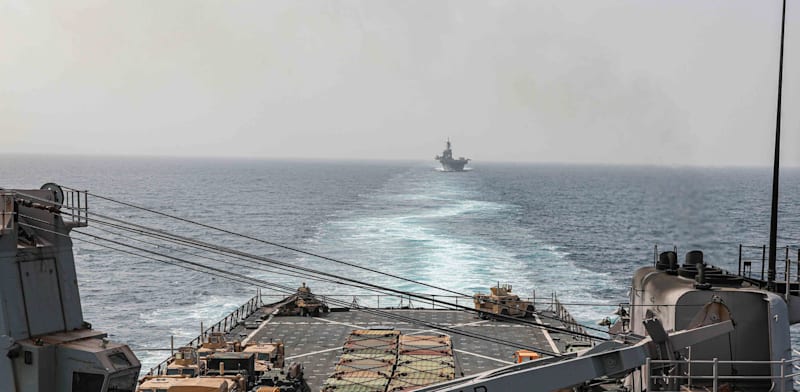
Iran has ordered the Houthi rebels to prepare to close the Bab al-Mandab strait, the southern entrance to the Red Sea, in the event that the United States disables the Islamic Republic’s electricity grid, Reuters reports. The initiative, which was told by two senior Iranian officials and another senior official from the region, is the result of a discussion with the leadership of the Ayatollah regime, following which the order was transferred to Sana’a.
Iran’s emissaries in Yemen, the Houthi rebels (“Ansar Allah” / Supporters of God), are not the recognized government – but they control about 28% of the territory. In this framework, they hold the capital Sana’a and the strategic port city of Hudaydah, which allowed them to block Bab al-Mandab for a long period of time.
Until the outbreak of the Iron Swords War, Bab al-Mandab was an important point in navigation between the Suez Canal and the Strait of Hormuz, two of the five busiest shipping lanes in the world. Until October 7, 2023, 12% of all world trade and 30% of international container traffic passed through the Suez Canal, and in the Strait of Hormuz about 20 million barrels of oil per day, until Iran imposed the blockade with the outbreak of Operation Hari’s Roar. In general, about 14% of the world’s maritime trade passes through the Red Sea.
Blocking 20% of oil and natural gas trade and disrupting supply chains
This means that about 30,000 ships a year have already found themselves for a long period of time unable to evade the Houthis in the Bab al-Mandab area, where alone more than 50 million tons of grain and 6.2 million barrels of oil per day passed. For the sake of comparison, the width of the Red Sea is indeed about 200 km, but Bab al-Mandab, which is between Yemen and Djibouti, is less than 30 km wide. Therefore, it will be very difficult for ships to evade the Houthis on their way to or from the Suez Canal.
In a situation where the Houthis block Bab al-Mandab again, the world will face not only the blocking of 20% of the world trade in oil and liquefied natural gas that cannot leave Hormuz, but also the sailing from the Far East to Europe and back, will be extended – at least – by two weeks. We have already learned from the Houthis’ previous siege that the disruption of supply chains and the movement of ships also resulted in a four-week extension of delivery times, and even more.
A source close to the Houthis told Reuters that the terrorist organization has completed its preparations to attack vessels with missiles and drones near the Bab al-Mandab strait. According to him, they are awaiting orders from Tehran. According to the report, senior Revolutionary Guards officers who are already in Yemen will lead the decision on when to begin the renewed siege of Bab al-Mandab.
For your attention: The Globes system strives for a diverse, relevant and respectful discourse in accordance with the code of ethics that appears in the trust report according to which we operate. Expressions of violence, racism, incitement or any other inappropriate discourse are filtered out automatically and will not be published on the site.