Many state-owned enterprises have assets worth trillions of dong, but it is difficult to grow due to entanglements in governance mechanisms and lack of capital autonomy, according to experts.
At the seminar on restructuring state-owned enterprises on July 21, Mr. Bui Khac Hien, Deputy Director of Planning and Finance (Ministry of Agriculture and Environment), stated that the State actually allocates capital and assets to businesses, but they are not considered real assets for them to actively exploit.
According to him, many businesses hold assets worth trillions of dong but find it difficult to grow because they do not have the right to self-determination. They are also not allowed to actively use these resources for production and business.
“If we consider land and infrastructure as capital, we must give businesses the right to do business. If we only assign management and exploitation, it cannot be counted as capital to require them to grow,” Mr. Hien said. At the same time, he believes that businesses cannot be blamed only when the management and governance mechanisms themselves constrain them.
He proposed clarifying the role of ministries and branches in managing state-owned enterprises, whether they are exercising ownership rights or just participating in developing policies and plans.
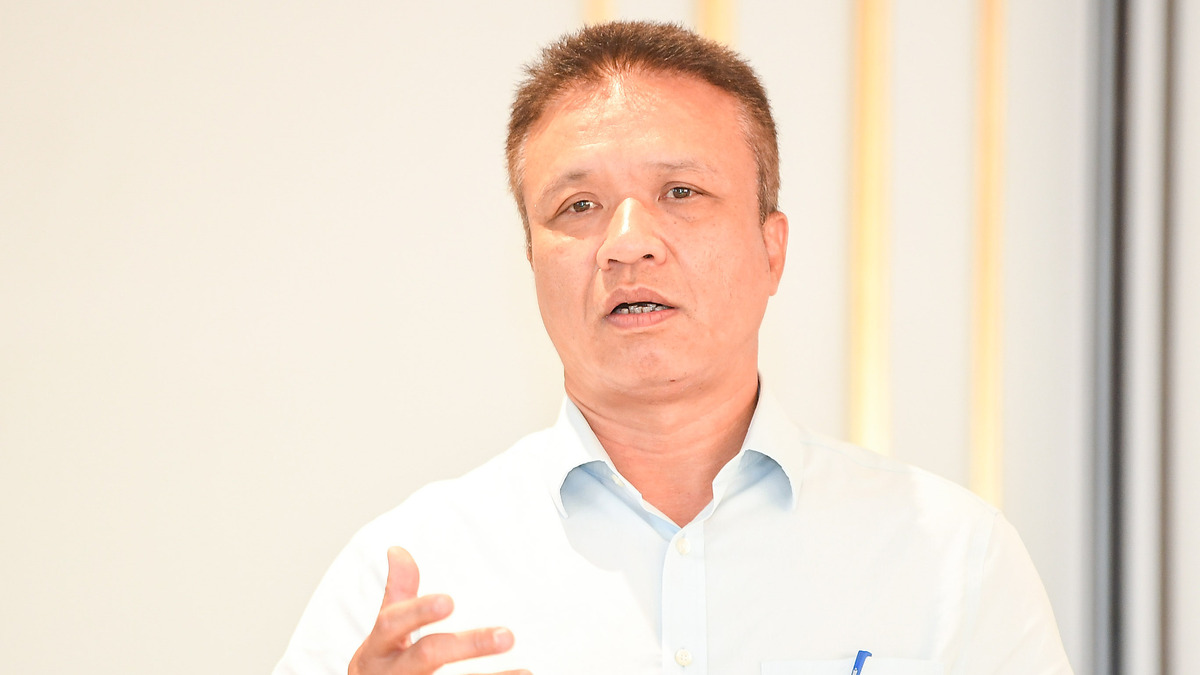
Mr. Bui Khac Hien, Deputy Director of Planning – Finance (Ministry of Agriculture and Environment), spoke at the seminar, July 21. Image: Tien Phong Newspaper
Inadequacies in governance are also one of the reasons why the arrangement and restructuring of state-owned enterprises has remained “stuck” for many years. By the end of 2025, the country will have 695 state-owned enterprises, of which the State holds 100% capital in 497 enterprises and controls 198 units. This business block owns about 4.5 million billion VND in assets, nearly 2.9 million billion VND in revenue and contributes about 390,000 billion VND to the budget, a significant increase compared to 2021.
However, the equitization and divestment process over the past 5 years has not achieved its goals. By the end of 2025, only nearly 30% of state-owned enterprises will have completed their restructuring projects. Also during this period, no enterprise has completed equitization, and only 17 out of 146 enterprises have divested capital. Total revenue from equitization and divestment reached about 3,720 billion VND.
According to Mr. Nguyen Tuan Linh, representative of the State Enterprise Development Department (Ministry of Finance), restructuring state-owned enterprises still has many limitations due to insufficient decentralization and complicated investment procedures. Not to mention, ineffective preparation and the mentality of avoiding responsibility on the part of business leaders and owner representative agencies.
Mr. Nguyen Duc Hien, Deputy Head of the Central Policy and Strategy Committee, said that Resolution 79 of the Politburo sets out a requirement to innovate thinking about restructuring state-owned enterprises. In particular, the focus is no longer on arranging or reducing the number of businesses, but on improving management capacity so that these units can play a leading role in key areas.
Vietnam aims to have 100% of state-owned enterprises apply the governance standards of the Organization for Economic Cooperation and Development (OECD) by 2030. Therefore, according to Mr. Hien, Vietnam needs to change the effectiveness assessment mechanism, shifting from relying on annual financial targets to taking an overall view so that businesses can feel secure in investing and pouring capital into the field of innovation, science and technology.
Along with that, the operator needs to consider establishing a National Investment Fund to handle weak businesses and implement strategic investment projects more effectively. The restructuring of the State Capital Investment and Trading Corporation (SCIC) also needs to be accelerated.
“If you want to have strategic autonomy, you must have strong enough businesses. Small and medium-sized enterprises can only develop when they have leading units leading them,” he said.
Sharing the same opinion, Mr. Phan Duc Hieu, a member of the National Assembly who is a full-time member of the National Assembly’s Economic and Financial Committee, said that restructuring state-owned enterprises is not simply about merging, dissolving or divesting capital, but must aim at improving operational efficiency and competitiveness.
According to him, in the immediate future, it is necessary to completely resolve the backlog of finance, land and legal obligations – “bottlenecks” that have lasted for many years, causing the process of equitization and business transfer to stagnate. For example, many businesses still have a situation where their charter capital is only recorded on paper, not enough actual capital has been provided, or many assets and projects have not had their full value determined when transferred.
“Enterprise arrangement and divestment need to shift from administrative thinking to market mechanisms, improving governance quality according to international practices,” Mr. Hieu said.
Professor. Dr. Hoang Van Cuong, former Vice Principal of National Economics University, also proposed separating state management functions from investment and capital management functions. According to him, management agencies should focus on policy planning, while investment and capital management should be assigned to specialized organizations operating according to market mechanisms. This will create a foundation for businesses to improve operational efficiency, lead and increase the competitiveness of the economy.