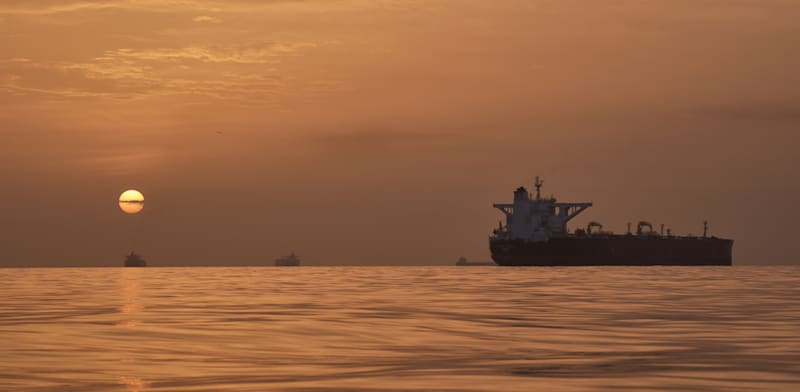
The Strait of Hormuz, which connects the Persian Gulf and the Indian Ocean, normally carries about 20% of the world’s oil and gas. But in light of the return of the blockades by Iran, and the counter-embargo by the US, the Gulf countries are beginning to understand that they will have no choice but to build bypasses that will allow the import and export of oil and other goods by land.
Deals are starting to close, construction of existing projects is accelerating, but several countries in the Gulf will have difficulty getting used to the new normal. “Everyone understands that what was in Hormuz will no longer be,” says Prof. Yehoshua Krasna, a former senior official in one of the intelligence organizations and today the director of the Forum for Regional Cooperation at the Dayan Center at Tel Aviv University.
Maritime transport is the lifeline of global international trade, and it will be very difficult to replace it. Prof. Krasna presents it in a simple way: “The largest tanker in the world holds 25 thousand tankers. How much is it in trucks? 25 thousand. Or even 250 huge trains. This means that there is no full replacement for transportation by sea, and the Gulf countries will not be able to give it up,” but on the other hand, “in the past it was not worth investing in land alternatives, due to high cost and little benefit. But today the risk has risen to such a level that the investment in surpluses and resilience is already worth the price.”
Dr. Ilan Gildin, manager of a hedge fund and partner in the Family Office funds, explains that “the players on the ground already understand that the situation in Hormuz is no longer temporary. If it was solvable at the level of months, there would be band-aids.
“But they are promoting the construction of infrastructure. This shows that the Iranian advantage is a strategic advantage, but it is wearing out. Iran is currently at the maximum it can achieve in Hormuz. As time goes by, the dependence on the Strait will decrease because they will find bypasses. Iran’s interest, then, is to start collecting money from Hormuz as quickly as possible, and the interest of the rest is to promote bypasses as quickly as possible.”
The United Arab Emirates is leading the way
The country that promotes bypass infrastructure the most is the United Arab Emirates. It is in a unique geographical location, and has one and only port outside the strait: Fujairah, at the eastern end of the country. Already today, there is an oil pipeline that leads from the emirate’s oil reserves in the areas of Abu Dhabi to the export port in the east of the country. But it is only able to transport 1.8 million barrels per day, half of the normal oil exports of the Emirates, which is about 3.5 million barrels per day during normal days. Especially since it has withdrawn from the international oil cartel OPEC, and is expected to significantly increase its production in the future beyond the quota that the cartel set for it in the past.
Even worse, the Fujairah port was also subject to frequent attacks by Iran against the oil export infrastructure there during the war.
Therefore, the United Arab Emirates initiated a number of projects designed to increase its bypass capacity: last May, it announced progress in expanding the pipeline in question to approximately 3.6 million barrels per day, at a cost of approximately $3 billion.
In June, it announced a dramatic acceleration in the construction of a railway to the port of Sohar in neighboring Oman, which is even further from Hormuz (and more importantly – in a neutral country in the conflict with Iran), and last Wednesday, the United Arab Emirates even announced the construction of two tank terminals at the port of Fujairah.
The last two projects result from the fact that the Emirates’ dependence on Hormuz is not only for exporting oil, but also for importing the basic commodities that are required to maintain a rich country with 10 million people in the heart of the desert. “The Emirates want to double the ports outside Hormuz, and Oman has become a big beneficiary, because they have 4 ports outside Hormuz,” explains Prof. Krasna.
Saudi Arabia: East-West Pipeline
Saudi Arabia, the world’s largest oil exporter, is among the main victims of the closure of Hormuz.
Its oil production rate dropped from about 10 million barrels per day between the months of September and February to about 7.7-6.6 million between the months of March and June.
The oil that Saudi Arabia manages to export goes through an “East-West” pipeline that can carry 7 million barrels of oil a day from the Persian Gulf to the Red Sea.
The bypass helped the country’s monthly oil revenues drop from March to April by about $6.3 billion “only” to about $18.5 billion.
However, in order to satisfy its customers in Asia, it is required to pass through another strait – Bab al Mandab, between Yemen and Africa. However, the Houthis in Yemen have declared a “sea blockade” on Saudi Arabia, as part of which they sink ships that are identified with the kingdom and try to pass there. The other solution, bypassing all of Africa via the Suez Canal, already creates a big gap compared to the ease with which ships sailed from the Gulf to Asia in the past.
Iraq: Promotes a pipeline to Syria
At the westernmost end of the Persian Gulf stands Iraq. It is a larger but much poorer country, and has no land connection with the eastern part of the Gulf outside of Hormuz. Therefore, she had to turn in the other direction, towards the Mediterranean Sea. There is currently one main pipeline that leads from the Iraqi oil depots in Kirkuk to the Turkish port city of Ceyhan on the shores of the Mediterranean Sea. It is also the port through which Israel receives most of its oil, which comes from Azerbaijan and Central Asia.
But this pipeline is not only insufficient, and carries only about 250,000 barrels per day (compared to millions of barrels per day exported through the Gulf in peacetime), it is not even connected to Iraq’s oil reserves in the south of the country.
Therefore, two new projects are now on the table: one, signed in an agreement between Iraq and Syria under American sponsorship, is the pulling of a pipeline from the city of Haditha in western Iraq through Syria to the port of Banyas on the Mediterranean coast, and the estimated cost is between 6-8 billion dollars. The second, proposed by Turkey, is a connection of the oil fields around the city of Basra in southern Iraq to Haditha, and from there the oil will also continue to Ceyhan.
The remaining gulf countries
But there are a number of countries for which no bypass is currently relevant. These are Qatar, Kuwait, and Bahrain. All three are small countries, sitting deep in the gulf, and will be completely dependent on the pipeline that will inevitably pass through Saudi Arabia. Kuwait is apparently a natural candidate for connection to Iraq and from there to the Mediterranean Sea, but according to Prof. Krasna “Kuwait still does not trust Iraq” since its invasion of the country in 1990. Which leaves it completely dependent on the graces of the regional giants Iran and Saudi Arabia.
In any case, says Dr. Gildin, there is a bright warning sign for Israel here. “This teaches us about the strengthening of regional alliances, and Israel is not currently in them. Saudi Arabia and Turkey are strengthening their cooperation, to transfer oil from Saudi Arabia through Syria and from there to Turkey and then to Europe, what we wanted to be the IMEC project, is a project designed to bypass that.
“Unfortunately, it does not seem that Israel is in any of these plans. The energy chains are starting to take shape, and Israel is not a player in any of the options.”
This is because the feeling among the countries of the region is that “Iran, the US and Israel started a campaign without taking into account the interests of the regional players. Therefore, it is not certain how much we can be relied on for long-term projects.”
For your attention: The Globes system strives for a diverse, relevant and respectful discourse in accordance with the code of ethics that appears in the trust report according to which we operate. Expressions of violence, racism, incitement or any other inappropriate discourse are filtered out automatically and will not be published on the site.