Gulf countries are accelerating the construction of a billion-dollar pipeline network to reduce dependence on oil transportation routes through the Strait of Hormuz.
Before the Middle East conflict broke out, about 15 million barrels of oil from the Persian Gulf were transported through the Strait of Hormuz every day. But in the next few years, most of them may no longer have to pass through this strategic waterway.
Many Gulf countries are actively planning to spend billions of dollars to build new pipelines to bring more oil to ports on the Red Sea, the Suez Canal and the Gulf of Oman.
According to government officials, oil and gas businesses and analysts, there are currently at least 7 large pipeline projects being built, planned or discussed, when oil prices are good and Iran still maintains pressure on Hormuz.
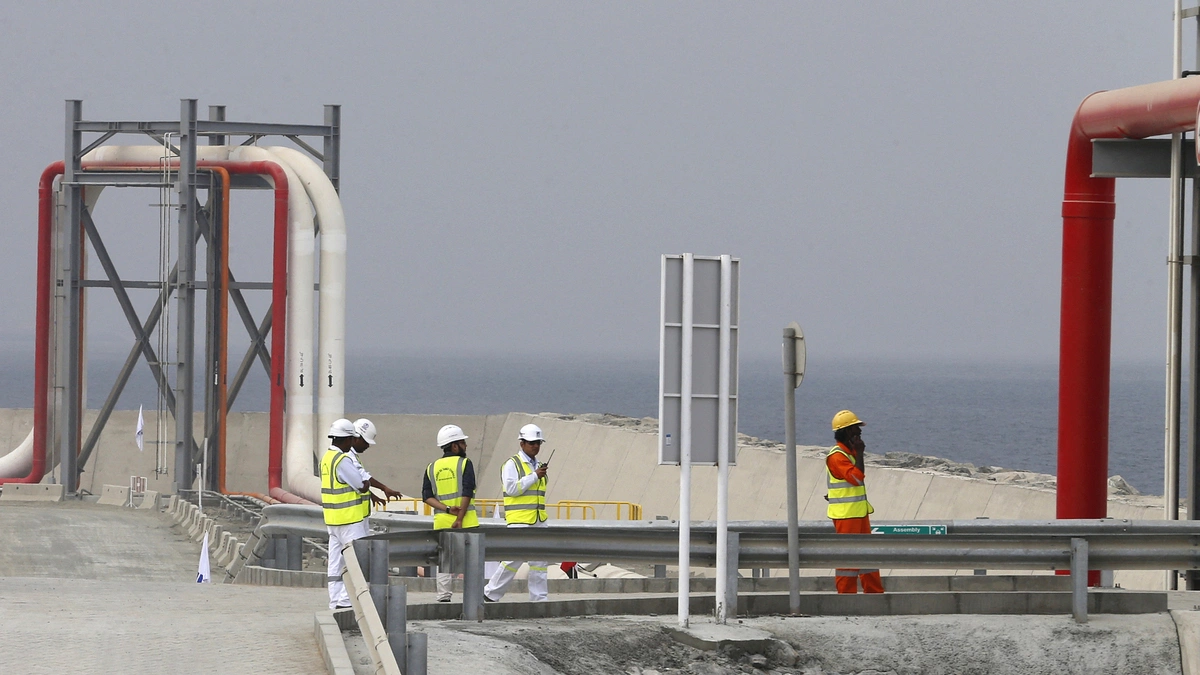
Oil transportation pipeline in Fujairah, UAE. Image: AFP
The US Energy Information Administration (EIA), said that before the war, the East – West route (Saudi Arabia) and the Habshan – Fujairah route (UAE) had a total excess capacity of 3.5-5.5 million barrels per day. Now, both are operating near maximum capacity.
But the existing capacity of these two pipelines is currently not enough. To pump more oil through routes avoiding the Strait of Hormuz, Abu Dhabi State Oil Company is accelerating the construction progress of a new 300 km long pipeline, worth $3 billion, to the port of Fujairah.
The new pipeline runs parallel to the existing Habshan – Fujairah route, expected to increase production by more than 1.2 million barrels per day. According to data analysis company Kpler, the project was launched before the conflict and is halfway implemented.
The initial goal was to complete in early 2027, but Kpler believes that this mid-year milestone is more feasible, due to the need to expand Fujairah port. Ms. Victoria Grabenwöger, senior expert at Kpler, said this ambition “becomes feasible in the context of the Strait of Hormuz being blocked”.
East – West route (green) of Saudi Arabia and Habshan – Fujairah route (purple) of UAE. Source:S&P
Meanwhile, Saudi Arabia is considering expanding capacity on the East-West route by 2 million barrels per day, according to Saudi sources. Reuters. The pipeline carries oil from the processing facility at Abqaiq, across the desert and to the Red Sea port city of Yanbu. From here, oil is pumped onto ships to be transported south to the Arabian Sea or north through the Suez Canal.
Iraq, OPEC’s second largest oil producer, is also heavily affected by disruptions in shipping through the Strait of Hormuz. This country’s oil output in June decreased by more than 50%, to about 1.9 million barrels per day, compared to about 4.2 million barrels previously.
About 90% of budget revenue comes from oil exports, forcing Baghdad to accelerate the construction of alternative export routes. Among them, one project will bring oil from the Basra export port – which once exported more than 3 million barrels per day, to Türkiye’s Ceyhan port on the Mediterranean coast.
This pipeline also has an additional branch to the Syrian port of Baniyas. On July 17, Basra Bassem Abdul Karim Nasr Petroleum Company and Syrian Petroleum Company Youssef Qablawi signed an implementation agreement.
In the long term, about 2 million barrels of oil could be transported to Baniyas (Syria) every day, which the US State Department calls an “important energy corridor”. “There is still a lot of room for Iraq to improve, increase oil production, and reduce dependence on neighbors,” US Secretary of Energy Chris Wright commented.
Iraqi officials are also working with Jordan to promote plans to build a pipeline from Basra to Aqaba. From here, the oil will be exported through the Red Sea or the Suez Canal to Asia and other markets.
Iraqi oil and gas pipeline network. In particular, the dark broken lines are construction plans and the light lines are unused. Source:S&P
According to Goldman Sachs analysts, the total of new pipeline projects to avoid the Strait of Hormuz could transport 3.8 million barrels per day by the end of next year and increase to 7.3 million barrels per day by the end of 2028. If the target is met, about 60% of pre-conflict Gulf oil exports (23 million barrels per day) will no longer depend on the Strait of Hormuz.
New pipelines help reduce risks, but the downside is that they can increase costs. Oil tankers departing from Yanbu port can choose to go through the Suez Canal, but this canal cannot receive the largest tankers with a capacity of up to 2 million barrels. This type of ship often has the lowest transportation costs for long journeys.
In addition, pipelines from the Persian Gulf to the Mediterranean take oil in the opposite direction from Asia – the main customer of oil passing through Hormuz. Therefore, to reach these markets, oil ships will have to go around the Cape of Good Hope at the southern tip of Africa, significantly lengthening the distance and increasing costs.
New pipeline routes are not completely immune to the risk of attack in the context of potential regional security instability. Oil transported from Saudi Arabia to the Red Sea through the pipeline still faces the risk of attack by Houthi forces in Yemen. In the past, this group has repeatedly disrupted shipping activities in the Bab el-Mandeb Strait – a maritime route connecting the Red Sea with the Gulf of Aden.
Pipelines located far from Iran are not completely immune to the risk of attack by Iran’s Islamic Revolutionary Guard Corps (IRGC) or allied armed groups. In May 2019, Saudi Arabia’s East-West pipeline had to stop operating after a Houthi drone attack.
Bob McNally, founder of consulting firm Rapidan Energy, said “the problem is not with the waterway”. “Iran can still use weapons to attack oil loading and unloading facilities, pumping stations, terminals, export ports and storage tanks along these pipelines,” he said on CNBC.