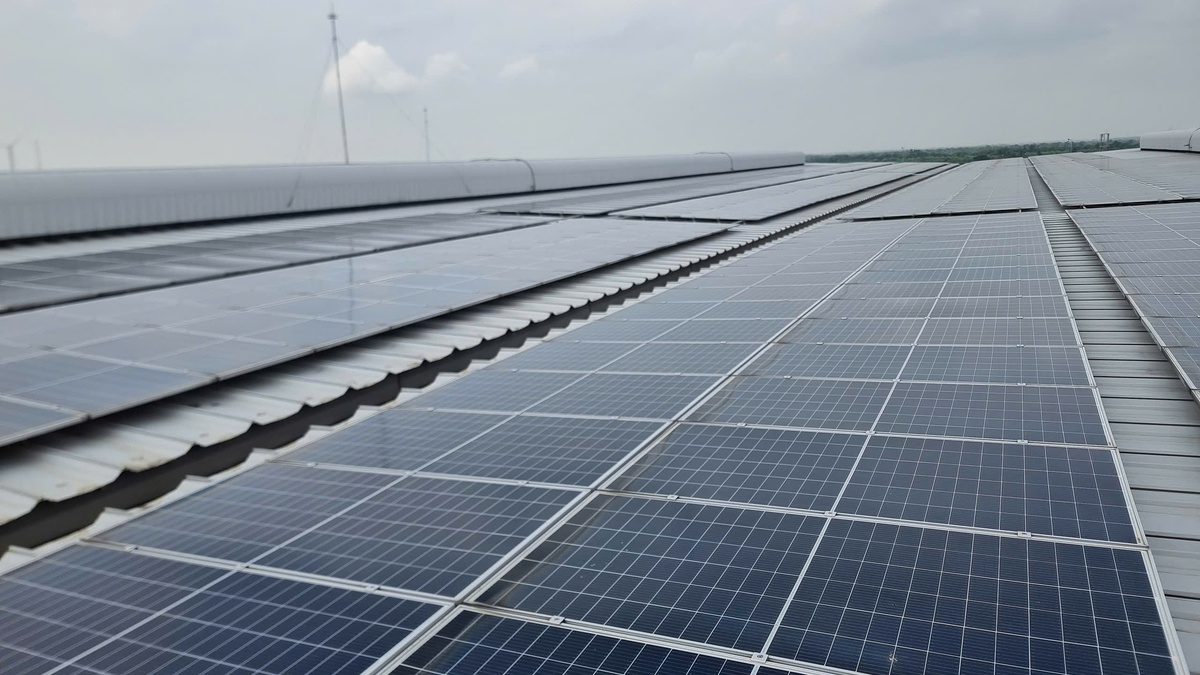
Every day, as the production line begins operation, the more than 11 MWp of solar power on the factory’s roof starts generating electricity, saving the company approximately 100 million VND in electricity costs.
Around 6 AM, the solar panels on the roof of FLAT Vietnam’s factory in DEEP C Industrial Park begin generating electricity. Around 5-6 PM, when workers finish their shifts, the system gradually reduces its output.
According to a representative from FLAT Vietnam, the power generation cycle almost coincides with the factory’s peak electricity consumption time of the day. The company views solar power as part of its production line, rather than as an energy investment.
On sunny days, the system reaches a peak capacity of over 9 MW, equivalent to 80-85% of its design capacity, meeting about one-third of the factory’s electricity needs. On average, the company saves approximately 100 million VND per day on electricity costs from the national grid.
This company is considering investing in an additional 1.5 MWp on the remaining rooftop space.
Rooftop solar power system at FLAT Vietnam. Photo: Quang Hung
Not only FLAT, but many businesses in DEEP C are also accelerating investment after policies on rooftop solar power gradually improved.
Mr. Dao Van Thuan, Electricity Manager of the DEEP C Industrial Park Complex, said that before 2025, the industrial park had already operated approximately 5.38 MWp of rooftop solar power. This year alone, businesses plan to add another 6.2 MWp. In just three months, from April to June, the total solar power capacity here increased by more than 70%.
According to him, businesses are increasingly viewing solar power not only as a solution to reduce electricity bills but also as a way to meet the emission reduction requirements of global supply chains.
This trend is not only happening in industrial parks. According to the Northern Power Corporation (EVNNPC), in the first half of this year, the unit developed approximately 8,500 new rooftop solar power customers with a total capacity of nearly 395 MW, far exceeding the plan in both the number of customers and capacity. By the end of June, EVNNPC had more than 10,000 customers with a total capacity of over 718 MW.
Previously, solar power was mainly found in a few large enterprises, but now the model has expanded to households, schools, medical facilities, and government offices.
In Hai Phong – the leading locality in rooftop solar power development in the North – by the end of June, there were 967 customers with a total capacity of about 60 MW. The local power company aims to increase this to 1,200 customers with a total capacity of 110 MW this year.
In Quang Ninh, many localities are also promoting the development of this model. In the Hai Ha area, approximately 139 customers have installed rooftop solar power systems with a total capacity of about 1.6 MW. Representatives from Hai Ha Power Company stated that they coordinated with the local government to survey the needs of each household, school, and medical center instead of applying a single model. The investment scale is calculated based on roof area, electricity usage needs, and the capacity of the power system.
They estimate that for households using approximately 800-1,200 kWh per month, the payback period is about 5-5.5 years. Households that use more electricity during the day may recover their investment faster.
In Mong Cai, the power sector is coordinating with the Provincial People’s Committee to install solar power on the roofs of schools, medical stations, and public offices. According to the plan, schools that have registered must complete installation before August 30th to be ready for use before the new school year.
According to EVNNPC, the market growth stems from several factors. Following the issuance of Decree 58/2025 on the development of self-sufficient rooftop solar power, along with the Prime Minister’s directives on electricity conservation and solar power development, the legal framework for this type of power has become clearer. Meanwhile, equipment costs have decreased, technology has improved, and awareness among businesses and the public about the benefits of solar power has also increased.
Another change is the increased active participation of local authorities. According to EVNNPC, all provinces and cities under its management have plans or directives for the development of rooftop solar power. Fifteen localities have set specific targets for government offices and households. Many places have assigned targets to individual communes, wards, or groups of schools and medical facilities.
Some localities are also researching support mechanisms such as green credit, incentives, simplification of investment procedures, or shortening of processing times. In Nghe An province, the Provincial Environmental Protection Fund provides loans at a preferential interest rate of 1.5% per year for environmental projects, including clean energy projects.
Despite its rapid development, rooftop solar power cannot yet completely replace grid electricity. In reality, electricity generation depends on weather conditions and only adequately meets demand during the day. At night or on days with less sunshine, the national power grid still has to handle the majority of consumption.
Therefore, experts believe that accurately calculating the investment scale and the electricity needs of each customer is a decisive factor in determining economic efficiency. Furthermore, expanding this model requires simplifying procedures related to construction, fire safety, and operational management.