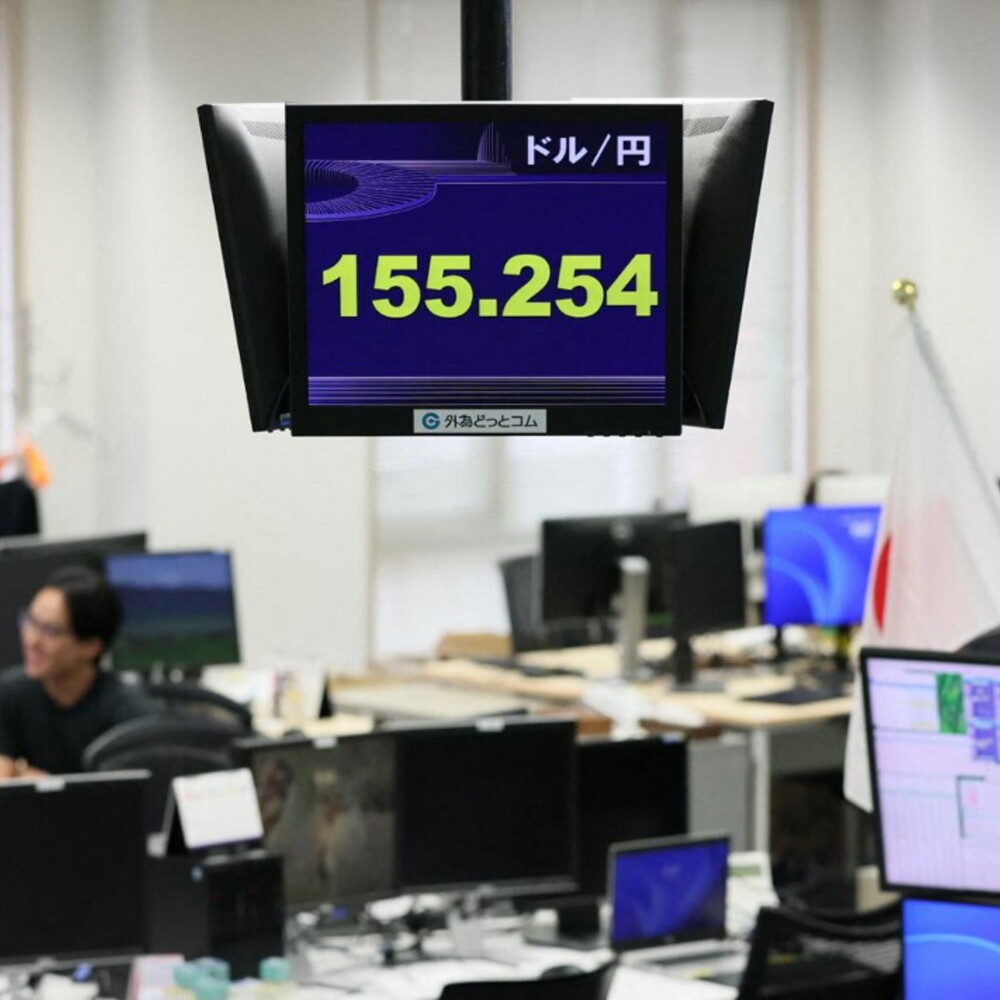
Donald Trump confirmed that the United States intervened to support the yen on the currency market, a “gesture of friendship” towards Japan, according to the American president, and also “positive for the global economy”.
Citing three anonymous sources close to the matter, the Financial Times reported that “the Federal Reserve Bank of New York made the unusual decision to sell euros to buy yen on behalf of the Treasury” on Friday, in coordination with Japan.
Asked aboard Air Force One about Washington’s reasons for spending money to support the Japanese currency, Donald Trump responded: “Because we have a good relationship with Japan.” The United States will benefit “financially” from this decision, the US president insisted, but “it was first and foremost (…) a gesture of friendship”, he added.
“We are very, very strong financially. They, as you know, have a weakening yen and needed a little help. And we always stand by Japan. Japan has been very generous to us, with the exception, of course, of Pearl Harbor,” he said.
Confirmations from Tokyo and Washington
This intervention coincided with the sudden appreciation of the Japanese currency, which in July reached its lowest levels since December 1986, reaching 163.24 yen per dollar, weighed down by the interest rate differential between Japan and the United States.
In Tokyo, Japanese Finance Minister Satsuki Katayama also confirmed the joint intervention of the two countries, specifying that her ministry had “purchased yen in coordination with the US Treasury Department” on Friday. “This joint action (…) has helped counteract the excessive volatility and disorderly movements of the yen in recent months (…) We will not hesitate to conduct further joint interventions,” he said in a statement.
A similar message came from US Treasury Secretary Scott Bessent: “We will not hesitate to participate in further joint interventions,” he said on X, citing economic security and the US-Japan alliance among the reasons for this decision.
Operation volumes and economic impact
On Friday, the yen was trading at 160.53 against the dollar, after reaching 158 the previous day, following rumors of Japanese government intervention. According to analysts cited by Financial Times, the Japanese intervention would amount to approximately 52.8 billion dollars, while the economic newspaper Nikkei he estimates it at between $37.5 and $44 billion.
And according to the British newspaper, it would be the first coordinated initiative between the United States and Japan to support the yen since 1998. A very weak yen mechanically increases the cost of Japanese imports, especially hydrocarbons quoted in dollars, while oil prices have skyrocketed this year, fueling persistent inflationary pressures in the archipelago.