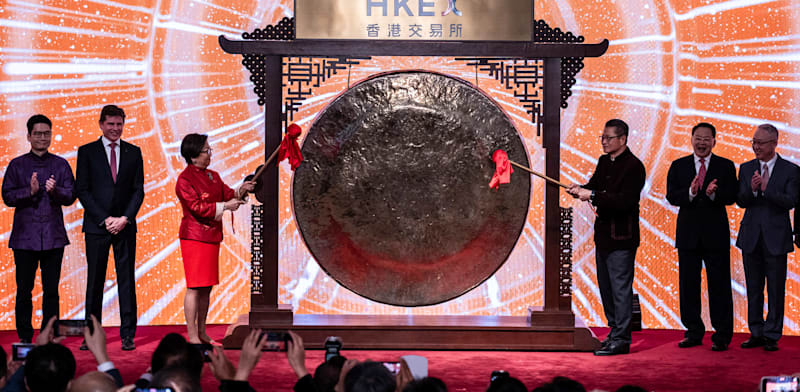
For decades, founders and investors in Chinese technology companies have used straw companies registered in tax havens to issue companies on overseas exchanges and hold billions of dollars outside the country. This loophole allowed China’s wealthy to bypass the country’s strict regulatory restrictions and avoid government oversight of their wealth.
Now the celebration ends. Through a series of new laws and regulations, China is reshaping the rules of the game for capitalists, aiming to tighten controls on how money leaves the country, and the consequences go beyond its borders.
● During the war with the USA: China supplies ammunition to Iran
● The Netherlands passed a law against trade with Israel, and made an exception for a giant company
The authorities are putting pressure on companies to abandon their foreign corporate structures and re-incorporate in China. Even companies that choose to issue in financial centers like Hong Kong are now required to make sure that the profits of the founders and stakeholders are invested back into China. At the same time, capitalists with assets outside the country face closer tax oversight of their profits overseas.
“The authorities in China simply did not enforce some of the rules they set themselves,” explains Erica Tay, an economist at the Maybank Investment Banking Group based in Singapore. “Now they are starting to put the house in order.”
Impact on the US
China’s new rules are causing discomfort among advisers to Asia’s wealthy. The volume of capital flowing from China has grown to such an extent that last year Hong Kong overtook Switzerland to become the world’s largest cross-border wealth management center, with assets amounting to $2.9 trillion, according to the Boston Consulting Group.
Beijing’s new rules will also have an impact on the US, as Asia’s wealthy families have become significant players in North America, with about half of their investment portfolios invested in the region, according to Swiss bank UBS.
China initially allowed the use of offshore corporate structures because they attracted foreign investors to its young tech companies and helped accelerate their growth. In the early 2000s, the Internet giant Tencent and other Chinese companies sold shares through a legal structure in which a mother company registered in the Cayman Islands held the economic rights to the company’s operations in China.
When these companies went public outside of China, the founders, early investors and employees accumulated capital in currencies that were not subject to China’s regulatory restrictions.
Over the next two decades, nearly every major tech company in China used the same loophole to raise capital through an IPO in Hong Kong or New York, creating billions of dollars in assets outside of China for thousands of founders, employees and early investors. Many of them also used straw companies registered in tax havens to hold their shares. The companies that operated in China transferred their profits to entities registered outside the country, and these distributed dividends to the shareholders in foreign currencies.
The whole system ran counter to Beijing’s long-standing principle that the state should have control over the flow of money outside its borders. For two decades, the Chinese authorities have limited the amount that citizens can transfer abroad to $50,000 per year, a limit that countries such as the United States and most developed economies do not usually impose on their citizens.
The new regulations
“Issuing shares of an entity registered outside of China but affiliated with a Chinese company is a simple way to circumvent capital control restrictions,” said Edmund Lau, senior partner at Singapore law firm Dentons Roddick.
“If I were the authorities, I wouldn’t be satisfied either,” he said. “Now they have decided to act.”
In recent months, Beijing has issued a series of new regulations through the government, the central bank, the Securities Authority and the Tax Authority. The latest government directive, issued by the State Council, China’s cabinet, went into effect this month and details how companies and individuals can invest outside the country.
Under the new system established by Beijing, Chinese founders can still issue their companies on stock exchanges outside China and later sell their shares. However, according to lawyers following the changes, the entrepreneurs must first return the money to China, pay tax on it – and only then request permission to invest outside the country.
“Simply from now on every step is visible to the authorities,” said Paul Jebeli, a partner at the Sterlington law firm, who lives in Hong Kong and represents wealthy clients.
Hong Kong has been one of the world’s hottest markets for initial public offerings, raising capital for companies while generating huge profits for early investors. Directors of Hong Kong-listed companies sold $7.6 billion worth of shares last year, the highest level in five years, according to data firm DiLogic.
According to economists and lawyers, Beijing wants to tighten its control over the flow of capital, while at the same time expanding the routes that will allow money to leave the country. It encourages all investors, including wealthy entrepreneurs, to invest outside of China through closed systems. In their framework, yuan is invested outside of China, for example in the Hong Kong stock exchange or in funds managed by asset managers, and after the sale of the investment or distribution of other profits, the money is returned to China in yuan. Thus the entire investment remains under government supervision.
A fine of 271 million dollars
The one caught up in this storm is billionaire Leaf Lee and his brokerage firm, Photo.
Li was one of the first employees of Tencent, which is now the company with the highest market value in China. When Tencent went public in Hong Kong in 2004, he became rich overnight. He later founded Photo in Hong Kong, to help investors invest around the world. At the end of the first quarter, the company’s clients held $156 billion in assets, making it one of the largest online brokerages and asset managers in Asia.
In May, the authorities imposed a $271 million fine on Foto, claiming that it illegally assisted cross-border investments, as part of an enforcement operation against similar companies. Following the announcement of the fine, the company’s stock fell by almost 30% in one day.
The company said that it is cooperating with the Chinese authorities, and clarified to investors that only 17% of the total assets of its customers are held in accounts originating in China.
Thanks to China’s trade surplus with the rest of the world, which reached 1.2 trillion dollars last year, Chinese companies accumulate large amounts of foreign currency. If they returned all the money to China, this could strengthen the yuan against the dollar and harm the competitiveness of Chinese exports. Capital outflows are offsetting this pressure, so analysts say Beijing is not trying to completely prevent investment outside of China.
The new policy is also intended to ensure that profits made outside China are subject to tax, an area where enforcement has been lax for decades.
This year, the Chinese tax authorities reminded the country’s citizens that they must report income generated outside of China, and emphasized China’s participation in the Common Reporting Standard (CRS), a system for sharing information between tax authorities around the world. According to lawyers, the new rules published by the State Council are also intended to regulate the transactions carried out by companies registered outside of China and owned by the country’s wealthy.
“Even if you made a capital gain outside of China, from now on you will have to pay tax on it,” said Kevin Wu, a partner at Hong Kong-based law firm Ins.