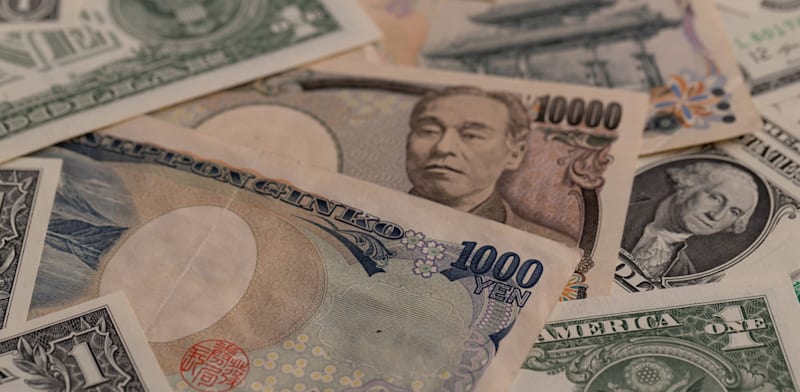
In a rare move, which has not occurred in the last 28 years, the US and Japan carried out a coordinated intervention at the weekend to buy yen, in an attempt to stop the sharp weakening of the Japanese currency. The yen, which fell last week to a low of almost four decades – strengthened by about 4%, from 163 to about 157 yen to the dollar.
US President Donald Trump presented the move as a “signal of friendship” towards Japan. US Treasury Secretary Scott Bessant said the action was aimed at dealing with “irregular movements” in the yen, and Japan for its part announced that it would not hesitate to make another coordinated intervention if the volatility continued. But the main reason for the move probably hides elsewhere.
To understand how unusual the move is, you have to go back. The US, which usually states that exchange rates should be determined in the market, has avoided intervening in the foreign exchange market in recent decades. Specifically in Japan, in 2011 there was indeed a coordinated intervention by the G7 countries, including the US and Japan, after the earthquake and tsunami in the country – but then the goal was the opposite: to weaken the yen, which strengthened sharply after the disaster.
In contrast, the last American-Japanese intervention designed to strengthen the yen was in 1998, in the midst of the Asian financial crisis. Therefore, if the current move is intended to purchase yen and support it, it is no longer “aid to a good company”, but an economic move that has not been needed for 3 decades.
Why did the US intervene?
The American intervention is first of all a move of self-defense. The weakness of the yen, which for months suffered from sharp interest rate differentials in relation to the US, threatens US government bonds.
This is because in the US interest rates have remained relatively high, while in Japan monetary policy has remained much more expansionary. The result was clear – investors preferred to hold American dollars and assets, and the yen became the currency used to finance “carry trade” transactions: borrowing cheaply between and investing in assets with a higher yield. However, the carry trade has a downside – the yen is weakening, imports to Japan are becoming more expensive, domestic inflation is rising, and political pressure on the government in Tokyo is increasing.
In the US, it is estimated that if Japan continues to try to stop the fall of the currency on its own, it will need dollars to buy yen. The direct way to raise dollars is to sell some of its dollar assets – primarily US government bonds.
And here probably lies the strongest motive of the US president to roll up his sleeves and enter the event. According to the official data of the US Treasury Department, Japan is the largest foreign holder of US debt, and the sale of large volumes of bonds could put upward pressure on yields, increase the financing costs of the US government and economy, and harm the stability of the markets.
The current timing of such a sale, even if it is staggered, is particularly dangerous for the American bond market, which is already dealing with large deficits, a continuing need for debt raising and relatively high long-term yields.
If so, it is easy to understand why Washington preferred to join Japan’s move, and reduce the chance of a forced sale of American bonds. Louise Lu, head of the Asian economy at Oxford Economics, explained to CNBC that there is an element of self-preservation here: “Volatility in Japan, especially if it leads to an aggressive fiscal policy or the sale of dollar assets, could spill over into the American bond market and destabilize the dollar as well.”
For Tokyo, American intervention serves as a force multiplier. In recent years, Japan has spent huge sums in an attempt to curb the weakening of the yen, but as long as the markets believe that the macroeconomic disparities are working against the currency, actions by the local government to change the trend will be limited. When the US joins, the message to the market is much stronger: this is no longer a one-off action by the Japanese Ministry of Finance, but a coordinated position of two of the world’s largest economies.
In addition, during the weekend the finance ministers of the two countries stated that they would not hesitate to carry out further joint interventions in the future.
Also protects the dollar
According to reports, the person who managed the sale on behalf of the US Treasury, is the Federal Reserve Bank of New York, through major banks including Goldman Sachs and Morgan Stanley.
Beyond that, the US did not sell dollars and buy yen directly, but used the euro for the purchase. And the logic is clear: selling dollars could have weakened the American currency – an outcome that Trump is not interested in, especially against the background of political sensitivity around inflation, imports and the status of the dollar.
In addition, the mere reporting of a possible intervention played an important role in strengthening the Japanese currency. A photograph of Bessant’s notebook, in which the task “Purchase of Japanese yen in the amount of 5-10 billion dollars” appeared, became an almost blatant public hint that the administration was preparing to buy yen. In the foreign exchange market, where expectations are just as important as the scope of the actual transaction, the signal made it clear to speculators that the authorities are ready to act, and perhaps not for the last time.
what will be the consequences
The short-term consequences are clear. Japan receives monetary relief, a stronger yen reduces the cost of imports, mainly energy and food, and makes it a little easier for households affected by rising prices. It may also reduce political pressure on the government and the Bank of Japan to raise interest rates quickly.
On the other hand, too sharp strengthening of the yen could hurt Japanese exporters and put pressure on the local stock market, thus, already during the weekend, the flagship index Nikkei 225, fell by 3.4%, compared to the jump between, which was 2.8%.
At the same time, the yield on 10-year US government bonds fell by more than one basis point to 4.69% (although the decline is also attributed to market expectations for a reduction in tensions with Iran).
Will the intervention change the trend or just buy time? If the interest rate differential between the US and Japan remains wide, and if investors continue to prefer dollars over the yen, it will be difficult to contain the pressure over time through currency purchases alone.
Either way, the market received a message that the weakening of the yen is no longer an internal Japanese problem, but a systemic risk that also worries Washington. And behind Trump’s talk of friendship is, therefore, an alliance of interests: Japan wants a more stable currency; The US wants to protect its bond market, the dollar and a financial order in which it is still the main player.
code of ethics
appearing
in the trust report
according to which we act. Expressions of violence, racism, incitement or any other inappropriate discourse are filtered out automatically and will not be published on the site.