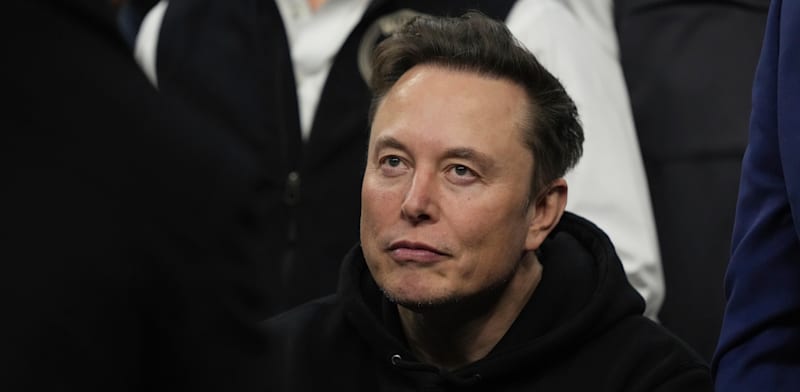
SpaceX , Elon Musk’s space and artificial intelligence company released its first reports as a public company on Tuesday, just two months after the largest IPO in history, in which it raised $75 billion at a valuation of $1.77 trillion.
SpaceX crushed the predictions, managed to increase sales in each of its activities, but the real drama took place in the investor call, when the major shareholder and founder Elon Musk announced that the company would dominate the global Internet market within a decade and promised that his “Starship” launcher would be able to “take off at least once a day into space, if not more.”
Despite the promises and fiscal success of SpaceX, investors brought the stock back to Israel. Before the report, the stock was trading at a low price of about 20% below its IPO price on June 12 and worth a trillion dollars less than its peak value on June 16, and on Wednesday it opened trading in New York with a decrease of about 12%. Today (Wed), after having weakened sharply in pre-trading, the stock continues to fall even with the opening of trading. Why do investors no longer believe Musk’s promises?
Musk’s promises
It’s not every day that Elon Musk gets on an investor call and makes promises from space, and according to his appearance on Tuesday, his promises are – to use the term used by another CEO, Alex Karp of Palantir – “out of this world.”
Musk tends to exaggerate his statements – in the past he said that “within six years we will put a man on Mars”, but then SpaceX was still a private company – now he must avoid exaggerations that could get him in trouble with the American Securities and Exchange Commission. That’s why his every promise was immediately met with messages of reassurance from the company’s executives who were present at the investors’ meeting. For example, his statement that SpaceX will dominate the global wireless Internet industry by the end of the decade led the company’s Chief Operating Officer, Gwynne Shotwell, to refine the message: “We expect to represent a significant part of the global Internet industry.”
When CFO Brett Johnson predicted that the annual revenue rate of the autonomous code generator Kerser, recently acquired by the company, would reach approximately $100 billion a year, Musk contradicted him when he said that “we will reach that number if we do nothing, but it is expected to be higher than that,” and explained that the company as a whole would reach an annual revenue rate of a trillion dollars faster than expected: “Before the IPO, we predicted that this would happen In 2031, now it has been brought forward to 2030 and there is a high chance that it will even happen in 2029.”
beat the predictions
All in all, SpaceX presented excellent reports: the company’s annual revenue rate today is about $32 billion and the profit without depreciation and taxes (EBITDA) was $3.5 billion, compared to a forecast of $2 billion.
So what disappointed the investors? Rather a very mundane figure – the one that brought down too many Big Tech stocks in the last quarter – the significant jump in capital expenditures to finance its growth.
In other words – the company’s artificial intelligence business – formerly xAI – which is essentially similar to Google’s or Microsoft’s artificial intelligence cloud – claimed a doubling of capital expenditures on chips, servers and server farms from $7.7 billion in the first quarter of this year to $15.8 billion in the second quarter.
One possible reason for the increase in capital expenditures may be attributed to the new partnership the company announced with Nvidia last Tuesday. SpaceX announced that it has signed an agreement to jointly design a server farm in space – one that will exclusively launch its graphics processors and core processors into space – “Vera Rubin”, and will allow each such server satellite to perform cloud processing and artificial intelligence with an electrical power of 250 kilowatts.
What do the analysts think?
While investors express doubts about the company’s condition, the leading Wall Street analysts, it should be noted, are on his side.
According to the group of analysts surveyed by the Wall Street Journal, the average target price per share is about $100 higher than its current price. Bank of America, for example, recently began reviewing the stock and issued SpaceX a buy recommendation with a target price of $235 – a potential upside of 45% – this is based on a forecast predicting a faster than expected commercial success of the Starship launch vehicle, an increase in Starlink’s market share, the purchase of the software code generator Curser and an improvement in profit margins.
According to Bank of America, if Starship becomes commercial and achieves good and reliable performance, the company’s launch cost will drop tenfold, SpaceX’s cash machine – Starlink – will be able to expand significantly and new markets will be able to develop at a faster pace – including AI servers in space.
The report compiled by the bank on the space company also states that the majority of the company’s revenues may lean in favor of xAI, the corporation’s artificial intelligence company – with the provision of AI processing services, the rental of server farm space and the sale of the Kerser code generator services.
What drives the optimistic attitude of the analysts? Analyst Omri Afroni of Oppenheimer claims that the company has a large number of growth engines, which have already demonstrated high growth in recent reports: “The company’s connectivity services, which are centered around Starlink satellites, have become a key growth engine: today they already have 10,200 second-generation satellites that generate high profitability of over 60%. Now, when the company is preparing to launch the next-generation V3 satellite, which embodies the high volume 10 times that of the previous generation, in just one year SpaceX may double its connectivity volume and gradually take over larger market shares with a move to the telephony and institutional market – after today 90% of its users are private customers, and increase its deployment in the shipping market and the flight market – where it is barely 10% of the market.
Despite the increase in investments in the field of chips, Efroni maintains a bullish attitude towards SpaceX and sees it as a company with multiple growth engines: the satellite services and connectivity it provides to ordinary citizens and security institutions, the cloud services it provides to giant companies – in what may make it one of the largest players in 2027 – together with expected revenues from the division of satellite launches into space – may already this year bring it to an annual revenue rate of 100 billion dollars. For comparison, Nvidia’s annual revenues are estimated at 200 billion dollars.
On the other hand, not everyone is optimistic. Oral Cohen, the founder of the ANEK investment fund, explains that “there are too many common lines here with Tesla: the car company in the past also tried to sell dreams, many of which did not come true: there was talk of the solar roof industry, fully autonomous vehicles, robot taxis – a large part of these dreams did not come true or were postponed, and even today – 80%-90% of Tesla’s value is derived from expectations for the future and the launch Optimus the robot.
“There is no doubt that SpaceX has many growth engines, but the stock is very expensive – its multiplier is very high, and many investors tend to see opportunities to invest in space, satellites, vehicles and server farms in other much cheaper stocks such as Amazon or Google.”