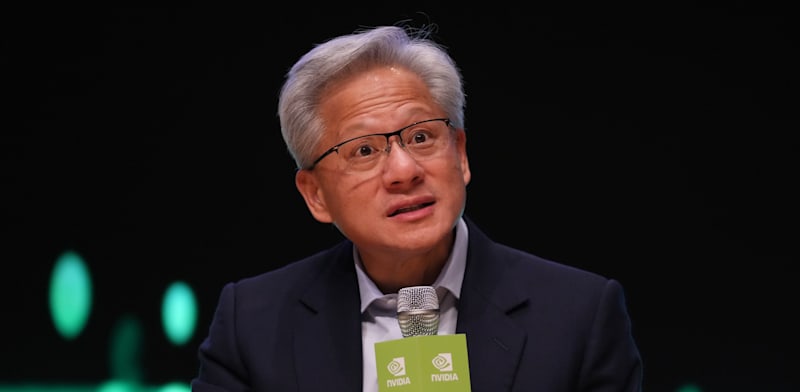
Nvidia completed an extraordinary display of purpose last week, during which she proved once again that she is the great winner of the age of artificial intelligence. The chip giant has proven that even with a value of more than 5 trillion dollars, it manages to double its revenues every year, while maintaining historical gross profitability (75%). Along with this, it provided an extraordinary forecast for the current quarter (where it will cross the $100 billion mark in revenue for the first time) and for the fiscal year 2028, in which its revenue is expected to grow by 70%. Those results sent the stock higher Thursday, adding half a trillion dollars to its market cap.
● Far above them all: Nvidia Israel’s revenues will amaze you
● Exclusive | Envidia enters Kfar Saba and raises a question: why expand to small places
● The real news of Nvidia was hidden in one sentence in the investor call
Beneath the surface, Nvidia seems to be working hard not only to sell its wares to the AI giants, and in the last quarter it also poured billions of dollars into its target market. She particularly excelled in promoting sophisticated financial transactions in front of technology giants, growing start-ups and large investment banks.
Thus, in what has been referred to by analysts in recent weeks as the “Bank of Nvidia”, the chip giant of the charismatic CEO Jensen Huang has become the most active financier in the AI market with dozens of different and sophisticated financing transactions with one goal: to increase its sales by injecting its capital into the market.
Nvidia’s innovation
Nvidia’s financing method starts from the bottom, even from the start-up worlds. Its investments in private companies, including American AI giants such as OpenAI, Anthropic, Grok (which was eventually acquired by it) and Israeli ones such as Decrat and Double AI, swelled from $22.3 billion last January to $51.2 billion – an increase of about 130% in six months.
Some of these investments carry quite a profit: after investing in Descartes of Dean Leitersdorf and his Moshe at a value of 4 billion dollars only three months ago – it is expected to enjoy a quick exit at a value of 6 billion dollars next week. Even before the Israeli exit, only during the first half of the year Nvidia recorded a paper profit of 7.5 billion dollars on these investments.
This is not a unique move, and Google, Salesforce and Microsoft also invest in start-ups and unicorns, but not on the scale of Nvidia. “My only regret on this issue is that I didn’t invest more earlier,” Huang replied when asked about his investments in AI labs.
Nvidia does not keep itself to the private market only, and it has significantly increased its investments in public companies from approximately 13 billion dollars at the beginning of the year to 42.8 billion at the end of June, much of this thanks to investments in the neo-cloud companies Nabios and Coruvive – which buy equipment from it wholesale and market it further through the rental of servers or the provision of complementary technological services. Nvidia is also known to invest in public companies such as Intel and Synopsis.
The major innovation presented by Nvidia in the last quarter and expressed in the investor call revealed a deeper strategy behind its sales growth: it not only invests in its customers in exchange for shares, but provides them with financing transactions that help their balance sheet and make it easier for bankers to grant them loans and guarantees.
In what the Morgan Stanley bank called “balance sheet” – Nvidia uses its financial strength to help its customers raise debt. CFO Colette Kress said it herself on the investor call: “These companies have extraordinary demand for computing power, but they’re growing faster than their balance sheets or credit profiles can support.” In other words, some of Nvidia’s fastest-growing customers want more AI infrastructure than they can afford.
Loans as an income channel
Nvidia doesn’t call it a loan – but rather an income channel. In return for the financial strength it provides to its customers and the capital that makes it possible to purchase more processors from Nvidia, it also collects additional revenue from them through a share of sales and services. Those customers, mostly model development giants, may represent about a quarter of the company’s revenue next year, according to Kress.
The total future commitments in capital investments in its customers already stands at 25 billion dollars and another 35 billion in commitments to purchase the minimum of AI services, if the customer does not reach the sales target.
But Nvidia is willing to go further and is not satisfied with providing guarantees for the service provided by the customers, but also for building real infrastructures. The main beneficiaries of this are OpenAI which is behind ChatGPT – which is considered the losing player and growing less compared to Anthropic (developer Cloud). Nvidia granted it and its partner Softbank an exceptional guarantee of 105 billion dollars for the construction and lease of space in a server farm in Ohio.
The asterisk behind the growth
This also has a price: beneath the high profitability and the rising revenues – the total amount owed by its customers jumped from $38.5 billion to $63.1 billion during the last two quarters, when the time to repay the debt increased from 45 to 60 days on average – significant evidence that part of Nvidia’s growth is actually financed through the credit it gives to its customers.
And while Nvidia is gaining success in the stock market, its risk premium (CDS) in the credit market actually increased – doubling since last March to 82 basis points. “The conversation about circular investments and the fact that Nvidia finances its customers gained momentum and became the talk of the day in the financial community, until it even came up in the conversation of its investors,” says Udi Mordechai, co-director of the foreign equities desk at Leader Capital Markets. Nvidia invests in them in turn and supplies them with equipment.”
However, says Mordechai, Nvidia does not take all the risk from its balance sheet – it even announced that it will raise 500 billion dollars to build server farms, power stations and AI infrastructure from investment banks such as Goldman Sachs and Blackrock – which will be directed to its customers.
“Despite the doubling of the risk premium, it is difficult to say that there is credit pressure on Nvidia – which for the first time revealed an annual forecast with a 70% growth in sales, with an AA credit rating and a good balance sheet and cash flow. What’s more, its growth limit stems from a supply and inventory limit and not from a demand limit,” says Mordechai. “The problem lies in the entire AI market, which since June has been faltering in the debt market – also due to commitments by companies such as Broadcom to Microsoft and debt raising by companies such as Meta, Google and Amazon outside the US. The forecast until 2029 for the debt in the AI-biased technology market is 7 trillion dollars, second in scope after the mortgage market with a debt of 11 trillion.”
For your attention: The Globes system strives for a diverse, relevant and respectful discourse in accordance with the code of ethics that appears in the trust report according to which we operate. Expressions of violence, racism, incitement or any other inappropriate discourse are filtered out automatically and will not be published on the site.