The government’s long-awaited decision on the gasoline subsidy is coming, but it is not yet completely ready.
Prime minister Petteri Orpo (kok) announced on Tuesday that the size of the support package would be approximately EUR 60 million. According to him, other than the Basic Finns would have acknowledged the package.
Kauppalehti has also asked the opinion of basic Finns on the package announced by Orpo, but has not received an answer.
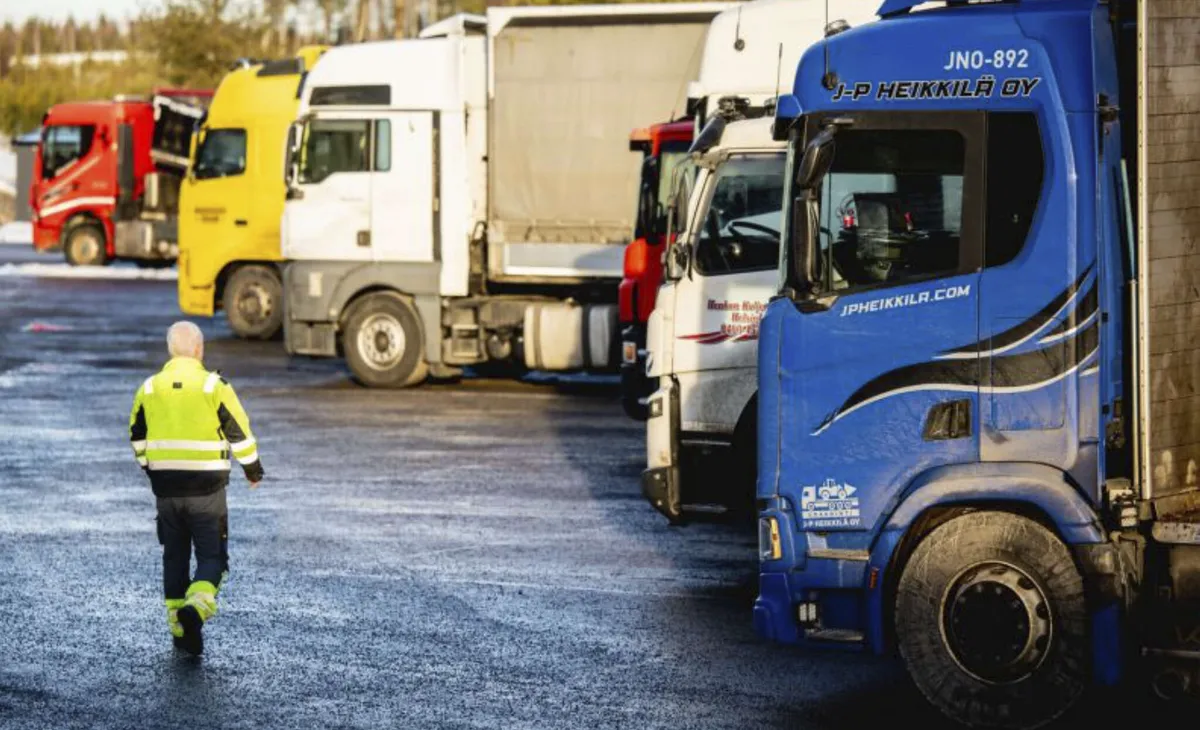
Throughout the process, Orpo has stressed that support should be targeted especially at professional drivers.
The subsidy amount reported by Orpo and the mention of professional motorists strongly suggest that the government implements support for professional motorists in parallel with Hello Marine (sd) government in 2022.
At that time, transport companies were reimbursed five percent of three months’ worth of fuel purchases retroactively. Support could be applied for at the State Treasury.
According to the State Treasury, the price tag was 27.5 million euros in 2022.
If Orpo’s 60 million keeps its itch until the end, there would also be something left from that support package for commuters. It is therefore likely that the recipients of the fuel subsidy are Transport companies and some commuters.
PS adheres to the distribution obligation
An important point is that the reduction of the distribution obligation is perhaps falling out of the picture.
This is the point where one of the ultimate reasons for the silence of basic Finns is revealed.
In the short term, the distribution obligation – the specified share of the renewable component in fuels – would be the cheapest way to lower the price of fuel in terms of state finances.
The fewer renewable elements there are in the fuel, the greater the proportion of fossil fuels, which are taxed more severely than renewables. Tax revenues could even increase in this equation. In Sweden, the distribution obligation is lower than in Finland.
However, the decrease in the distribution obligation has been suspected to have a slow effect, and it would increase the pressure to increase it sharply in the coming years.
For basic Finns, presenting the distribution obligation is also a way of questioning the rationality of the green transition they shun. And to make a difference to the other governing parties – especially the other major governing party coalition.
The coalition’s position in the dispute has been guided by the minister of environment and climate responsible for energy matters, also on behalf of his office Sari Multalawhich, like RKP, has opposed the decrease in the distribution obligation. A decrease in the distribution obligation would increase the emission burden.
For liquid distribution obligation is an important matter of principle, even though Finland is a small market. The core of the company’s business is renewable fuel. Its turnover is largely dependent on political support, i.e. the forced mix amount.
For example, Germany has recently made positive decisions about the distribution obligation from Neste’s point of view.
Plaster for the wound
The government does not have the funds to mitigate the fuel crisis with large sums. Therefore, taxes that quickly affect the price are out of the question.
For example, the revenue from the excise tax, which represents a share of tens of cents in the price of diesel and gasoline, is more than a billion euros in both diesel and gasoline.
The government has therefore only had a band-aid in its hands for the problem affecting the citizens.